
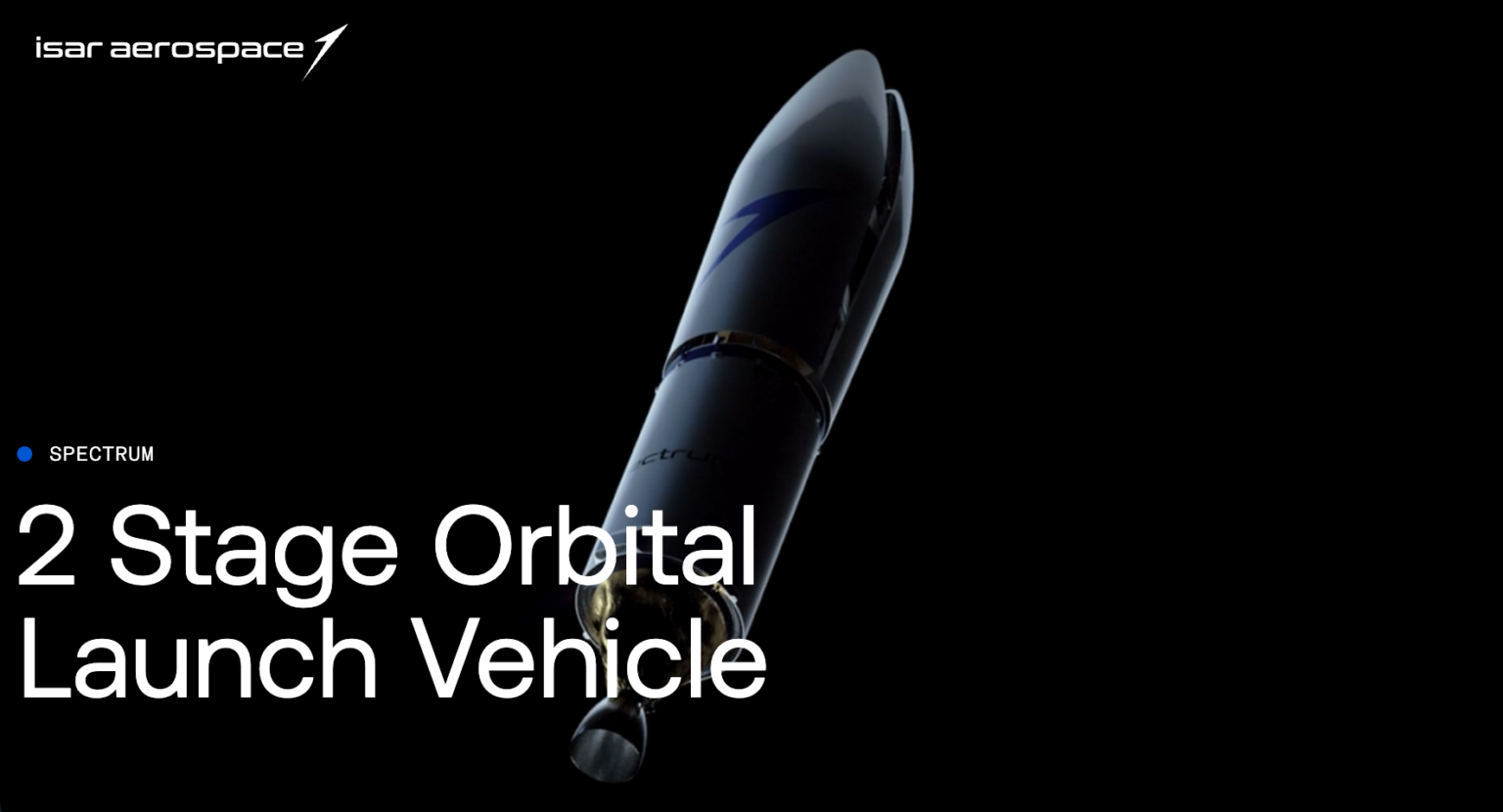
A German rocket startup is on the verge of making European space history. Isar Aerospace, founded in Munich in 2018, is targeting May 2026 for the second flight of its Spectrum launch vehicle from Andøya Spaceport in northern Norway — the mission that, if successful, will mark the first time a rocket has reached orbit from European soil and the first orbital qualification flight for any privately developed European launch vehicle. The company’s mission updates hub tracks the live campaign status.
The mission, dubbed “Onward and Upward,” carries real stakes for anyone in the smallsat market. Six payloads are aboard, five universities and commercial operators stand ready to deploy their spacecraft, and a potential €2 billion valuation is reportedly on the table for investors watching whether Isar can close the gap that has kept Europe dependent on American, Russian, and Chinese rockets for small payloads. Bloomberg reported in March 2026 that Isar was in discussions to raise €250 million at that valuation.
Six Payloads, One Historic Target
The campaign has been in progress since January 2026. The qualification flight is a formal milestone in Isar’s development roadmap: it is the first Spectrum mission designed to carry customer payloads to orbital insertion, the threshold that separates a rocket under development from a rocket in commercial service.
Five of the six payloads are separable CubeSats selected through ESA’s Boost! programme and the German Space Agency at DLR’s Microlauncher Competition: CyBEEsat from TU Berlin, TriSat-S from the University of Maribor in Slovenia, Platform 6 from the Bulgarian smallsat integrator EnduroSat, FramSat-1 from NTNU in Norway, and SpaceTeamSat1 from TU Wien’s Space Team in Vienna. The sixth payload, “Let It Go,” is a non-separable in-orbit demonstration from the German space hardware manufacturer Dcubed.
Exolaunch, the Berlin-based satellite integration firm, is managing payload integration and deployment using its EXOpod Nova deployer system — integrating all five CubeSats at Exolaunch’s Berlin headquarters before shipping the loaded deployer to Andøya. The target orbit is sun-synchronous, a regime standard for Earth observation and scientific smallsats, reached by flying northward over the Norwegian Sea from the Arctic launch site.
Five Scrubs and a Determined Crew
Getting to this point required navigating a campaign that tested every element of launch operations.
Isar first targeted January 21 for the mission, but a faulty pressurization valve forced a scrub before the countdown could reach its window. The team rescheduled to March 19, then pushed to March 23 as persistent strong winds arrived at Andøya. On March 25, the countdown reached T-3 seconds — three seconds from engine ignition — before an abort was called. A Norwegian fishing vessel had entered the maritime exclusion zone around the pad; by the time range safety cleared it, propellant temperatures in the vehicle had risen above acceptable limits.
A fourth attempt on April 9 ended before the window even opened: Isar stood down to evaluate a suspected leak in a composite overwrapped pressure vessel, a high-pressure gas storage component used in propellant pressurization. The COPV issue pushed the campaign into May.
CEO and co-founder Daniel Metzler was matter-of-fact about the accumulated delays. “There is no question that we will reach orbit and demonstrate reliable access to space,” Metzler said in April. “Scrubs are part of rocket industry; every successful rocket company has been here.”
What Spectrum Is and How It Works
Spectrum is a two-stage, liquid-fueled launch vehicle, 28 meters tall and 2 meters in diameter. Its first stage is powered by nine Aquila engines burning liquid oxygen and propane — a propellant combination Isar chose for its energy density and storability. The second stage uses a single vacuum-optimized Aquila engine designed for multiple in-flight restarts, eliminating the need for a separate kick stage when delivering payloads to specific orbits.
Isar designs and manufactures the vast majority of Spectrum’s components in-house, including its propulsion system — a vertically integrated approach the company argues is essential for production cost control and iterative improvement. Spectrum carries up to 1,000 kilograms to low Earth orbit from its planned second launch site at the Guiana Space Centre in French Guiana, and up to 700 kilograms to sun-synchronous orbit from Andøya.
For comparison, Rocket Lab’s Electron — the current benchmark for small European commercial payloads — carries up to 200 kg to SSO. Spectrum, at 700 kg to SSO, targets the higher end of the smallsat market alongside Firefly’s Alpha.
March 2025: Thirty Seconds That Proved a Point
The first Spectrum flight, on March 30, 2025, is now part of European space history for reasons both positive and sobering. The rocket lifted off successfully from Andøya at 12:30 pm CEST — the first time any orbital-class launch vehicle had cleared the pad from continental Europe. Thirty seconds later, an unintended vent valve opened at the start of Spectrum’s pitch-over maneuver, causing the vehicle to lose attitude control. The flight termination system cut the nine Aquila engines at T+30 seconds, and the vehicle descended in a controlled, aerodynamically stable arc into the sea near the pad. The launch site sustained minimal damage.
An investigation reviewed with the Norwegian Civil Aviation Authority concluded within two months. The findings identified the unintended vent valve opening and subsequent loss of attitude control as the initiating events. Isar upgraded the software and increased the vehicle’s margins for the second flight. No one was injured and the flight safety system performed exactly as designed — a data-rich partial success that most rocket companies take before their first clean flight.
Europe’s Launch Gap and Why It Matters
ESA Director General Josef Aschbacher put the geopolitical context directly: “With the second Spectrum launcher on the launchpad in Norway, we are witnessing a clear signal of Europe’s burgeoning commercial space transportation services. Isar Aerospace is poised to rise to a great challenge, one that will be instrumental in advancing a resilient and autonomous Europe in space.”
The words “resilient” and “autonomous” are deliberate. The retirement of Ariane 5 in 2023 and the slow cadence ramp-up of Ariane 6 — which serves a different, heavier payload market segment — left European institutions and commercial operators with no reliable European option for small payloads. ESA Director of Space Transportation Toni Tolker-Nielsen put the threshold clearly: “Regardless of the outcome of this second flight, it will be another step to make European launch services more mature and independent.”
That independence gap is sharpening into a business problem. No European micro-launcher has yet delivered a commercial payload to orbit. Isar’s qualification flight, if successful, would be the first. Competitors including Rocket Factory Augsburg, which suffered a static fire failure in 2024, and PLD Space in Spain continue their own development programs but have not yet reached orbital qualification.
Customers, Capital, and Countdown
Isar’s commercial position is already substantive. The Norwegian Space Agency signed a contract in March 2025 to launch two Arctic Ocean Surveillance satellites on Spectrum by 2028, representing Norway’s first institutional commitment to a commercially operated European launch vehicle. In March 2026, Isar signed with Astroscale Ltd — the UK subsidiary of Tokyo-based Astroscale Holdings — to launch the ELSA-M In-Orbit Demonstration, Astroscale’s first commercial active debris removal mission, no earlier than 2027. U.S. company SEOPS has a dedicated rideshare mission on the manifest for 2028 as well.
On the production side, Isar has vehicles 3 through 7 in various stages of construction and is opening a 40,000-square-meter manufacturing facility near Munich in Vaterstetten to support rising cadence. The company has grown to more than 400 employees from over 50 nations across five international locations since Metzler co-founded it with Josef Fleischmann and Markus Brandl at the Technical University of Munich in 2018.
Financially, Isar raised over €400 million in total capital before a June 2025 convertible bond of €150 million from Eldridge Industries. The potential €250 million Series E round at a €2 billion valuation — reported in March 2026 — would bring total raised capital to roughly €600 million, making Isar the most capitalized independent launch startup in Europe.
What Needs to Go Right
For Spectrum to complete its qualification objectives, the vehicle must clear a sequence of milestones in rapid succession after liftoff: first-stage engine cutoff, stage separation, second-stage ignition, payload fairing jettison, and second-stage cutoff with the spacecraft bus and CubeSats at target altitude and velocity. Exolaunch’s EXOpod deployers then release the five separable satellites in sequence into their sun-synchronous orbits.
The window available from Andøya is characteristically short — range conditions, weather, and the mechanics of sun-synchronous insertion allow only a narrow slot per day. Isar has scheduled a public livestream on its YouTube channel starting approximately one hour before the opening of the window.
Whatever the outcome, the broader trajectory is clear. Europe’s commercial launch sector is now operational from continental European soil — something that could not be said three years ago — and the number of European institutions and companies that have committed real money to fly on Spectrum signals that the sector is treating Isar as a credible provider, not a future promise. A clean orbit from Andøya would convert that signal into evidence.