
Is the earth unique? Or can you find planets like ours everywhere in the universe? ESA’s new space telescope Plato sets out to investigate this. The Dutch space research institute SRON contributed to the mission, with advantages for Dutch astronomers.
In a line-up of space telescopes, Plato stands out immediately. Behind a large solar panel (which also functions as sunscreen), mounted on top of a box full of electronics, are no fewer than 26 cameras. Together, they look like a honeycomb. Hidden behind that high-tech honeycomb are the largest CCD image sensors ever sent into space. They are capable of taking photos 2.1 billion pixels in size.
The Plato (PLAnetary Transits and Oscillations of stars) space telescope will be launched in the spring of 2027. Afterwards, it will study 200,000 stars in the southern part of our Milky Way for at least two years. Very patiently, the cameras peer at the same starlight, which sometimes suddenly dims for a few hours and then becomes brighter again. It is proof that a planet has passed in front of the star.
With this ‘transit method,’ Plato can determine the mass and orbit of exoplanets. The telescope is sensitive enough to also observe stellar oscillations. These movements, caused by the planets, can reveal something about the age of an exoplanet. If you combine data from Plato with observations from Earth-based telescopes, you can discover more about the composition of exoplanets.
To date, the existence of approximately 7,000 exoplanets has been confirmed. Almost all of them are significantly larger than Earth and are often located much closer to their parent star. ‘Plato is going to take an important next step in the research into extraterrestrial life,’ says Heike Rauer, Plato’s principal investigator. ‘The telescope is specifically looking for rocky planets within what we call the “habitable zone.” This is the zone around a star where it is neither too hot nor too cold, and where life as we know it could arise.’
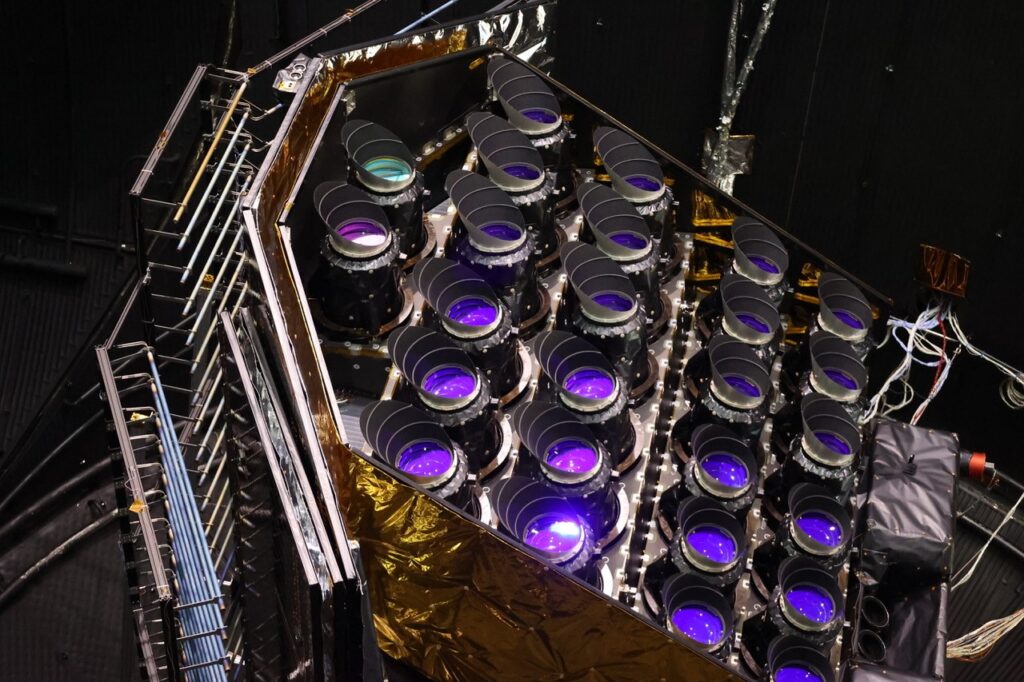 © ESA
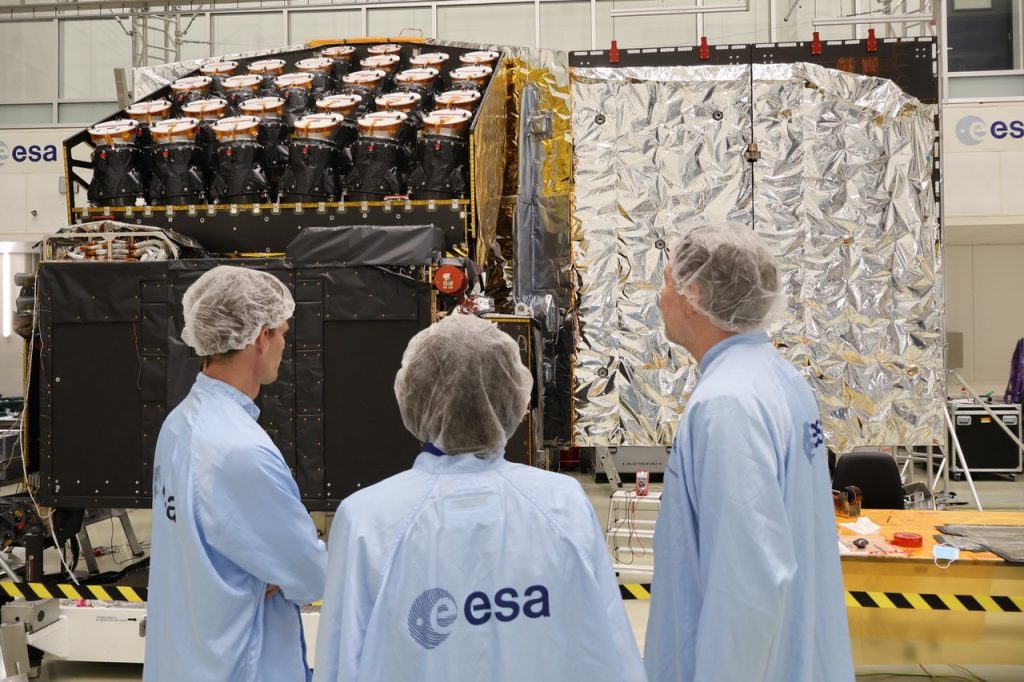
© ESA
Unique features
For its search for other worlds, Plato combines three features that you won’t find together in any other space telescope. First: a large field of view. Plato surveys an area 10,000 times the size of a full moon. Converted, that is about five percent of the night sky. Second: extreme sensitivity. The telescope can distinguish a marble from a kilometer away. And subsequently see a grain of sand on that marble. Third: extremely long-term observations. Plato looks at the same stars for at least two years. This way it can see an Earth-like planet pass twice around its parent star.
SRON is involved in the Plato mission on behalf of the Netherlands. The research institute tested eleven of the 26 cameras. To do so, it built a special space simulator in Groningen. A tank that mimics the vacuum of space and can subject hardware to significant temperature fluctuations—in this specific case: between -110 degrees and 40 degrees Celsius. ‘Plato’s cameras must be extremely stable and clean for the mission to succeed,’ says Michiel Min, senior researcher at SRON. ‘We are one of the few institutes in Europe that possesses the knowledge and expertise needed to conduct these tests.’
New capabilities
With its new space simulator, SRON contributed to the quality of the Plato space telescope. But that is not the only benefit, explains Jolien Diekema, senior science advisor at the Netherlands Space Agency: ‘By investing in technological innovation through the ESA astronomy program, the Netherlands is developing high-quality capabilities that we can also make good use of in the future.’ For example, the Plato simulator has already been used for ESA’s Envision mission, which will investigate the planet Venus. SRON’s investment in Plato is of great use for Dutch science as well, Diekema explains: ‘When you work on a space instrument, or test it before it goes into space, you know exactly how that instrument works and what data it will produce. This knowledge provides an edge: with Plato’s data, Dutch astronomers can conduct world-class science.’
1.5 million kilometers
What happened on a small scale at SRON—instrument-level space testing—was carried out by ESA’s technical center ESTEC in Noordwijk for the entire Plato mission. In 2026, the space telescope was shaken considerably and bombarded with noise to simulate the launch with an Ariane 6 rocket. In the Large Space Simulator, Plato was subjected to temperatures ranging from -90 to +150 degrees Celsius. ‘These are even more extreme conditions than the mission will encounter in reality,’ says Thomas Walloschek, ESA’s Plato project manager. ‘We leave nothing to chance.’
After the launch from French Guiana in the spring of 2027, the Plato space telescope will fly to the second Lagrange point, 1.5 million kilometers from Earth. From there, the telescope will send its observations back to Earth. The first research results are expected after more than two years. ‘We won’t find extraterrestrial life with this telescope,’ Michiel Min of SRON tempers expectations. ‘But the Plato mission is a crucial step in the research into this by answering the question: how habitable is our universe?’
Share this page