
Agency
19/05/2026
203 views
7 likes
British experts who helped develop a groundbreaking mission to unlock the secrets of Earth’s magnetic shield are celebrating the spacecraft’s launch into space.
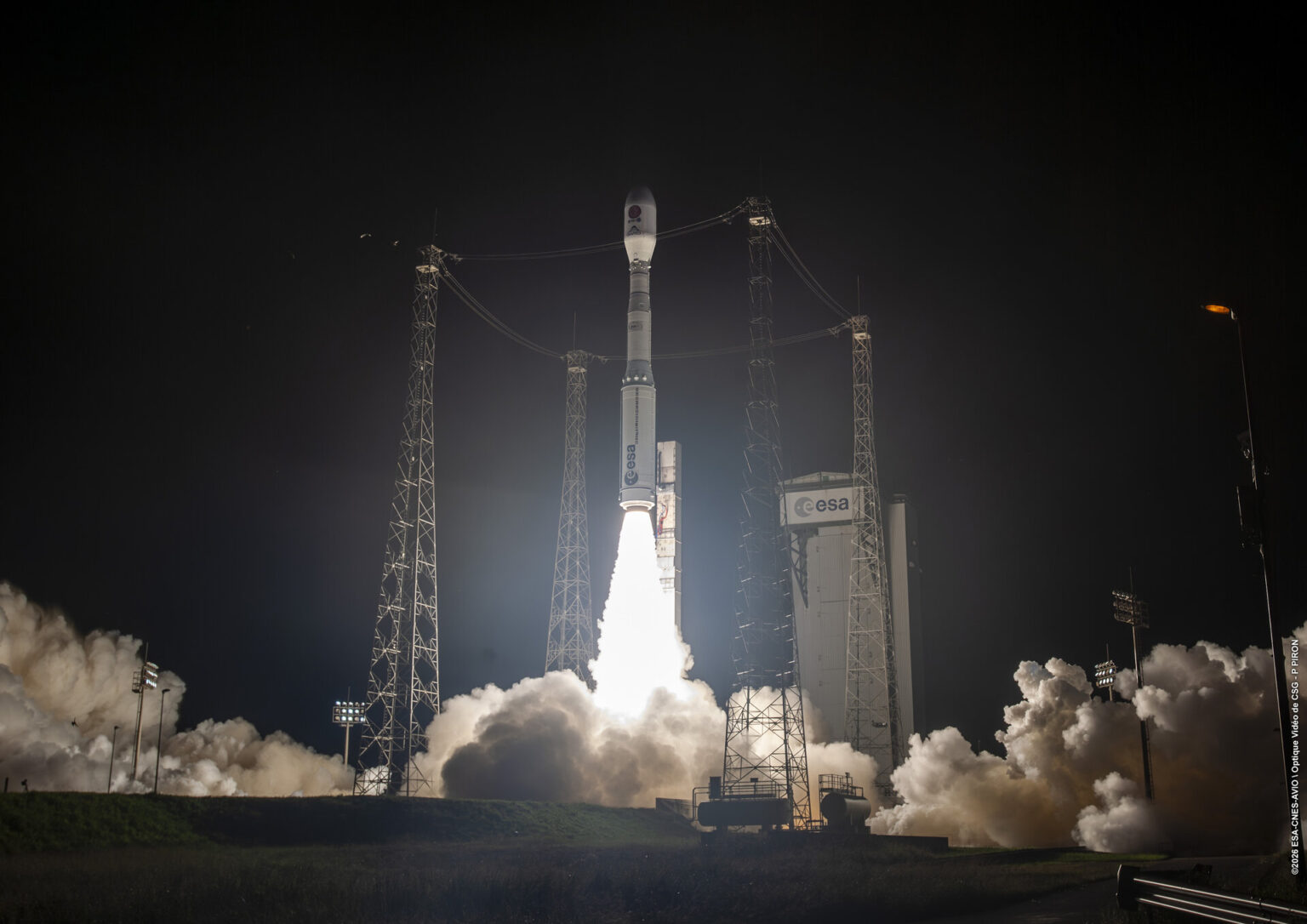
The Smile spacecraft lifted off aboard a Vega-C rocket from Europe’s Spaceport in French Guiana on 19 May 2026, kicking off its ambitious mission to improve understanding solar storms, geomagnetic storms and the science of space weather.
Smile’s X-ray camera sees Earth reacting to coronal mass ejection
Smile is a joint mission between the European Space Agency and the Chinese Academy of Sciences (CAS). Following its successful launch, the spacecraft will begin using its advanced instrumentation to deliver new insight into the magnetosphere – which protects Earth from solar radiation – and how it responds to the stream of charged particles and radiation emanating from the Sun. This information is envisioned to help scientists better understand and predict space weather, supporting efforts to protect astronauts, satellites and terrestrial technologies from its impacts.
The UK is making significant contributions to Smile, with Dr Colin Forsyth of University College London’s Mullard Space Science Laboratory serving as Co-Principal Investigator for the overall mission.
Labelled Smile spacecraft (artist impression)
The University of Leicester led the European consortium responsible for developing Smile’s Soft X-ray Imager (SXI), which is one of the spacecraft’s four instruments. Developed using facilities at the university’s Space Park Leicester, SXI will deliver the first-ever X-ray observations of Earth’s magnetic field.
Beyond the activities of UK academic institutions, UK companies supplied vital hardware and software for the mission.
Chelmsford-based Teledyne e2v delivered a key component of SXI, with Hastings-based Photek Ltd developing hardware for Smile’s Ultraviolet Imager (UVI) instrument, which will observe the auroras globally in ultraviolet light.
Top three mysteries Smile will solve
UK Space Minister Liz Lloyd said, “Smile is an excellent example of what British science and industry can achieve on the world stage. From the brilliant researchers leading the mission’s science to the precision engineering of companies building the spacecraft’s instruments, the UK is central to this mission.
“Understanding how our planet’s magnetic shield protects us from the Sun isn’t just fascinating science — it has real consequences for how we safeguard our satellites, our infrastructure and our astronauts. I’m proud that the UK is helping to answer some of the biggest questions in space science, and inspiring the next generation of scientists and engineers in the process.”
You can read the full story on the launch of Smile on the Space Science pages of esa.int
Like