
Harvest moon: How to grow potatoes at a lunar base
Published 3:00 pm Wednesday, May 20, 2026
Oregon State University conducts NASA research to feed astronauts at future space base
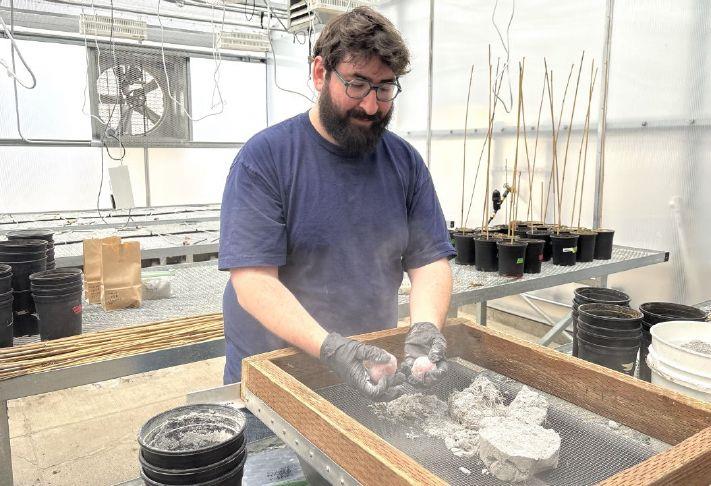
CORVALLIS, Ore. — David Handy emptied a pot filled with simulated moon regolith — a loose blend of soil, dust and rocks — and sifted through the light gray matter to pull out two red-skinned Modoc potatoes.
One day, an astronaut at a lunar base might harvest food the same way.
Handy, an Oregon State University astrobiologist, is conducting NASA research on how to grow potatoes on the moon.
Experiments have been encouraging, producing edible and nutritious vegetables thanks to the addition of vermicompost and slow-release pellet fertilizer.
“It’s the compost that makes a difference on yield,” Handy said.
He added there was no substantial difference between a control with Eastern Oregon soil and a 30% compost mix added to replicated lunar regolith.
Handy is working with 10 varieties of potatoes from across the country. “Upstate Abundance looked like it was doing well,” he said.
Those white potatoes, the size of golf balls, were developed in New York and often are grown by organic farms that need hardy plants.
Part of NASA’s Artemis mission
Handy’s experiments are part of the Artemis mission to create a permanent moon base and build toward Mars explorations.
Space adventurers will need plenty of food, but the cost of rocket fuel to regularly transport provisions to the moon would be prohibitively expensive.
Food also would take up valuable real estate on space shuttles, he said.
NASA’s priority is ready-to-eat crops with little waste.
That includes leafy greens and tomatoes, but the caloric-dense potato was the perfect staple food, said Aymeric Goyer, a plant biologist and Handy’s advisor.
“It provides the energy and nutrients that the astronauts are going to need,” he added.
Potatoes also are adaptable to different environments and have great genetic diversity, said Goyer, who worked for 17 years at the OSU Extension Service station in Hermiston, Ore., a potato industry powerhouse.
NASA currently has about 15-20 projects on lunar regolith.
“In terms of crops, we are one of the very few. We are the only one doing potatoes,” Goyer said.
Highland lunar soil most viable
Lunar soil is extremely rare on earth for obvious reasons, so Handy instead uses simulated moon regolith.
The moon has two main regolith types — “mare” soil from lower elevations that’s dark and volcanic and lighter gray “highland” soil filled with glass-like microparticles from meteor impacts.
Both have no nitrogen and little phosphorus.
The highland soil performed better in tests, pointing to those regions as potential base sites.
While the 30% compost mix did well, a 15% blend would function for food production, scientists said.
They’re looking at a 5% mix to investigate if potatoes can still produce strong yield or become inedible when stressed in lunar soil.
Subterranean greenhouse a likely solution
The moon poses challenges besides the lack of oxygen and extreme temperatures, as it typically has 14 days of light followed by 14 days of dark, and shielding against radiation in space also is necessary.
An enclosed, subterranean greenhouse with grow lights could be a solution, with plants in pots or in soil piled atop a floor.
Plants would provide oxygen for people, who would reciprocate with carbon dioxide in the closed loop system.
Astronauts could provide compost via treated human waste — think of the novel and movie “The Martian.”
Questions remain, including how plants would take up water in less gravity.
Handy’s two-year project has a $300,000 NASA grant that expires in July.
He’s hoping for additional funding, but could pivot to growing in difficult environments on earth.
“If we could grow food in space, we could grow food anywhere,” Handy said.