
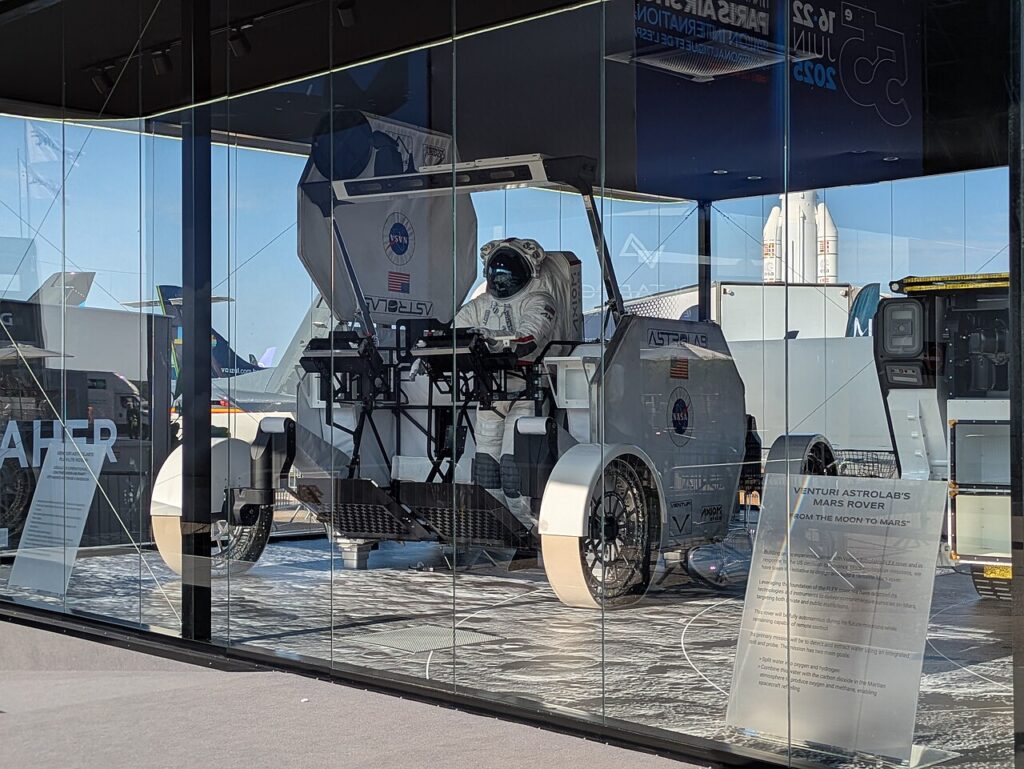
Astrolab announced on 18th May that its FLIP (FLEX Lunar Innovation Platform) rover will carry four scientific instruments from NASA centres to the Moon’s south pole later this year. The rover will fly aboard Astrobotic’s Griffin-1 lander as part of NASA’s Commercial Lunar Payload Services (CLPS) initiative, which supports the broader Artemis campaign to return humans to the lunar surface.
The mission will launch in late 2026. The company will announce additional commercial payloads in the coming months.
Scientific Instruments Onboard
FLIP will transport research equipment from four different NASA facilities, each designed to address specific challenges of lunar exploration.
NASA Ames Research Centre is sending a special camera called METAL. It will study the Moon’s soil to look for helium-3, a rare material that scientists think could be useful in the future.NASA Goddard Space Flight Centre created a device with special mirrors that bounce laser beams back to spacecraft orbiting the Moon. This will help scientists track exactly where the rover is. The device does not need electricity and will stay on the Moon even after the mission ends.NASA Johnson Space Centre built a sensor that studies lunar dust. Moon dust can damage machines, solar panels, and other equipment, so scientists want to understand how it builds up and affects hardware over time.NASA Marshall Space Flight Centre is providing a special LiDAR system. It uses lasers to create detailed 3D maps of the Moon’s surface, helping the rover avoid rocks, holes, and other dangers while driving.Platform Design and Innovation
FLIP is specifically designed to operate without a deployment ramp, enabling direct egress from the top of the lander. This innovation reduces mission complexity and allows for a wider range of landing configurations.
Unlike larger rover platforms, FLIP provides a nimble, mobile platform that enables multiple NASA investigations in one mission. The rover will also collect engineering data and operational experience to inform development of Astrolab’s larger FLEX (Flexible Logistics and Exploration) rover, which is being designed to support future Artemis missions and commercial lunar operations.
Company Background
Astrolab, headquartered in Hawthorne, California, was formed by a team of NASA veterans, former SpaceX employees, and JPL engineers. The company maintains strategic partnerships with institutions, including electric vehicle pioneer Venturi Group.
“We’re honoured to deliver NASA’s instruments to the lunar surface,” said Jaret Matthews, founder and CEO of Astrolab. “Together, these efforts will help pave the way for Artemis astronauts to explore more of the Moon”.