
An analysis of data collected by the Hubble Space Telescope over the past 14 years on Jupiter’s moon Europa has given scientists at the Southwest Research Institute (SwRI) a better understanding of the characteristics of its thin atmosphere. These findings cast doubt on earlier data suggesting that this icy moon periodically emits faint plumes of water from a likely subsurface ocean.
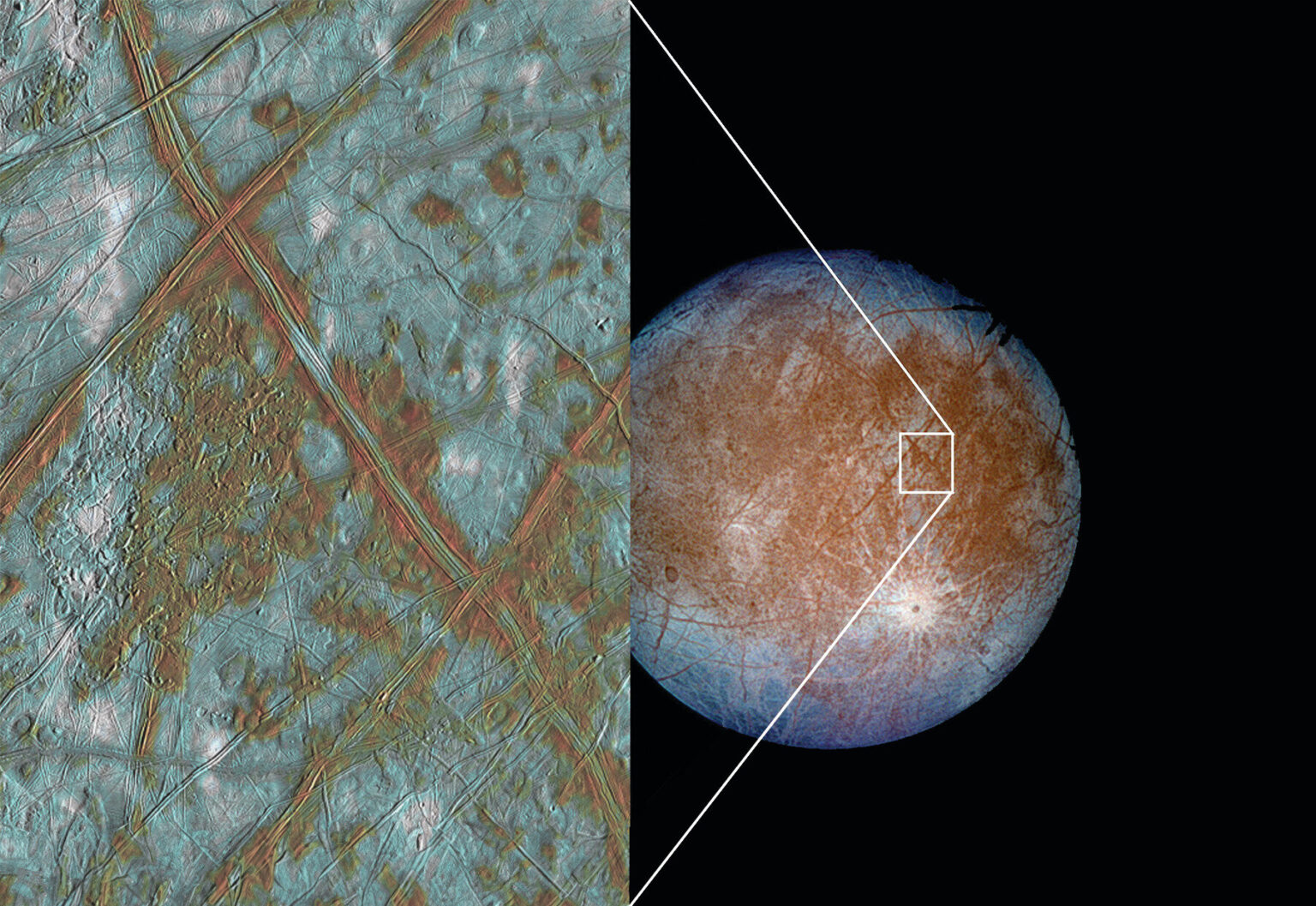 Jupiter’s moon Europa. Source: phys.org
Viewing data from 15 years ago
“The evidence for water vapor plumes on Europa isn’t as strong as we first understood it,” said SwRI’s Dr. Kurt Retherford of SwRI, one of the authors of the 2014 paper in which this hypothesis was first proposed. Retherford and his colleagues recently published a new paper in which they reanalyzed the data.
A new article examines data from the past 14 years, obtained using the spectrograph on the Hubble Space Telescope (HST/STIS), regarding Lyman-alpha emission from Europa. Lyman-alpha is ultraviolet light of a specific wavelength emitted and scattered by hydrogen atoms. Between 2012 and 2014, a team of researchers pushed the limits of the Hubble Space Telescope’s capabilities.
“One of the difficulties in interpreting the data back then was determining where to place Europa within its context,” Retherford said. “The way Hubble works left some uncertainty in terms of placement relative to the center of the image. If Europa’s placement was off even by just a pixel or two, it could affect how the data gets interpreted.”
Consequently, something they thought might be evidence of the existence of water vapor plumes may turn out to be nothing more than statistical noise.
Reduced probability of detection
A reanalysis by the scientists reduced their initial confidence in the existence of the pillars from 99.9% to less than 90%. This is not enough to confirm the validity of the claims they initially made.
Retherford noted that the current data do not rule out the possibility of the existence of water vapor plumes described in the 2014 paper, but no longer provide concrete evidence of their existence.
“The description of the phenomena just doesn’t hold up the same way anymore,” said Retherford. “The new data has made us reconsider the strength of the previous paper’s conclusion regarding water vapor plumes. The recent analysis also provides improved information about the neutral hydrogen atom component of Europa’s escaping atmosphere, originating from its water ice surface.”
Still some hope
Scientists at SwRI are still hoping to detect plumes of water vapor erupting from Europa. Similar plumes of water vapor have been confirmed on Saturn’s moon Enceladus, and on Europa’s neighbor, Io—another of Jupiter’s moons—plumes of sulfur dioxide are observed spreading out into space.
Scientists are particularly interested in Europa because its icy surface is believed to conceal a vast ocean of salty water. Cracks in Europa’s icy shell could serve as potential pathways through which liquid water rises to the surface and escapes into space. This remains a very real possibility that NASA’s Europa Clipper mission will investigate upon its arrival in the Jupiter system in 2030.
According to phys.org