
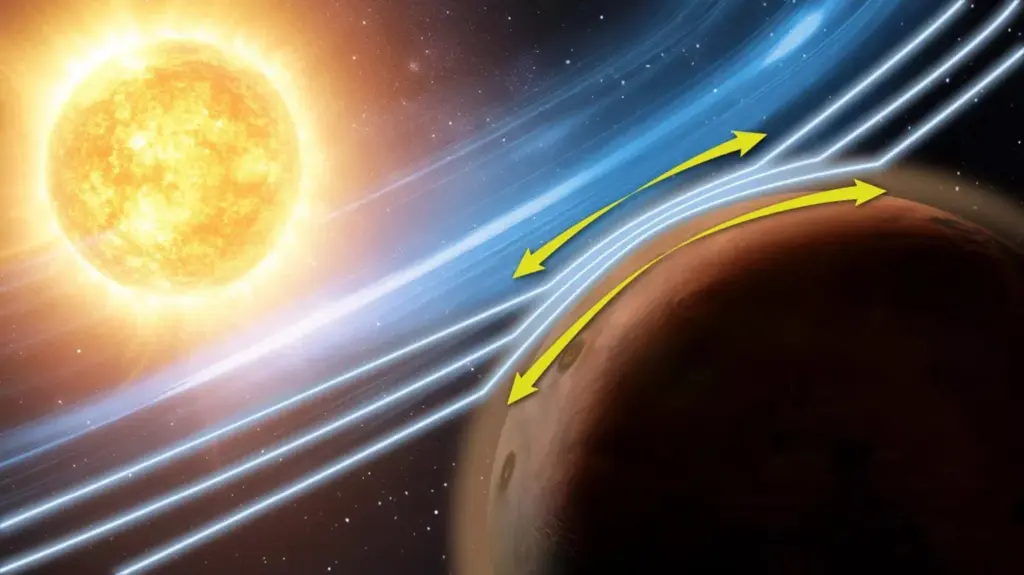
The Zwan‑Wolf effect was thought to be limited to planetary magnetospheres for decades. Originally discovered in 1976, it is the process by which charged particles are squeezed along magnetic features, like toothpaste through a tube. On Earth, this mechanism deflects much of the solar wind and protects us from the Sun’s constant bombardment.
Now, scientists have found the same effect in an unexpected place: deep within Mars’ atmosphere. Using NASA’s MAVEN (Mars Atmosphere and Volatile Evolution) spacecraft, researchers observed the Zwan‑Wolf effect in the ionosphere below 200 kilometers, where electrically charged particles are abundant.
Mars does not have a global magnetic field like Earth’s. Instead, it has an induced magnetosphere created as the solar wind interacts with its ionosphere. That magnetic shield is a tenuous entity that can change shape and size quickly in the throes of solar storms.
During a strong solar storm, the Zwan–Wolf effect became so vigorous that it was measurable by MAVEN’s instruments, and Fowler and his team identified it in the data. The effect most likely continuously happens on Mars but has been too weak to notice, the researchers suggest.
NASA’s MAVEN Spacecraft acquired stunning views of Mars
The discovery stemmed from perplexing swings in MAVEN’s readings of the Martian magnetic field. Digging deeper, the team analyzed data from several instruments and found anomalous behavior in the ionosphere. For once, all alternative hypotheses were ruled out, and they attributed the anomalies to the Zwan-Wolf effect, which consistently accounted for the signals recorded.
Investigating the Zwan‑Wolf effect on Mars contributes to our broader understanding of planetary science and informs how space weather affects unmagnetized bodies like Venus and Saturn’s moon Titan. More importantly, it highlights the dangers posed by solar storms to both spacecraft and future human missions to Mars.
“Knowing how space weather interacts with Mars is essential,” said Shannon Curry, MAVEN’s principal investigator and research scientist at the University of Colorado Boulder. “The MAVEN team continues making discoveries with our datasets and finding these links between our host star and the Red Planet.”
MAVEN, launched in November 2013 and circling Mars since September 2014, was intended to help scientists understand the planet’s upper atmosphere and ionosphere, and to learn how the Sun and solar wind erode its atmosphere. This process is essential for understanding Mars’s climate history, the fate of its liquid water, and its long-term habitability.
However, MAVEN itself faces challenges. The last time they managed to contact the spacecraft was on 6 December, 2025. NASA established an anomaly review board in February 2026 to assess its condition and determine whether recovery was possible.
In bits and pieces, each new MAVEN observation is filling in the jigsaw picture that shows how Mars lost so much of its atmosphere. This study may provide an explanation for how Mars turned from a wet, potentially habitable world to the cold desert we see today. Seeing the Zwan‑Wolf effect on Mars’ ionosphere is more than an academic interest, as it shows that small processes can play a significant role in planetary evolution.
MAVEN still has an uncertain future, but MAVEN will always be remembered. As a result, both the Mars spacecraft and the observations have shown that it’s quite an active planet, continually being altered as it continues to be influenced by its interactions with the Sun. And now, Mars, ground zero for the Zwan‑Wolf effect baked into its atmospheric narrative, has revealed that, just like Earth, it too sports a concealed magnetic signature that could echo throughout other unmagnetized bodies in our solar system.
Journal Reference:
Fowler, C.M., Hanley, K.G., McFadden, J. et al. Detection of the Zwan-Wolf effect in the ionosphere of Mars. Nat Commun 17, 4224 (2026). DOI: 10.1038/s41467-026-72251-9