
After my last post about Anatolian coffee divination, a lot of people messaged me asking the same question: "Okay, but how does this contact actually work in practice?"
Most Westerners think coffee reading is just a fun parlor game or a Rorschach test with dried mud. You see a horse, it means a wish; you see a fish, it means money. But if you look at the strict, traditional rules people follow in rural Turkey, you realize this isn't a game at all. It’s a highly structured ritual to invite a Hadim—an entity-servant—into the room.
Let's dissect the actual steps, because every single domestic rule has a darker, hidden purpose.
First, the brew itself. Old-timers always say that for a good reading, you must put at least a tiny bit of sugar in the pot, even if you drink it bitter. The mundane reason? It helps the sediment stick. The real reason? Sugar acts as a binding agent. Without it, the loose grounds just float around randomly. It needs that sugar to hold a stable shape, functioning like a physical grid that can capture a frequency.
Then comes the flipping of the cup. You finish the coffee, put the saucer on top, and you must turn it inward, toward your chest. People say "it turns your luck toward you." In reality, you are aligning the cup with your own personal energy field, sealing your timeline inside the porcelain before you flip it upside down.
As soon as the cup is upside down on the table, people immediately put a metal object on it—usually a silver ring, a coin, or a key. If you ask a local, they’ll tell you it’s just to make it cool down faster. But why metal? Metal is a grounding conductor. It anchors the volatile, hot energy inside the cup. It stabilizes the environment so the entity can manipulate the mud without outside interference. This is exactly when old practitioners whisper the traditional formula under their breath: "Kahve-i pir kalbime gir, kalbimden çık falıma gir." It’s a direct invocation asking the patron spirit of the craft to enter the reader's heart and manifest through the cup.
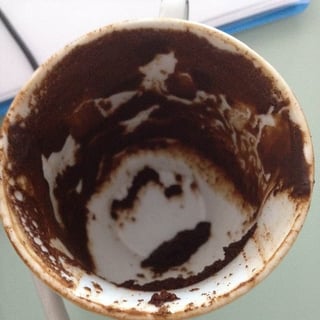
When you open the cup, you are looking at a literal map of the person's life, and the layout is strict. The handle represents the home and bloodline. The rim is the fluid, immediate future. The pitch-black bottom of the cup is the deep matrix—long-term events. If the sludge at the bottom is thick and zift-like, we call it sıkıntı (a heavy spiritual blockage). The right side shows moving, positive forces; the left side holds the hostile ones.
A real reader doesn’t just guess shapes. They stare into that stark black-and-white contrast until they enter a mild trans state. The information doesn't come from the mind; it’s channeled through Hatif—a voiceless whisper or a sudden, unearned drop of knowledge into the brain about the seeker’s darkest secrets. This process completely drains your aura. If you ever watch a genuine Turkish fortune teller, they will yawn uncontrollably throughout the session. It’s not boredom; it’s a physical symptom of rapid energy theft and psychic vulnerability.
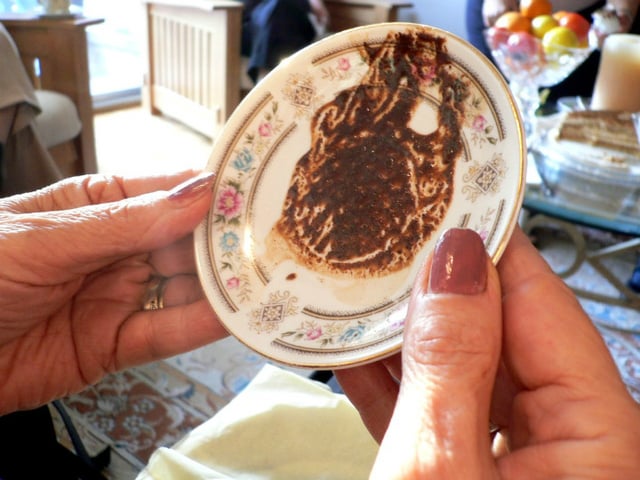
This is also why the "Sultan’s Omen" (Padişah Falı) is an absolute taboo. Sometimes, the suction is so strong that the cup sticks completely to the saucer. Traditional law says you never force it open. To break that seal is to violently interrupt an active manifestation of the Unseen. Rural lore warns that forcing it open tears your aura and invites severe attachments (musallat).
Even the very last step—washing the cup under running water while saying "let the fate wash away"—isn't about cleaning. It’s closing the circuit. You are literally dissolving the physical geometry that allowed an outside consciousness to speak through a modern cup.
by bortakci34