
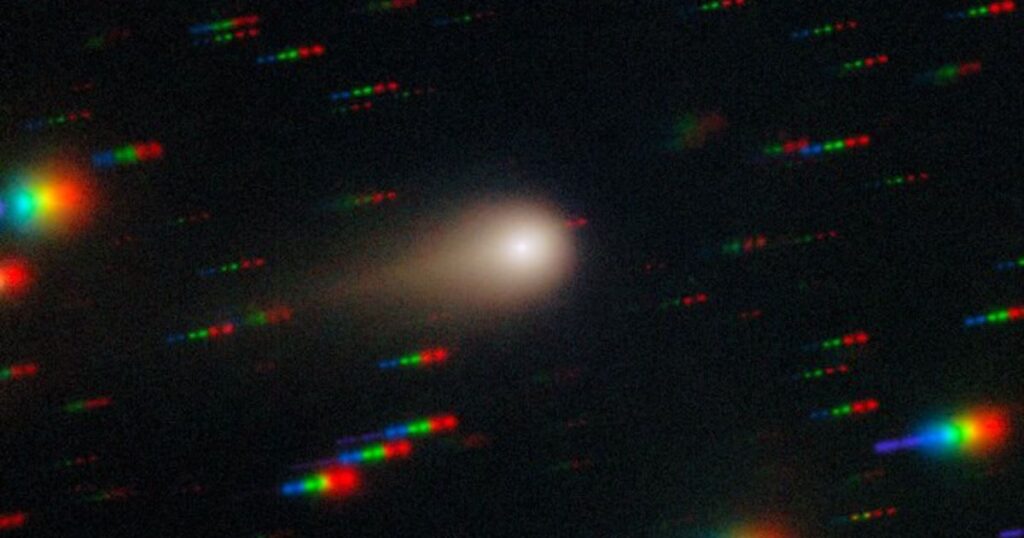
The imaging was done using an instrument that also found changing composition of the comet.
By working together, ESA’s Jupiter Icy Moons Explorer (Juice) spacecraft and NASA’s Europa Clipper have captured some unprecedented observations of the comet 3I/ATLAS. According to the Southwest Research Institute, both probes simultaneously used the Ultraviolet Spectrograph (UVS) instruments (led by the institute) at the end of last year to observe opposite hemispheres of the rare interstellar comet.
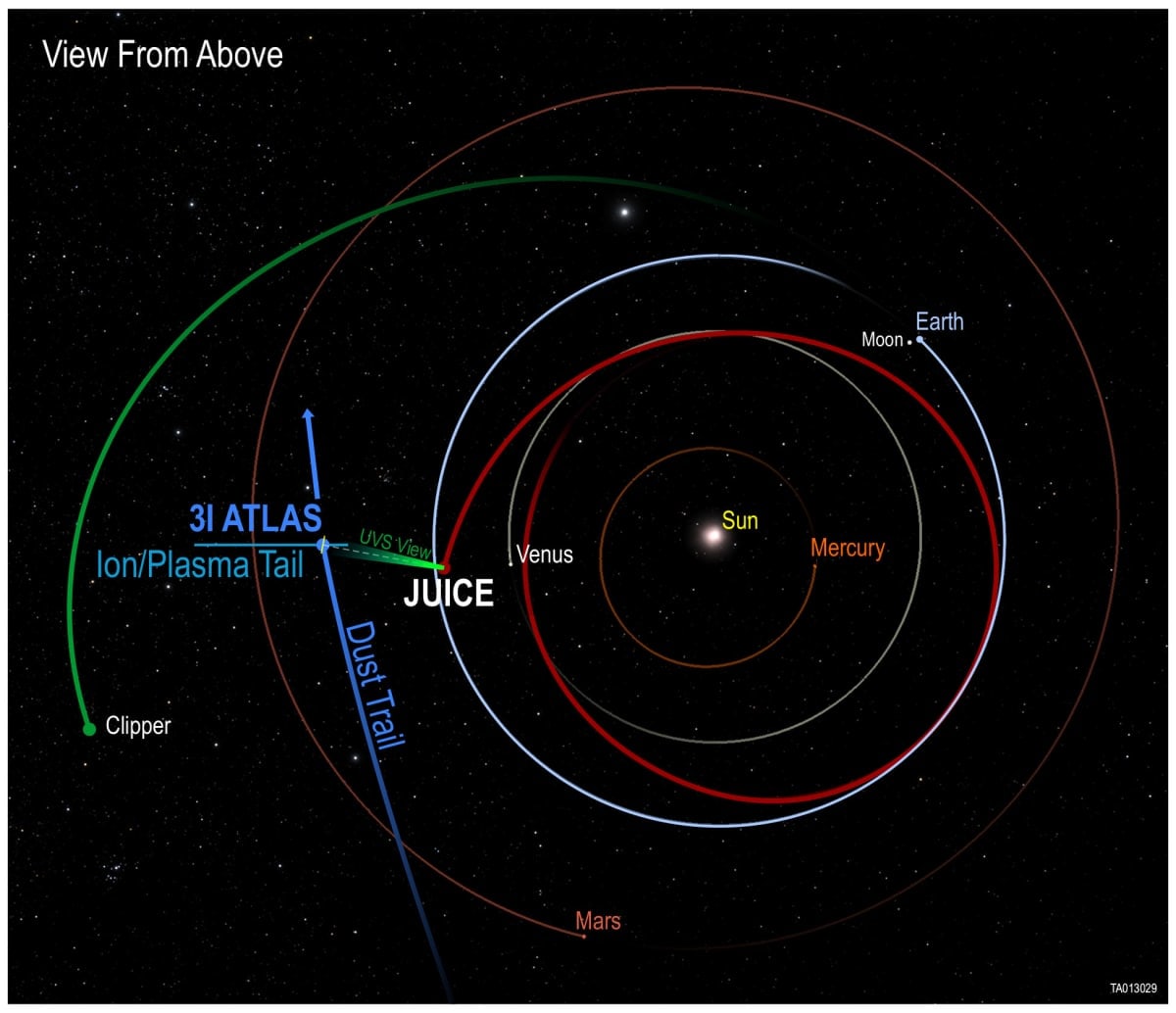
In November 2025, 3I/ATLAS passed between ESA’s Juice and NASA’s Europa Clipper spacecraft. (Image Source: NASA | ESA | SwRI)
“As the comet passed between Juice and Europa Clipper, we were able to informally coordinate observations between the two spacecraft,” said Dr. Kurt Retherford, the principal investigator of the UVS instruments on both spacecraft. Dr. Retherford also mentioned observing emissions of hydrogen, oxygen, and carbon, as an effect of gases escaping the comet’s nucleus breaking apart into atoms after being exposed to sunlight. This is likely due to 3I/ATLAS being relatively close to the Sun compared to its potential origin in a place far colder than our solar system.
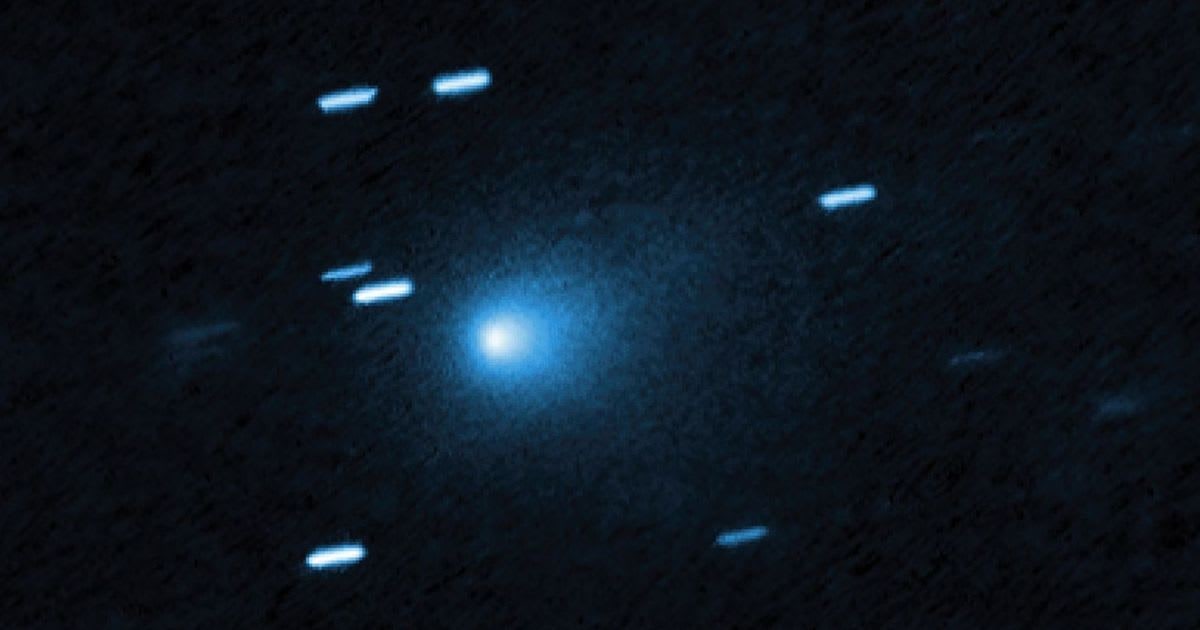
A black space background with white streaks and a single fuzzy white dot. The streaks are stars and the dot is comet 3I/ATLAS (Representative Image Source: ESA/TGO/CaSSIS)
A similar phenomenon was recently observed in a Jupiter-family comet called 41P/Tuttle–Giacobini–Kresak, which started spinning in an opposite direction as it came into the vicinity of the Sun. Essentially, the sublimating gases shooting off the comet’s surface acted like thrusters on a spacecraft to reverse its spin, vaguely similar to gases escaping from both hemispheres of 3I/ATLAS. “This was the first time we’ve had simultaneous direct views of a comet’s coma of escaping gas from two directions,” said SwRI’s Dr. Philippa Molyneux, co-deputy principal investigator for the Juice-UVS instrument. “Europa Clipper showed us the night side of the comet, with a great deal of scattered dust, while Juice imaged mostly glowing gas on the day side.”
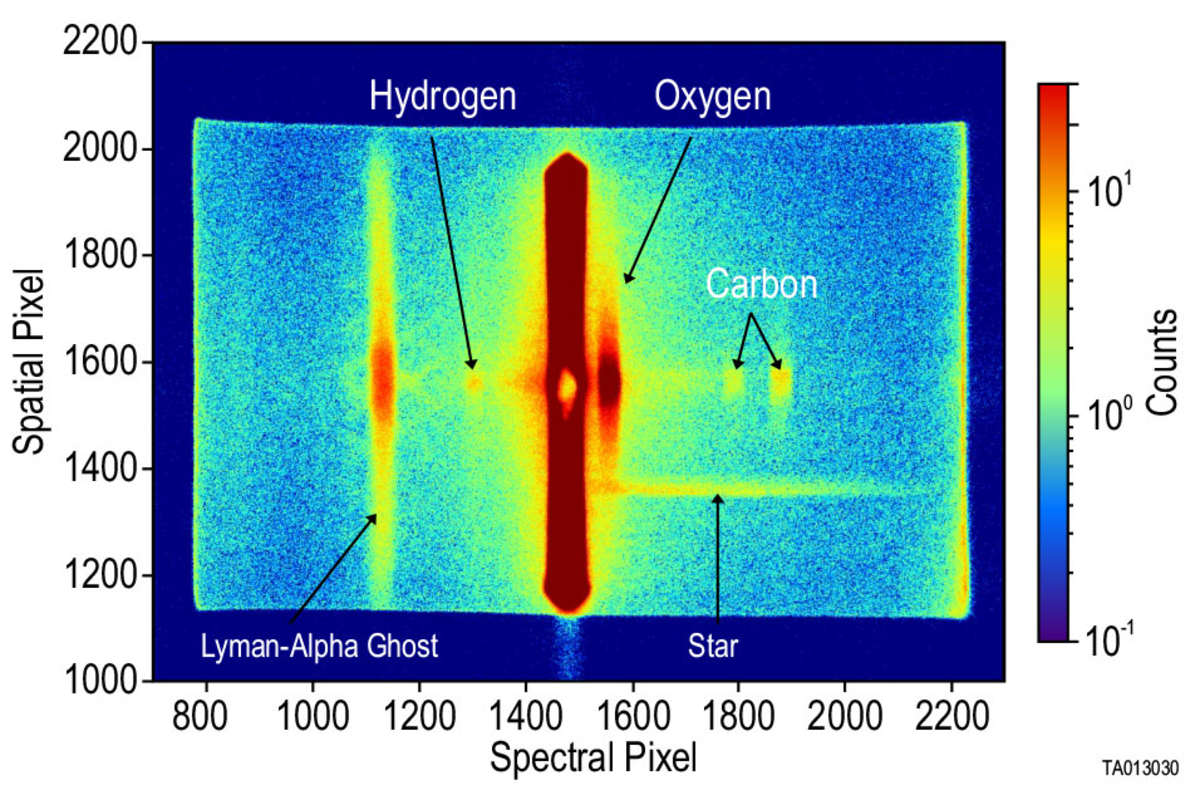
SwRI Ultraviolet Spectrograph (UVS) aboard ESA’s Jupiter Icy Moons Explorer (Juice) spacecraft observed the interstellar comet 3I/ATLAS. (Image Source: SwRI | NASA | ESA)
Comets are composed of water ice, dry ice (frozen carbon dioxide) and other materials, such as dust. Scientists tend to make note of the patterns emerging from the flow of the emissions over several days. What was unusual about 3I/ATLAS was that astronomers discovered carbon being emitted at a higher rate than expected early on, especially when compared to other recorded comets in our Solar System. They found that the ratio of these molecules were altered as temperatures changed, which reflects the comet’s evolution during its journey through our solar system. Moyneux explained, “By studying the ratio of water ice and dry ice, we can compare the composition of this interstellar comet to comets native to our solar system. This helps us understand if the solar system where 3I/ATLAS formed is similar to ours or different.”
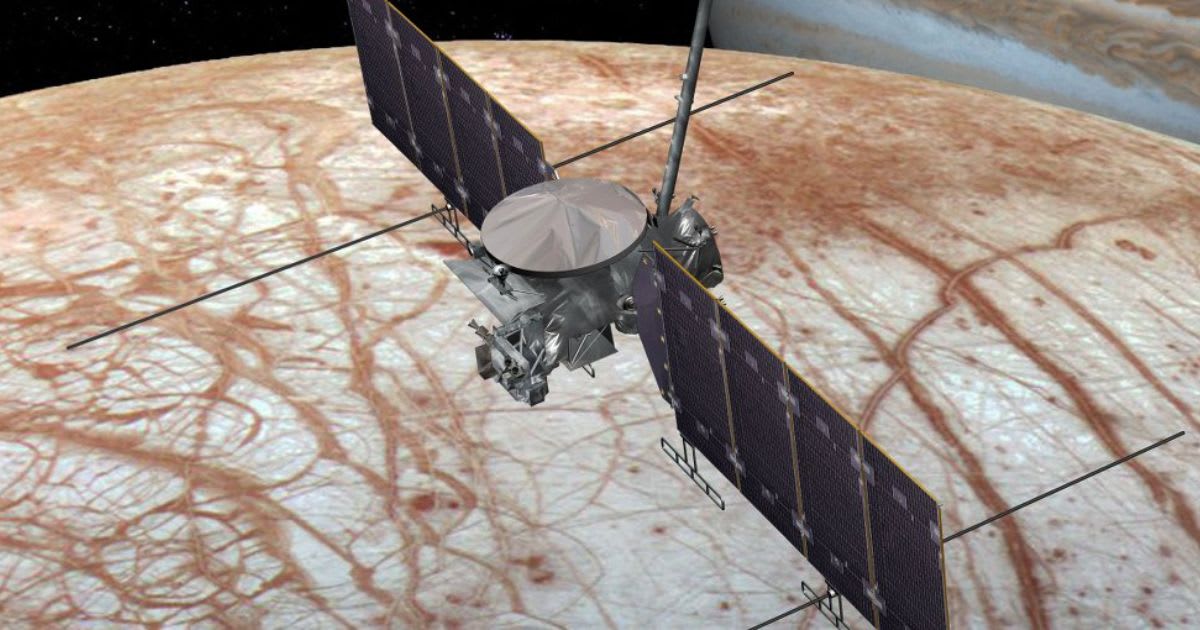
Europa Clipper will conduct a detailed reconnaissance of Jupiter’s moon Europa and investigate whether the icy moon could harbor conditions suitable for life (Representative Image Source: NASA)
Dr. Retherford called the coordination between Juice and Europa Clipper “a fun and impactful demonstration,” highlighting that the SwRI’s team is involved in both missions thanks to their efforts toward their UVS instruments. The UVS is one of Juice’s ten and Europa Clipper’s nine onboard scientific instruments. Juice is currently on the lookout for signs of life in the moons that are in Jupiter’s sphere of gravitational influence. NASA’s Europa Clipper is on a mission to study and analyze Europa, one of Jupiter’s Galilean moons. Despite their original missions being meant for Jupiter’s moons, Juice and Europa Clipper’s design for studying icy worlds seemed to work with 3I/ATLAS, too.
More on Starlust
3I/ATLAS was spewing 70 Olympic swimming pools’ worth of water daily when ESA’s Juice observed it
NASA’s SPHEREx images 3I/ATLAS again, detects organic molecules in the interstellar comet