
British physicist and science popularizer Phil Halper emailed me about two new surveys he and others had conducted with 1675 physicists, asking their views about fundamental questions in the field. This is not, of course, a guide to the truth, but simply a snapshot of where physicists stand on things like quantum gravity, black holes, and the Big Bang. The links to the surveys are in the text below, sent by Phil. I’ll highlight a few of their stands on interesting (to me) issues. Phil’s words are indented:
My co-authors and I just released the largest survey of physicists ever done. In conjunction with the American Physical Society we got more than 1600 replies to our Big Mysteries Survey.
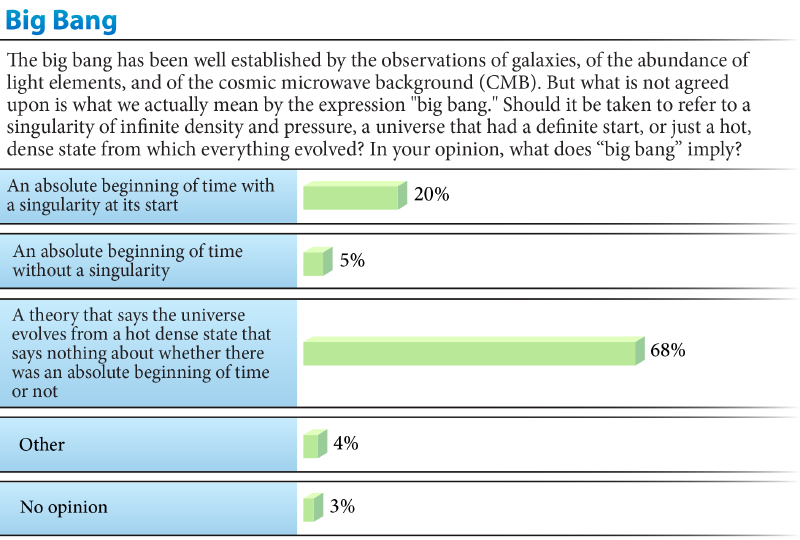
What’s relevant for debates between believers and non believers is that we only got a large consensus on one topic and that is the Big Bang should be understood only as a theory that says the universe evolved from a hot dense state that says nothing at all about a beginning of time . Interestingly, we got 68% in both this large survey of a broad cross section of physicists and for a smaller scale survey we did of leading physicists in Copenhagen with the Niels Bohr Institute. This seriously undermines William Lane Craig’s Kalam cosmological argument which is defended by claiming that physicists agree that the Big Bang has shown that the universe had a beginning, we now have strong empirical evidence that physicists think no such thing.
On the fine tuning argument the most popular answer was that constants are brute facts that need no explanation. This was found in both of our survey and in the Phil papers survey of philosophers.
You can see the results here
And the Copenhagen Survey is here.
JAC: The Copenhagen Survey involved views of 151 physicists attending a conference on black holes in 2024.
And there is a video with Sean Caroll, Niayesh Afshordi, and Ghazal Geshnizjani discussing the results here. [JAC: I’ve put the video below.]
You might also enjoy the recent debate I did on science, cosmology and faith with Stephen Meyer here.
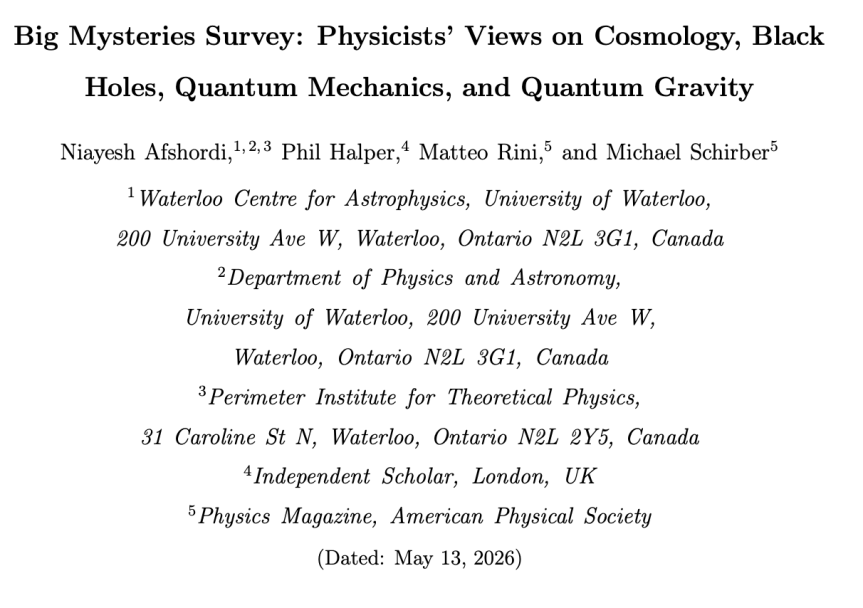
I haven’t yet watched the videos, but I did look at the big survey; you can access the pdf for free by clicking on the screenshot below:
First, a bit of methodology from the paper:
In the summer of 2024, a survey was conducted at the Black Hole Inside Out Conference in Copenhagen to assess physicists’ views on a range of ongoing controversies [1]. Eighty-five scientists responded. One year later, the authors collaborated with the American Physical Society’s Physics Magazine on a substantially larger follow-up survey, which polled 1,675 participants from the magazine’s readership and the members of the American Physical Society. The Physics Magazine survey therefore provides a broader view of attitudes within the physics community and allows comparisons with the more focused conference-based Copenhagen sample.
Taken together, the two surveys make it possible to compare views expressed in a specialist conference setting with those expressed by a much larger and more heterogeneous respondent pool. On some topics, the results are remarkably similar; on others, the differences are substantial. This paper presents the Big Mysteries Survey results, offers commentary on their interpretation, and highlights points of agreement and divergence relative to the Copenhagen survey
Here are a few bar charts from the paper. First, what the Big Bang implies (Sean Carroll explains this at the beginning of the video below). A big majority of physicists think that the Big Bang says nothing about whether it marked the ‘beginning of time”:

Of course tyros like me have no idea why the Big Bang doesn’t imply the beginning of time, but so be it: all of this is above my pay grade but I’m happy to see where physicists stand on these issues now.
What about cosmic inflation? A bit more than half of physicists think that cosmic inflation (the expanding universe) explains “an unexpected uniformity” of the universe.

Dark matter: does it explain anomalies in the rate of rotation of galaxies? No consensus:

Also no consensus on whether dark energy explains the accelerating expansion of the Universe:

There’s no consensus on why the universe’s physical constants appear to be “fine-tuned” for the existence of worlds that can produce life. (This is a favorite theological argument for God.) The “brute facts” explanation brings a stop to searching for explanations, but only 26% of physicists hold it. 20%—and I think this includes Carroll—think it’s explained by a multiverse.

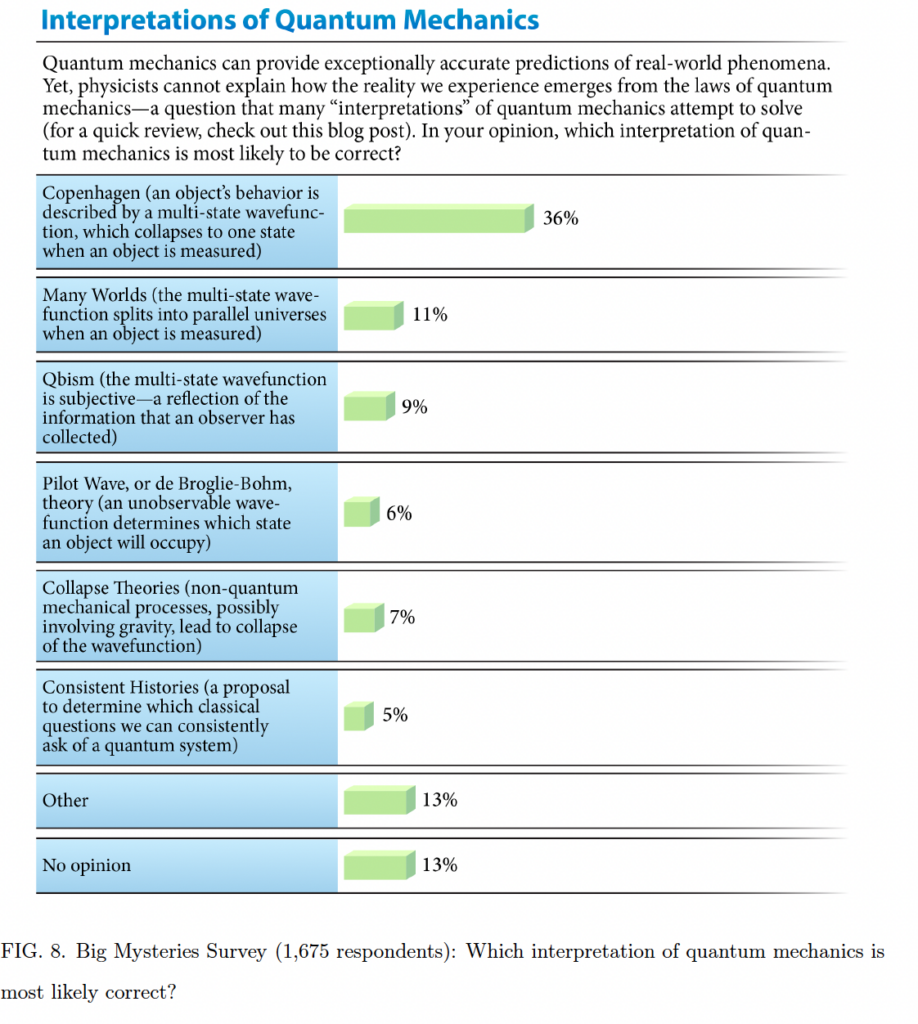
There are more graphs, but I’ll show just one more. What kind of picture of the Universe is provided by quantum mechanics? The Copenhagen explanatoin, which people like me can’t reconcile with physical reality, is the favored explanation. I believe it was Feynman who said that if you think you understand quantum mechanics, you don’t. I’m still baffled by the issue of quantum entanglement, and don’t even understand the experiments buttressing it.

And here’s the video with Sean Caroll, Niayesh Afshordi, and Ghazal Geshnizjani. Carroll, as usual, gives some very succinct and lucid explanations. The other physicists are good as well.
Have a look at the paper for more opinions, including about what black holes mean and what they do.