
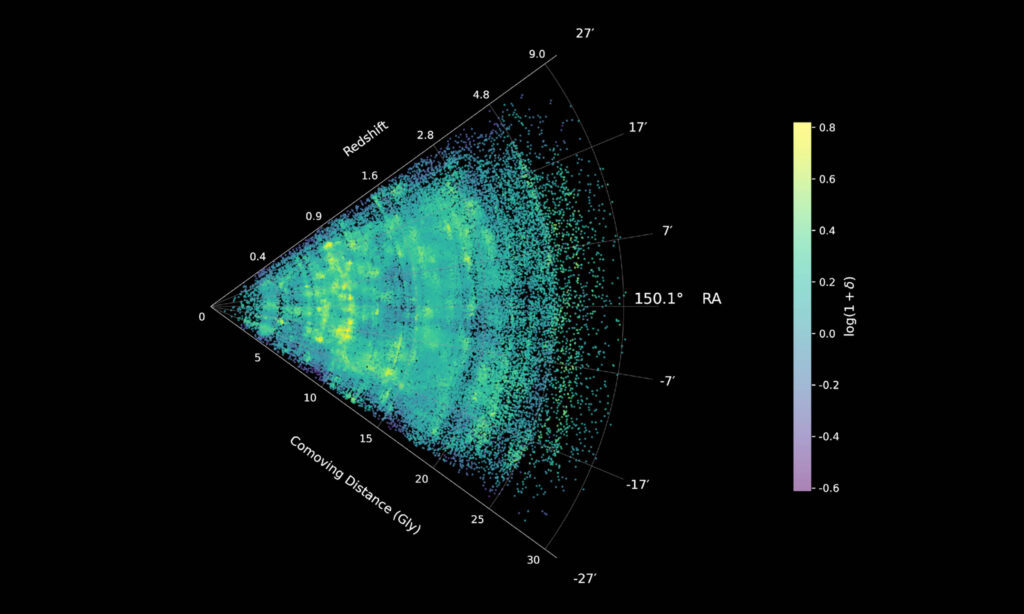
For years, maps of how matter is arranged across the universe came with a built-in compromise. Individual galaxies showed up fine.
The filaments and clusters they formed – the bigger architecture – remained smeared at the edges.

The James Webb Space Telescope (JWST) is changing that. Its largest survey has produced the most detailed map of that architecture ever created. What it finds in the early universe doesn’t quite match the older, blurrier versions.
Mapping the cosmic web
The cosmic web is the underlying architecture of the universe – a skeleton of filaments and sheets of gas and invisible matter, with immense empty voids in between. That invisible matter provides the gravity that holds the threads together despite emitting no light.
Galaxies and clusters sit along those filaments, threaded into one connected structure. Where threads cross, galaxies pile up. Where they thin out, almost nothing exists at all.
Astronomers led by researchers at the University of California, Riverside (UCR) have now produced the most detailed map of that structure ever made.
The team drew on the largest space telescope survey ever conducted to trace the web back to when the universe was about one billion years old.
The COSMOS-Web map
That survey, COSMOS-Web, is the largest single research program the telescope has ever carried out. It covered a continuous patch of sky roughly the size of three full Moons.
Tiny by everyday standards, huge for a deep-space survey. Within that patch, the team identified 164,000 galaxies and sorted them by distance.
They then stitched the data into a three-dimensional model that stretches from the present day back to the universe’s earliest visible eras.
Reaching cosmic dawn
Hossein Hatamnia, a graduate student at UCR and the Carnegie Observatories, led the analysis. The map he and his colleagues built spans 13.7 billion years of cosmic history.
A light-year, the distance light travels in one Earth year, is roughly 5.88 trillion miles. A galaxy at the map’s far edge appears not as it is now, but as it was more than 12 billion years ago.
“For the first time, we can study the evolution of galaxies in cluster and filamentary structures across cosmic time, all the way from when the universe was a billion years old up to the nearby universe,” said Hatamnia.
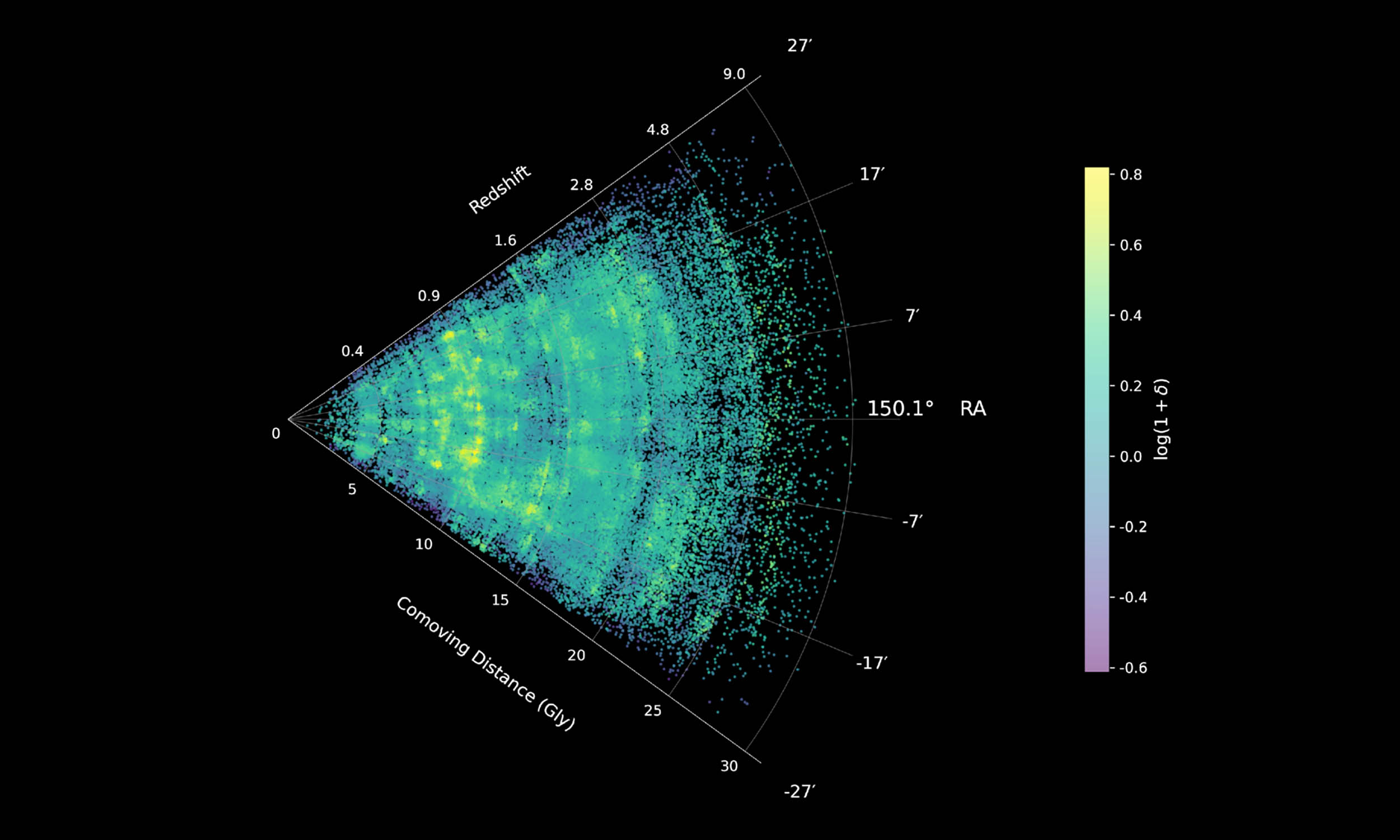 A slice through the COSMOS-Web cosmic-web map, showing galaxies across nearly 14 billion years of cosmic history. Credit: Hossein Hatamnia, UC Riverside. Click image to enlarge.What Hubble couldn’t fully see
Hubble had imaged this same patch of sky for years. Maps drawn from that data, however, glossed over fine detail. The new view rewrites it.
Bahram Mobasher, a distinguished professor of physics and astronomy at UCR and Hatamnia’s advisor, said the gap between JWST and Hubble is visible at a glance.
“The jump in depth and resolution is truly significant, and we can now see the cosmic web at a time when the universe was only a few hundred million years old, an era that was essentially out of reach before JWST,” he said.
Much fainter galaxies
Hatamnia explained that the leap comes from two strengths of the telescope working together. JWST picks up much fainter galaxies than Hubble could see. It also pins down their distances with far more precision.
That second piece is what turns a flat list of galaxies into a real map, with each galaxy landing in a much narrower slice of cosmic time.
Earlier surveys had hinted that the network existed at those depths, but the structures looked smeared together.
The new view from COSMOS-Web resolves them. Single clumps split into several. Voids that were softly defined now have sharp edges.
Exploring Webb’s giant dataset
Everything is now public: the pipeline used to build the map, the catalog of 164,000 galaxies with their measured positions and densities, and a video showing the cosmic web evolving across billions of years.
Dozens of scientists from institutions across four continents contributed to the project. All of it is now public, and researchers anywhere can apply their own questions to the dataset.
Earlier studies have shown that galaxies threaded along filaments grow at different rates than those in emptier regions, and the new map allows that comparison to extend much further back in cosmic time into ages that were previously inaccessible.
One small patch of sky
The map covers a single patch of sky – roughly three full Moons of area – rather than a broader sample of the cosmos.
Structures found in one region may not represent the universe as a whole.
Astronomers call this limitation cosmic variance, and they say more surveys across different regions will be needed to determine whether the results hold universally.
COSMOS-Web and future study
Astronomers can now ask – for the first time with this much clarity – how galaxy growth depends on environment going back almost to the beginning of cosmic history. It is a question that could not be answered before.
For cosmologists, a clearer picture of how dark matter – an invisible substance detectable only through gravity – is believed to have built cosmic structure can now be tested against direct observations from earlier ages than ever before.
Computer models of structure formation now face a stricter test.
The new map shows that the early universe is more textured than previous observations implied, and any simulation hoping to match reality will need to reproduce that complexity.
The study is published in The Astrophysical Journal.
—–
Like what you read? Subscribe to our newsletter for engaging articles, exclusive content, and the latest updates.
Check us out on EarthSnap, a free app brought to you by Eric Ralls and Earth.com.
—–