
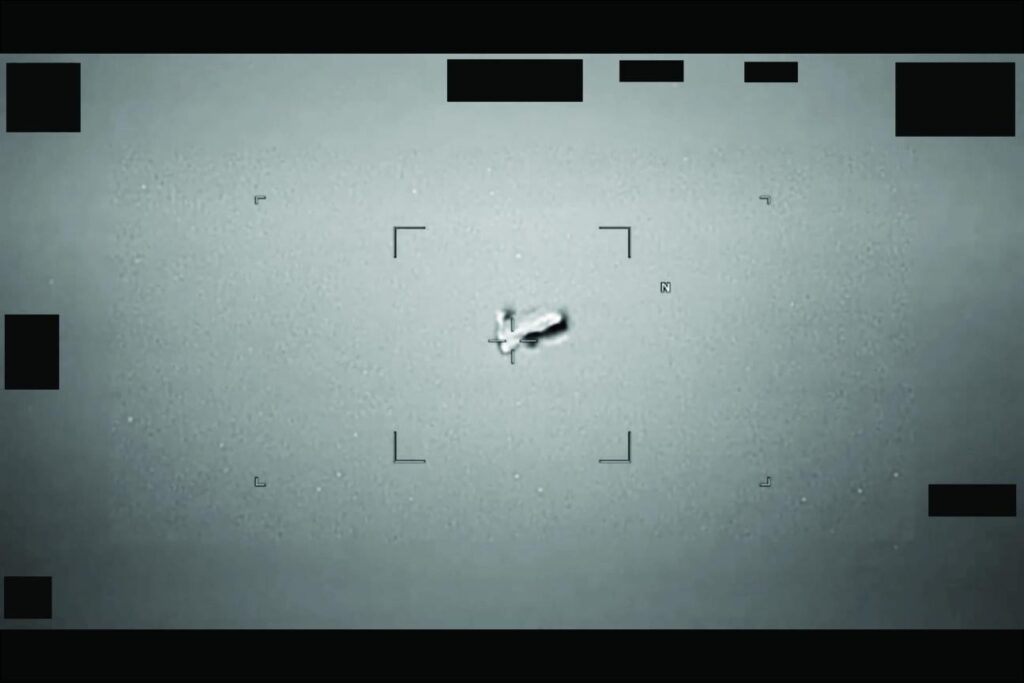
The PURSUE release has been picked clean for the obvious stuff. Apollo dots. Buzz Aldrin's flashes. The triangular formation in the lunar sky. Mick West has already announced there's nothing interesting in the dump and gone home.
The sceptics moved too fast. Sitting in the same archive, next to the FBI flying-disc summaries and the Skylab transcripts, is a ninety-page document by retired French Air Force generals that names the extraterrestrial hypothesis as the most credible explanation for the residual UAP cases. It has been sitting on the personal websites of researchers since 1999. In 2026 it is sitting on war.gov. The discourse has not noticed.
This is the one to look at.
In July of 1999, a retired French Air Force general named Denis Letty walked into the office of the Prime Minister of France with a ninety-page document under his arm. The Prime Minister was Lionel Jospin. The document was titled UFOs and Defense: What Should We Prepare For? It was the product of three years of private work by a committee of former defence-college auditors, retired generals, and engineers from the French national space agency. The committee had named itself COMETA.
Jospin received the document, annotated it, and filed it. The French scientific press treated it as an embarrassment. The report was not translated into English by any government. For most of the next quarter-century it sat in archives and on the personal websites of UFO researchers, occasionally cited in books that respectable academics avoided.
In May of 2026, the same document appeared on the website of the United States Department of War.
COMETA was chaired by Letty. Its preface was written by André Lebeau, former chairman of the Centre National d'Études Spatiales, the French equivalent of NASA. Its membership included senior officers from the French Air Force and Navy, engineers from the aerospace industry, a former director of the Institut des Hautes Études de Défense Nationale, and qualified scientists from physics, life sciences, and the social sciences. These were not enthusiasts. They were the kind of men who, by background and training, are constitutionally suspicious of anomalous claims. They had spent careers ruling things out.
What they concluded, after three years of working through cases, was that roughly five percent of the residual sightings examined by French authorities could not be attributed to natural phenomena, known human aircraft, sensor artefacts, or perceptual error. For that five percent, the most credible remaining hypothesis was that the objects were of extraterrestrial origin.
That hypothesis was named, and defended, in the final pages of the report.
The cases COMETA built its argument around are documented in the body of the text. The Mirage IV encounter of March 1977, in which a French strategic reconnaissance aircraft tracked an object that performed manoeuvres its pilots could not reconcile with known aerospace technology. The Air France 3532 sighting of January 1994, in which a flight crew over Coulommiers observed a large dark object at close range and reported it to military air-traffic control, which independently confirmed an unidentified radar trace. The 1981 Trans-en-Provence landing case, in which physical alterations to vegetation at the reported landing site were examined by the French government's official aerospace research agency. The committee did not select these cases by accident. They selected the ones with radar correlation, multiple witnesses, trained observers, and where the conventional explanations had been exhausted by other investigators before COMETA arrived.
Ten years later, in 2009, a follow-up working group inside the French aeronautical society, 3AF Sigma, reviewed the same body of cases. They reached the same conclusion. They wrote that the central hypothesis proposed by COMETA "still cannot be rejected" and "remains perfectly credible." The phrase they used for the residual cases was: a technology far ahead of ours.
A caveat is warranted. COMETA was not a government commission. It was a private association, self-funded by its members, that produced the report on its own initiative. The Prime Minister received the document as a courtesy, not as a brief. The French government has never adopted COMETA's conclusions as its own position. Neither has the Department of War, which has been careful to frame every file in the May 8 release as unresolved and to caveat every photograph as subject to other interpretation. The site is built to release without endorsing.
Both of those caveats are real. Neither of them dissolves what's strange about the document being included in PURSUE.
COMETA is unusual in the literature for one reason. It is the only document of its kind in the modern UAP era where people with high-level defence credentials examined the evidence in detail and concluded, on the record, that the extraterrestrial hypothesis was the best available explanation for the residual cases. Not we can't rule it out. Not more research is needed. A working hypothesis, named and defended, by a retired general who had spent his career inside an institution whose job is to be precise about threats and origins.
For twenty-seven years, this fact was an embarrassment. The document existed on the edge of the conversation. Cited mostly by enthusiasts. Ignored by everyone else.
In 2026, the same document sits on a US government website.
The interesting question is not whether COMETA is right. The interesting question is what its presence in PURSUE means.
One reading is that it means nothing. The Pentagon was asked to dump UAP material, and a French report on UAPs technically qualifies. Somebody at the Department of War added it to the inventory without thinking too hard. The document is in the archive because the archive is built to be inclusive, not because anyone in the building has taken a view.
A second reading is more cautious. By including a document that names the extraterrestrial hypothesis as probable, alongside several hundred unresolved cases the government also refuses to characterise, the Department of War has done something quieter than disclosure. It has placed the hypothesis on the table without standing behind it. The reader is invited to draw the conclusion the document already draws. The reader is also invited to disagree. The institution itself remains silent.
This is the same posture the institution has taken for seventy years. What has changed is the staging.
A third reading is more interesting than either. For most of the modern UAP era, the official position of every major government was that the phenomenon did not warrant serious attention. The COMETA report was an embarrassment when it appeared in 1999. By 2026, the same document is sitting on war.gov. The institutional contempt for the question has not exactly reversed. It has been replaced by something stranger. A controlled curiosity. The Pentagon is releasing files and welcoming private-sector analysis. It is publishing French generals who said the extraterrestrial hypothesis is credible, and Apollo astronaut debriefings, and federal law-enforcement accounts of orbs launching other orbs. It is doing this without saying what it thinks.
The phenomenon has not changed. The framing around the phenomenon has changed completely.
There is a pattern in the long history of unusual aerial events. A signal appears. The institutions that exist do not know how to process it. The first response is denial, then ridicule, then bureaucratic absorption. Eventually the signal is given an acronym, a website, and a release schedule. None of this resolves the underlying question. It resolves only the institutional posture toward the question.
What COMETA did in 1999 was take the signal seriously inside a defence-college vocabulary. The document is dry. It does not speculate about civilisations or motives. It catalogues cases, examines the alternatives, eliminates the alternatives, and arrives at a hypothesis. The hypothesis was then handed to the Prime Minister, who annotated it, filed it, and did nothing. The document then waited, in archives, for twenty-seven years.
Then, without explanation, it appeared on the website of the United States Department of War.
I have no inside knowledge of why the document is in the archive. I am a writer who noticed it was there. The most honest position is to note that the staging has changed without the substance changing, and to be careful about what gets read into the change. Anna Paulina Luna, the congresswoman who pushed for the release, has said the next tranche should appear within thirty days. She has said it will include forty-six UAP videos that the Department of War has so far withheld. Whether that materialises is another matter.
What is already in front of us is enough to think about. A 1999 report by retired French generals, naming the extraterrestrial hypothesis as the most credible explanation for the residual cases. Sitting in a US government archive in 2026. Treated by the coverage as a footnote…
Sources
- COMETA. (1999). Les OVNI et la Défense: À quoi doit-on se préparer? Paris: Association COMETA. Special issue of VSD magazine, July 1999.
- 3AF Sigma. (2010). Working report on aerospace phenomena. Aeronautical and Astronautical Association of France.
- Kean, L. (1999). "France's COMETA Report on UFOs and Defense." VSD magazine, July 1999.
- Department of War. (2026). PURSUE first tranche, released May 8, 2026. https://www.war.gov/ufo
Full post and previous essays at https://thegodmachine.substack.com/p/the-report-the-pentagon-quietly-published
by MCstroj