
Courtesy of Afonso Salcedo
Readers usually know what they’re getting when they pick up a Steven Rowley novel. The author of beach reads like 2021’s “The Guncle” and 2024 sequel “The Guncle Abroad” delivers sun-drenched locations, witty gay protagonists and an effervescent escape from the mundane pains of daily life.
But Rowley, a Thurber Prize for American Humor winner, appears to be struggling to find something to laugh at in these increasingly troubled times. The result, “Take Me with You,” has hung on to many of his balmy and droll trademarks but adds an unflinching look at a stagnating marriage and our collective dismay with the world in which we live.
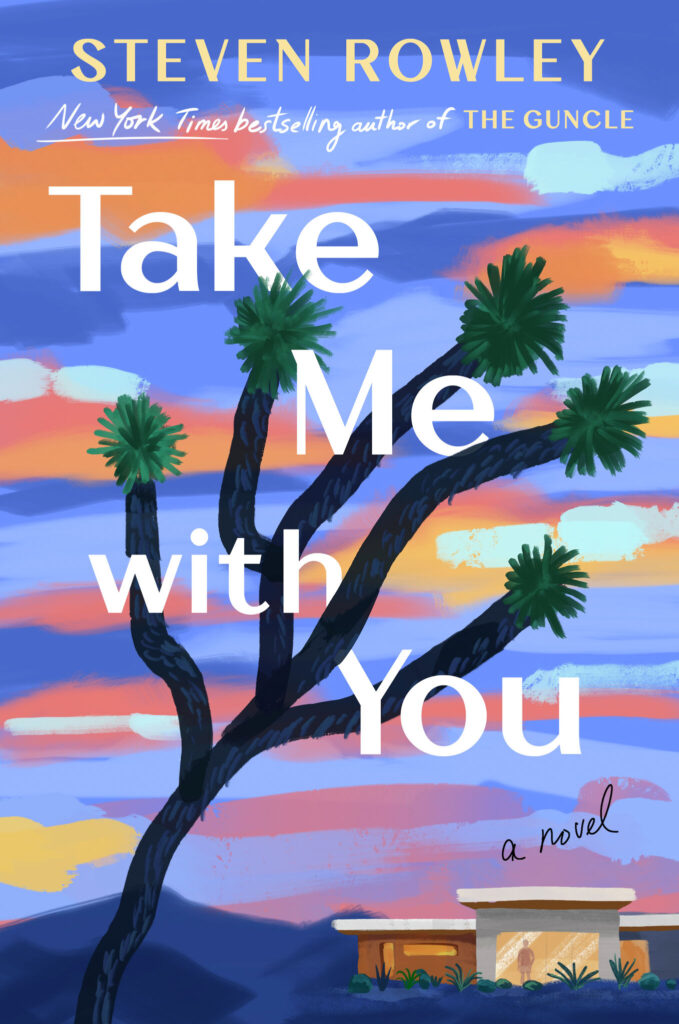
Take Me With You
By Steven Rowley
(G.P. Putnam’s Sons; 368 pages; $30)
16th Annual Book Group Festival with Steven Rowley: 6 p.m. Thursday, May 21. $20. Rakestraw Books, 3 Railroad Ave., Danville. 925-837-7337. www.rakestrawbooks.com
At the center of Rowley’s latest is humor writer and professor Jesse del Ruth, who met his architect husband, Norman, in a chance encounter 30 years ago. The couple are in trouble, but it’s not the big, dramatic trouble of “Who’s Afraid of Virginia Woolf?” Rather, it’s more like the quiet desperation of the early acts of “Mr. & Mrs. Smith.”
Article continues below this ad
Jesse and Norman recently left the big city for Joshua Tree to build a dream home that hews to Norman’s minimal, almost chilly ethos. Free of the clutter of urban life, they can finally focus on what matters. But Jesse can’t make himself write, the couple’s interactions are increasingly biting and every day the headlines offer an all-to-familiar firehose of despair. As it turns out, their escape wasn’t much of an escape after all.
If any of this strikes a little too close to home, hang in there, because the next bit is a full-on left turn.
“Take Me with You” by Steven Rowley
G.P. Putnam’s Sons
One night, Norman steps into their backyard, and as Jesse watches, he’s pulled into the sky by a blinding light. He doesn’t seem to fight the abduction, nor does he give Jesse more than a glance as he goes.
San Francisco Chronicle Logo
Make us a Preferred Source to get more of our news when you search.
Add Preferred Source
It’s an unusual decision for any writer to drop this sci-fi event in the exact spot where you’d typically find the reveal of an affair or similar form of deception. But these are unprecedentedly desperate times, Rowley seems to suggest, and they call for similarly desperate measures.
Article continues below this ad
Instead of dealing with a fairly relatable breakup scenario, Rowley asks us to follow Jesse down a befuddled hole of grief, anger and eventual acceptance. It’s a surprisingly cathartic journey, made sweet and tart by Jesse’s self-aware (perhaps too self-aware) inner monologue. He swings from painful loneliness and loss, to the joys of newfound independence, to the mystery of Norman’s abduction — if you can call a seemingly willing participant an abductee.
Rowley deftly describes the painful mundanity of the longtime relationship without overplaying his hand. You can see what first drew these guys together, as well as the inertia that keeps them there. His hand grows less sure after Norman’s disappearance, which goes unquestioned far too long by those in their orbit. The universe Jesse and Norman live in seems to share our world’s creeping rise of fascism, but it seems blessedly free of people consumed by that suspicious real-life mindset brought on by Nextdoor, the neighborhood social networking platform, and true-crime TV.
When the questions do arise, they’re resolved pretty neatly. Norman’s sister, Lally, does eventually start to wonder where her brother has gone. But the private detective she hires soon becomes part of Jesse’s bubble, joined by a conspiracy-minded neighbor, some of Jesse’s students and Lally herself. These funny, charming side characters are vintage Rowley, a reminder that if he hadn’t chosen to stretch with the more fantastic plot aspects of “Take Me with You,” we’d still have a very entertaining book.
Even when those stranger plot turns don’t fully land, Rowley’s decision to be a little more ambitious — and to flirt with a little bit of darkness — deserves to be recognized. It would be far easier, and likely more lucrative, to churn out “Guncle” sequels until he retires. (Who knows? Maybe he’ll return to that beloved mini-franchise one day.)
But one hopes he keeps pushing himself further into the territory explored in “Take Me with You.” This book isn’t just an enormously satisfying addition to Rowley’s body of work, it’s a roadmap for how to live alongside the existential dread with which many of us wake every day.
Article continues below this ad
After all, we can’t just count on being abducted by aliens.
Eve Batey is a freelance writer.