
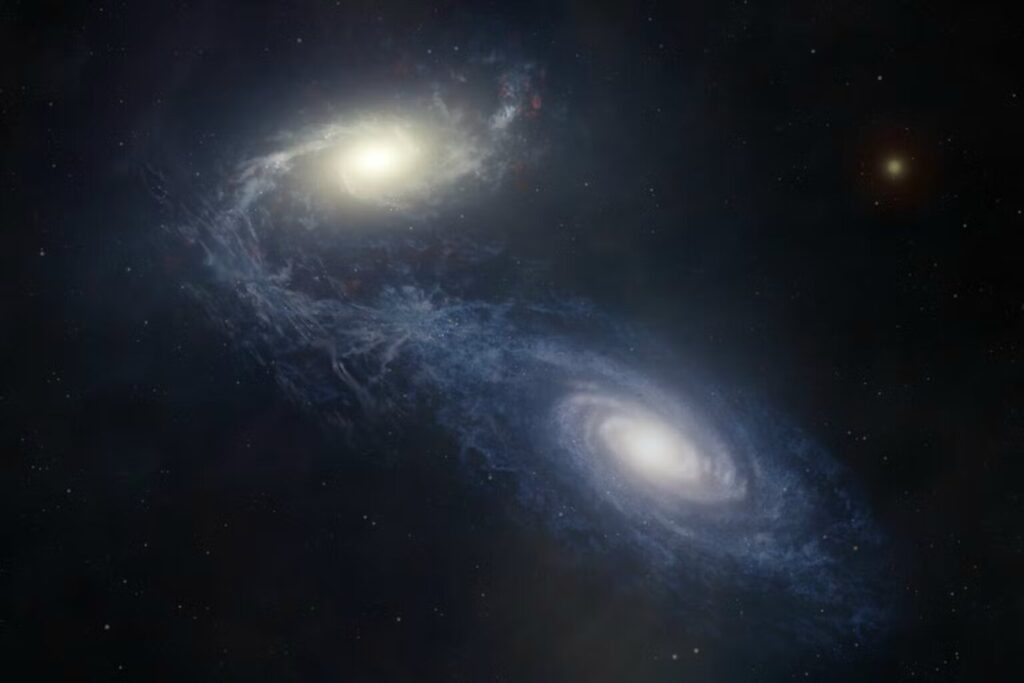
Astrophysicists have reconstructed the detailed history of a spiral galaxy outside the Milky Way for the first time. For this purpose, they analyzed the chemical signatures of the galaxy’s gas clouds and compared them with computer models. This allowed them to trace how the galaxy formed and evolved over the course of 12 billion years.
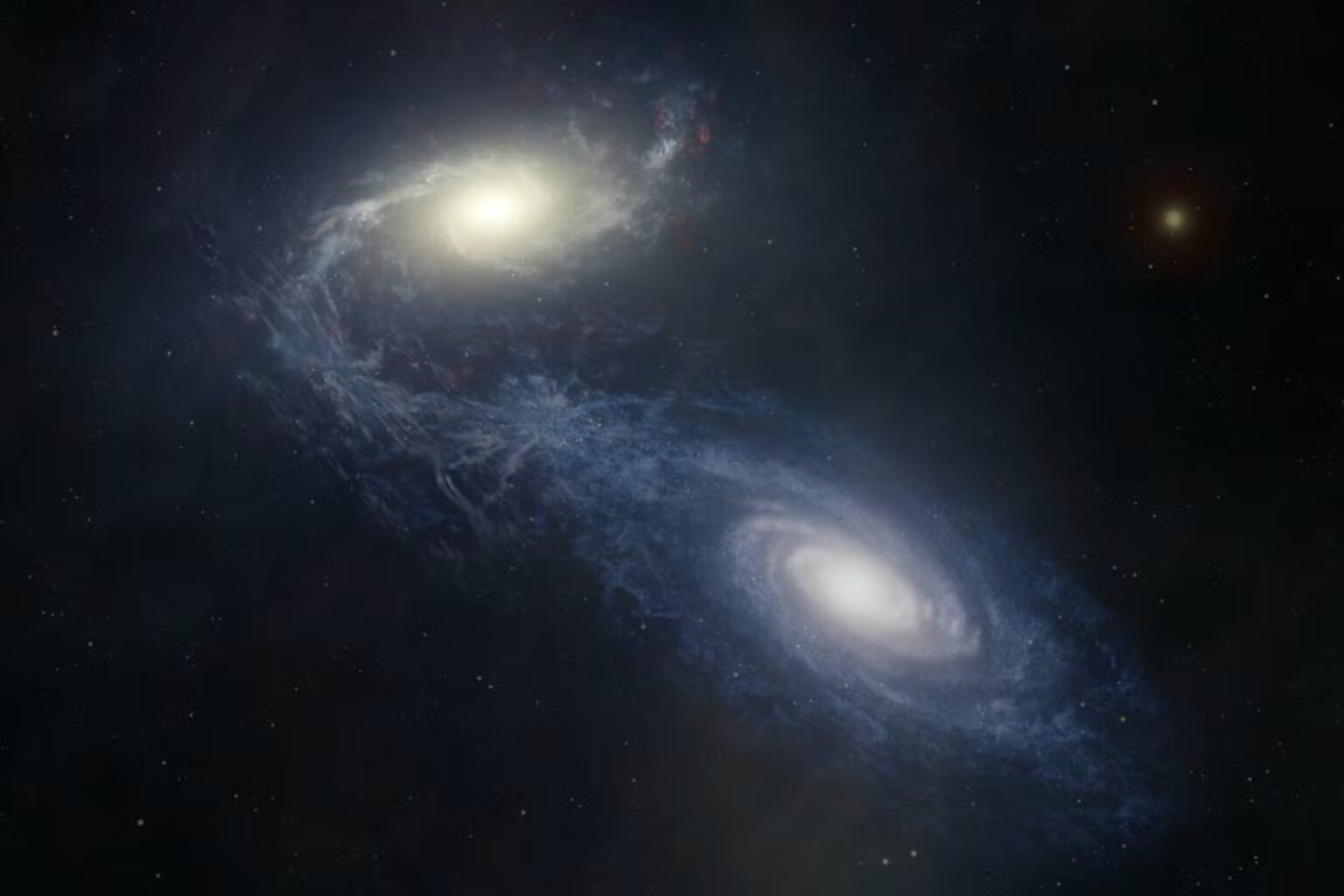 Illustration of spiral galaxy NGC 1365 during its collision and merger with a smaller satellite galaxy. Credit: Melissa Weiss/CfA. Source: cfa.harvard.edu
How to read chemical prints
When massive young stars emit ultraviolet radiation, their light excites the surrounding gas. Each element in this gas—including oxygen—responds by emitting distinct, narrow lines of light at specific wavelengths. This is how spectroscopy works, allowing scientists to determine the chemical composition of galactic gas based on the characteristic signals of each element.
Scientists have long known that the centers of galaxies are generally richer in heavy elements than their outer regions. This asymmetry has built up over billions of years and provides information about when and where stars formed, how gas moved, and how many times it collided with other gas.
Telescope and 20,000 simulations
The researchers focused on the galaxy NGC 1365, often referred to as the Great Barred Spiral. It is located relatively close to us, and its disk is oriented directly toward us. Using the Irénée du Pont telescope at Las Campanas in Chile, the team mapped oxygen in thousands of star-forming clouds within the galaxy.
The researchers then examined approximately 20,000 simulated galaxies and identified the one that most closely matched NGC 1365 in terms of chemical composition and the distribution of heavy elements. Using this model, they “rewound” time and reconstructed its likely evolutionary path.
Center appeared before the spiral arms
It turns out that the central region of NGC 1365 formed early in the galaxy’s history and quickly became oxygen-rich. The outer disk grew much more slowly.
Over billions of years, the galaxy has been devouring smaller dwarf galaxies, which have brought with them fresh gas and new stars. Most of the gas at the edges of the spiral arms formed there during the late stages of NGC 1365’s evolution.
Open questions
This is one of the first studies in which the method of chemical archaeology has been applied outside the Milky Way with such a high level of detail. However, some details remain unclear. Different combinations of gas flows and collisions can sometimes produce similar chemical signatures.
A broader question also remains unanswered. It is unknown whether NGC 1365’s trajectory is typical for large spiral galaxies or whether it is unique. It is also unclear whether its growth is influenced more by collisions with neighbors or by the accretion of external gas. And most importantly—to what extent does the history of NGC 1365 resemble the evolution of our own Milky Way.
According to theconversation.com