
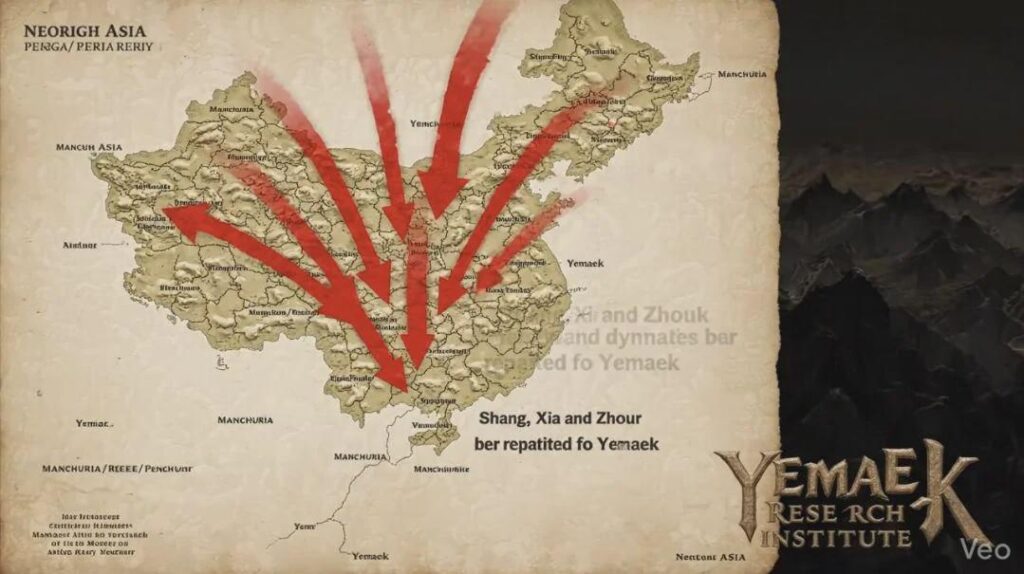
Introduction The historiography of East Asian civilization has long emphasized the independent development of the Yellow River basin and the Shang Dynasty. However, alternative perspectives argue that Gojoseon, founded in the Taebaek Mountains, functioned as a continental federative state whose influence extended deeply into the Yellow River region. This paper re-examines the origins of writing, cultural transmission, and population genetics to argue that the Shang Dynasty was not an autonomous polity but rather a branch state under Gojoseon’s continental order.
Methodology
- Genetic Analysis: Ancient DNA samples from the Yellow River basin were compared with those from the Liao River region, revealing northern predominance and continuity with modern Koreans.
- Archaeological Evidence: Dolmen clusters and megalithic structures demonstrate Gojoseon’s organizational capacity and federative control.
- Textual Records: Passages from Hwandan Gogi, though often dismissed as apocryphal, record linguistic diversity among federated tribes and astronomical phenomena such as the “Five Planets Alignment” (五星聚婁), which modern science confirms.
- Comparative Epigraphy: Symbols on Gojoseon artifacts were analyzed against Shang oracle bone inscriptions, revealing notable similarities.
Discussion
Proto-Writing in Gojoseon The linguistic diversity among Gojoseon’s federated tribes necessitated a unified system of notation. Evidence from artifacts suggests that Gojoseon possessed a proto-writing tradition prior to the Shang Dynasty.
Oracle Bone Script as Adaptation Oracle bone inscriptions, traditionally regarded as an indigenous Shang innovation, may instead represent adaptations of earlier Yemaek-Gojoseon writing systems. Archaeological findings reveal symbols on Gojoseon artifacts that closely resemble oracle bone characters. Thus, oracle bone script should be interpreted not as an original invention but as a derivative system rooted in Gojoseon’s proto-writing.
Shang as Branch State The Shang Dynasty’s 550-year existence unfolded within Gojoseon’s continental order. Shang rulers functioned as vassal kings, legitimized through investiture by the Dangun sovereign. Their reliance on Gojoseon’s ritual systems, bronze technology, astronomical knowledge, and writing traditions reinforces the interpretation of Shang as a branch polity rather than an independent civilization.
Han Ethnogenesis Over time, northern and southern populations mixed, crystallizing into the Han ethnicity during the Han Dynasty. This process of admixture and political consolidation marks the decisive moment in which earlier genetic and cultural influences became unified into a distinct ethnocultural identity.
Conclusion This study argues that oracle bone script was not an original Shang creation but a derivative adaptation of Gojoseon’s proto-writing. Combined with genetic, archaeological, and astronomical evidence, the interpretation of Shang as a branch polity under Gojoseon’s continental order gains credibility. The integration of these perspectives restores the historical significance of “Continental Gojoseon” as a sovereign federative state shaping East Asian civilization and situates the Han Dynasty as the crystallization point of Han ethnogenesis.
Keywords: Gojoseon, Yemaek Federation, Shang Dynasty, Oracle Bone Script, Branch State, Ancient DNA, Hwandan Gogi, Han Ethnogenesis
by Key-Dot-9013