
 사진 확대 Getty Images Bank
A light-year means the distance light travels in one year. It is a distance with 13 zeros after the number 1, and it is measured not in centimeters or meters, but in kilometers.
Written as a number, “10 trillion kilometers” looks like this: “10000000000000 km.” Even a plane crossing continents and oceans covers only a few thousand kilometers, so you would need to add 10 more zeros. To travel that far, you would have to circle the Earth hundreds of millions of times.
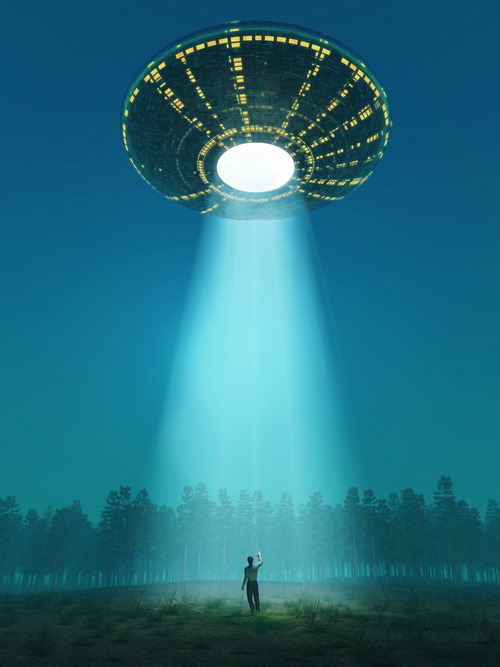
From the perspective of the universe, however, even one light-year is just a tiny speck and a fleeting moment. Humans can hardly imagine how vast the cosmos really is. In such an immense space, could humanity truly be the only civilization? Then again, another question is unavoidable. Is it really plausible that aliens would travel between stars and arrive on Earth, appearing as unidentified flying objects (UFOs) or unidentified anomalous phenomena (UAP)? And how would they even know we are here?
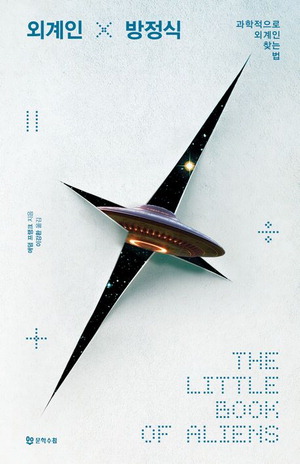
A new book, “The Alien Equation,” has been published. It is a sweeping reflection on how far research into the search for extraterrestrial life has come, what methods are being used, and what questions become possible if extraterrestrial civilizations do exist. The author, a professor of physics and astronomy who won the Carl Sagan Medal in the United States and served as a science consultant for the film Doctor Strange, examines the history of searching for nonhuman civilizations. At times, he dismisses hasty speculation with a cold smile. At others, he nods in welcome as he thinks through the subject.
Debates about aliens also existed in ancient Greece. Aristotle was a pessimist on the question. At the time, the planets beyond the Sun were only Mercury, Venus, Earth, Mars, Jupiter and Saturn, and he said, “There cannot be more than one world.” But several thinkers known as atomists believed that “everything in the universe is made of atoms, tiny divisible particles that move rapidly, collide and combine.” Even in antiquity, pessimism and optimism coexisted.
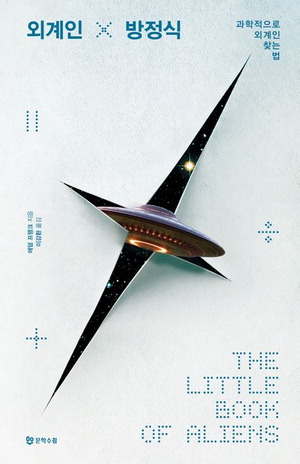 사진 확대 “The Alien Equation,” by Adam Frank, translated by Lee Kang-hwan, published by Moonhak Soochup, 19,000 won
In modern times, humanity’s serious interest in UFOs began on June 24, 1947. An amateur pilot named Kenneth Arnold headed to a nearby area after hearing that a reward would be paid for finding the wreckage of a missing transport plane. There, he spotted nine blue-tinged objects arranged diagonally. A simple calculation showed that they were moving at twice the speed of sound, or 2,400 kilometers per hour.
Arnold’s claim that “the flying objects looked like crescent moons with wings and flew in an arc” made headlines. But a misunderstanding entered the story at that point, and the image has stayed in our minds ever since. One newspaper misheard Arnold’s testimony and printed the phrase “supersonic flying saucer.” Newspapers in 140 countries then reported the objects Arnold saw as saucer-shaped, and the stereotype of “UFO = saucer-shaped” took hold. In fact, what he saw was “a thin C-shaped craft, like a bat-shaped shuriken.”
Even if extraterrestrial civilizations really do exist, the problem is complicated. Interstellar travel, as described above, is impossible with humanity’s current technology. One can imagine a generation ship, perhaps. But from an alien’s point of view, if it takes so long to reach Earth that they die before meeting humans, they would need to have children during the journey to avoid that dilemma.
If travel between two planets takes 200 years, humans would not live long enough to even start a conversation. In that case, even if the first negotiation were somehow possible, it would take two centuries to get a reply. One could also imagine a spacecraft powered by sails pushed by photons or lasers. The problem is that it would have to slow down as it nears Earth, and it cannot stop. Without reverse thrust, it would spend hundreds or even thousands of years flying here, only to pass by without a wink or a handshake.
Even if we met them, the question would remain: how would we talk? Since Homo sapiens began evolving about 300,000 years ago, our only conversation partner has been ourselves. Even if language communication became possible, what would we ask them? If they had intelligence, the author argues, the most important questions would be whether they believe in God and whether mathematics is a language unique to humans or a verbal expression of the universe’s order.
Even if we recognize that they exist, there is still the question of whether we should dare to speak to them. A balanced conversation on equal terms may be nothing more than our own fantasy. Looking back at human history, it took about 9,000 years to go from planting crops to launching spacecraft. But if a technological civilization has lasted for hundreds of millions of years, could we really sit at the same table with them?
Liu Cixin’s novel The Three-Body Problem, adapted into a Netflix series, presents the hypothesis that extraterrestrial civilizations all hide from one another (the Dark forest hypothesis). In the novel, the first reply from an alien civilization that receives Earth’s initial message is this: “Do not respond. Do not respond….” In a universe of predators and prey, revealing oneself is an act of suicide, so the message meant that no one should acknowledge the others.
Still, the author argues strongly that discovering aliens would also carry great meaning for humanity. If it were confirmed that the formation of life on Earth was not a one-time event in the universe, but a second occurrence, humanity would begin to live in a different world. Two would no longer mean “1+1,” but could mean “1+2,” “1+30,” “1+3 billion,” or even more. Life does not merely appear and disappear; it dreams of new creation. The civilizations it creates could become our mirror.
[Kim Yu-tae]
This article has been translated by GripLabs Mingo AI.