
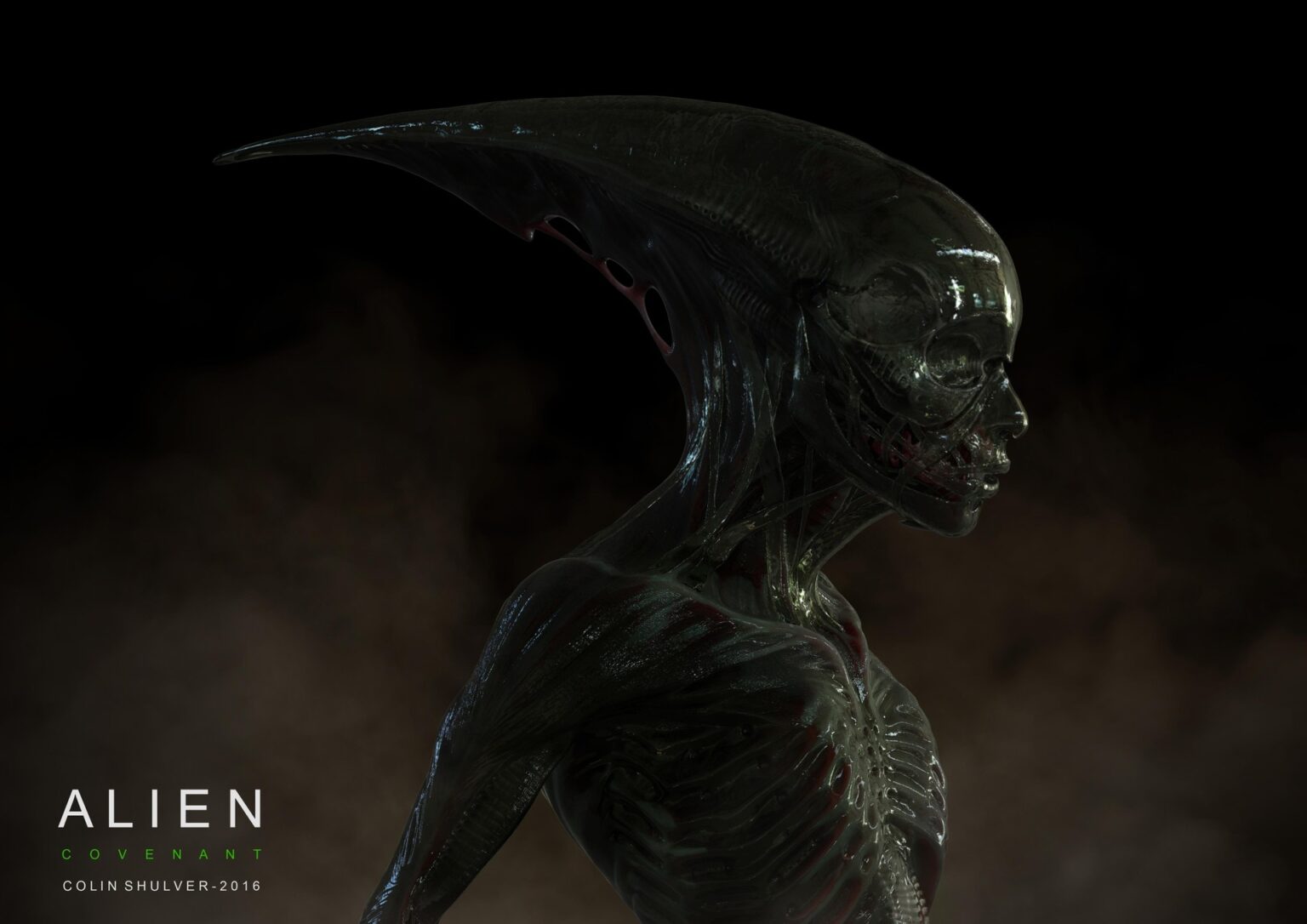
Colin Shulver is a highly experienced concept artist and creature sculptor who worked extensively on Ridley Scott’s 2017 prequel, Alien: Covenant. In this interview, Colin talks about how a scheduling conflict almost caused him to miss out on the opportunity to work on the film, and takes us through his fascinating creative pipeline using ZBrush and 3D printing. He also reveals the backstory behind his early, Sil-like Neomorph concepts, the creative process of deconstructing the classic Alien to give it a much more biological and anatomical look, his work on the ‘Meet Walter’ viral campaign, and much more!
We interviewed Colin for Episode #54 of the AvPGalaxy Podcast. You can listen to the interview via the audio player below, and read on for a full text transcription. Please note that the accompanying transcript has been edited for clarity and brevity.
https://www.avpgalaxy.net/files/podcasts/avpg_pc_episode54.mp3
Early Career, Prometheus, and Designing the Neomorph
Aaron Percival: I’m joined by another of Alien: Covenant‘s concept artists, Colin Shulver. Thank you for joining us today.
Colin Shulver: Thank you. Hi, Aaron, and hi everyone. Nice to be here.
Aaron Percival: I was hoping you could provide a little bit of background about yourself for our listeners. Who are you, what do you do, and how did you become involved with the film industry?
Colin Shulver: My background is as a sculptor in creature effects. I’ve been doing this now for about 28 years. I’m based in the UK. I moved more into concept art, but I still do a bit of creature sculpting as well. Alien is a big part of my history and childhood. It’s one of those films that I loved as a kid, as we all did. So it’s great to be a part of that legacy now.
Aaron Percival: Do you remember the first time you encountered the Alien?
Colin Shulver: The first film I saw was actually Aliens, and I was too young, of course! I was probably about 15 or 16 at the time. Then I saw Alien on VHS video, before the days of DVD and Blu-ray. It made a big impression on me. I grew up on Ray Harryhausen movies and monster films. I wanted to do stop-motion initially when I was in college, and then I started getting into sculpting creature masks and that sort of thing. Alien had a massive impact on me.
Aaron Percival: Which do you think would be your favourite of the films?
Colin Shulver: Alien. The first one has to be the best. It’s the most atmospheric. It’s slower-paced, of course, but it has such drama and mystery, and phenomenal design. Aliens is a great film and a great piece of entertainment, but in a lot of ways, I felt it diminished the creatures. It expanded it—the Queen Alien is amazing, it’s great cinema—but I loved the mystery of Alien. The space jockey, the juggernaut, and the creature itself were a shock. The atmosphere of that film is brilliant; it’s such a mood piece. Aliens became an action film, and the creatures just became monsters. It was a bit of a shame in a lot of ways, but I still love that film. It’s phenomenal.

Prometheus US Poster
Aaron Percival: The idea of mystery leads us to this next question quite nicely. Despite going in an Alien direction, Alien: Covenant was Prometheus 2. It was a sequel to that one. What did you think of Prometheus?
Colin Shulver: I worked on Prometheus for Conor O’Sullivan, who was the prosthetics designer on the film. I’m freelance, so I jump on and off projects with him. My experience working on that was initially doing the Engineers.
It’s a weird one to look at from a creature and film point of view. Working with Ridley Scott, coming back to the Alien franchise was fantastic. But I remember reading the script and feeling a little disappointed because I felt it was demystifying some of that lovely mystery of the original Alien film. I felt a little bit bad participating in destroying a bit of that mystery.
The Engineers are a little controversial. Some people love them, some people hate them. But from an experience point of view, I enjoyed working on it. Now that we’ve worked on Alien: Covenant, I actually feel that Prometheus feels a bit better because it’s becoming a part of a bigger picture. It’s a bigger world that Ridley is trying to create. It’s not just a standalone film; it’s setting up the whole world of the aliens.
I kind of like Prometheus. Some people will probably lynch me for that, but there are some problems with it.
Aaron Percival: I think people tend to think that Prometheus was hated a bit more than it actually was. The critical response was generally favourable, and if you look at the aggregators, it tends to have a higher rating from viewers and fans than you’d necessarily think. I think you’re safe. I don’t think you’re going to get lynched for that!
Personally, I just find it frustrating from all the open ends and the bits where you can see how it was an Alien film, but then they’ve tried to scrape it away. There are still elements left hanging over, like the Hammerpede that looks like a facehugger and a chestburster together, and the Trilobite that functions like a facehugger and a chestburster together without any real coherency. It’s like Alien, but it’s not like Alien, and it seems messy.
Colin Shulver: I guess Ridley is trying to set up how the alien world and the xenomorphs came into existence. There was a little bit of confusion; people weren’t quite aware that’s what he was doing initially. Now it’s become clear that’s what he was doing with Alien: Covenant.
Everyone was expecting to see the xenomorph turn up, and we got this little end piece, which really wasn’t what we were wanting. We wanted the big monsters running around corridors. Hopefully, now that Alien: Covenant is changing that view, the next Alien movie will really take us into the world of biomechanics and the true world of the alien.
Aaron Percival: Your work has actually been featured in some of the books, predominantly The Art and Making of Alien: Covenant, and I think it was also in the official collector’s edition mini-book that Titan put out as well.
Colin Shulver: Yes, we got the cover on that as well. They did about three different covers on that one. The UK version has the art piece, but there’s also a beautiful poster as well.
Aaron Percival: Despite your work being out there and being used for marketing, you yourself have kept very much below the radar regarding your involvement with the film. I was hoping you could tell us a little bit about how you ended up working on Alien: Covenant. Am I assuming it was through your prior association with Conor and Creatures Inc.?
Colin Shulver: Yes, exactly that. I’ve worked with Conor now for a while, and he’s a great employer. He’s very artistic, very creative, and loves developing all these ideas. It’s fantastic working for him, especially in the Alien world.
When the film came up, there was talk of Australia, and my initial response was to turn it down. Not because I didn’t want to do it, but we have a young son, and I didn’t want to be apart from them. Going to the other side of the planet didn’t seem to be an option for us. Fortunately, we talked to the schools, were able to take our son out of school, and we flew out to Australia and spent about five months over there.
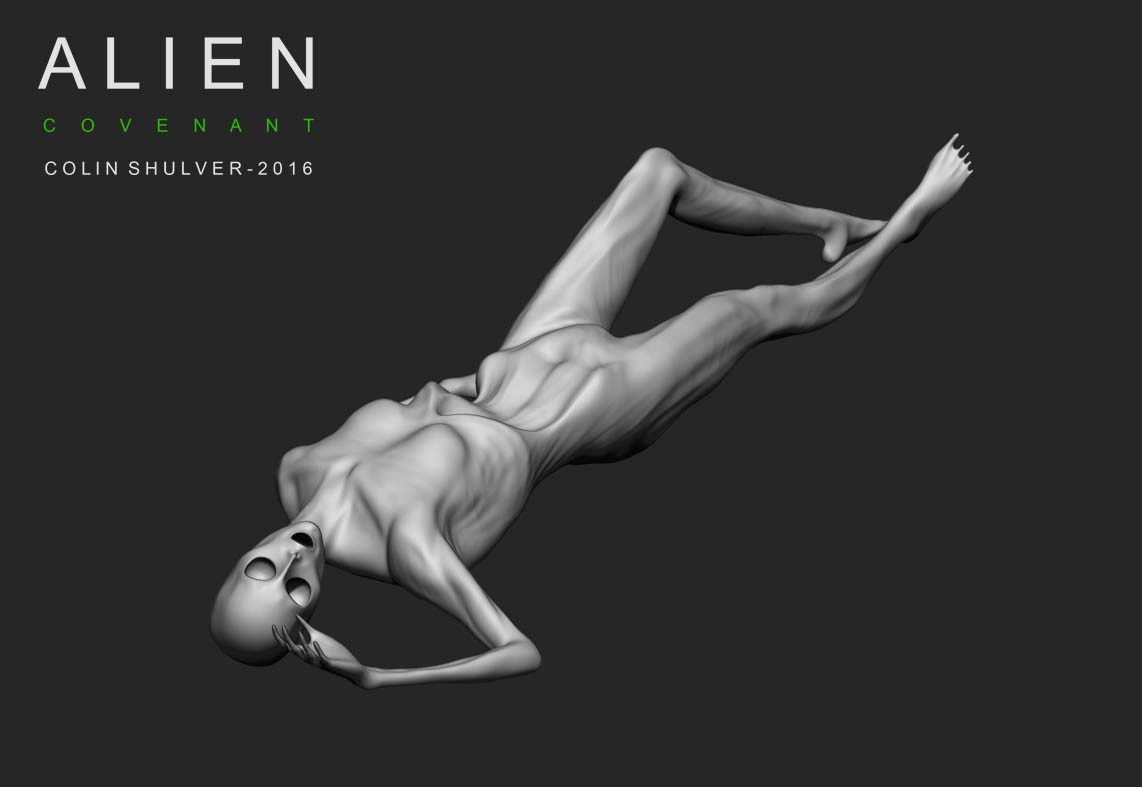
Dead Engineers
I started on the film initially in England, doing concepting work and some 3D modelling for printing the dead Engineers. Then we continued working on it out in Australia with the guys at Odd Studio.
Aaron Percival: I was hoping you could explain a little bit about the technicalities of your particular style of artwork. Am I right in thinking that the stuff you’ve been sharing is 3D modelling and 3D sculpting?
Colin Shulver: Yes, I use a piece of software called ZBrush, which is used a lot in the industry now. It’s a fantastic programme designed for practical, real-world sculptors like myself. They tried to design a piece of software where you don’t have to be a technical whiz to use it. It’s very user-friendly, and you can get into it very quickly.
It’s a great tool because not only is it a design tool, but you can also use it for 3D printing. We can create something, use scans from other work, rework them, and print them out into the real world. For the alien itself, we had a concept sculpt produced by Bradley Sims. That was scanned and given to me as a digital model. I back-engineered that to create the inner skull and the dome, creating all the teeth and parts, and then that was 3D printed.
After we got the print, it was moulded and used for sculpting the rest of the creature. Bradley then went back to working on the head for the full-scale alien, creating the skin for that. You can flip things, mirror things, and really clean things up. For example, there are bones that run down the side of the alien’s head, and they’re actually bone models from scans, which I incorporated and fused into it.
Aaron Percival: Sounds quite powerful.
Colin Shulver: It is, and it’s pretty much used throughout the industry now. I use it all the time. I’m moving more into the digital side rather than real-world sculpting. I do a bit of both, but it’s becoming more and more of a tool. Also, some of the models can go off to the CG departments. With Alien: Covenant, we had the Protomorph and the Neomorph models go off to the CG departments. I don’t know how much of it was used for animatics or reference, but they wanted the models as a starting point.
Aaron Percival: Which do you actually prefer then? Do you like getting your hands dirty, or is it just easier going digital?
Colin Shulver: I’m becoming more and more into the digital world. I still love sculpting in the real world, but with digital, you get a lot more freedom. There are some problems with it; sometimes things in the CG world look a bit plasticky or fake, and it’s a real challenge trying to make that look real.
But the lovely thing about it is that there are no limits to scale. For something very small, you can go in and do really fine detail, which would be difficult practically. Like with an embryo, trying to put that level of detail into a real-world sculpt is really tricky. Digitally, you can sculpt an insect at actual size.
Aaron Percival: In preparation for working on Alien: Covenant, did you do any particular prep? Did you revisit the older films or look at the old art books, like Giger’s Necronomicon or The Book of Alien?
Colin Shulver: I definitely looked at Giger’s original Alien, but I have to admit I tried to avoid looking at the other films. We weren’t going to go in those directions. It was clear early on that they wanted something different. It still had to look familiar, though.
Giger was referenced a lot. There was a particular piece we were asked to look at when designing that Conor said Ridley was very keen on, which wasn’t the classic alien. It was one of Giger’s designs that had these stretched, insect-like eyes on the side. We referenced that and incorporated it into the skull underneath the dome.
Aaron Percival: Is it Necronom IV? The one with the coiled tail?
Colin Shulver: Possibly. Fans are going to be like, “What? Don’t you know this stuff? You should know it!” Hang on… yes! I see it. Yes, that is the one. That’s Necronom IV.
So that was something Ridley was told to reference, and he particularly liked that design. There was also a piece of classical sculpture that Conor said Ridley liked, which was a flayed body in very black stone. We referenced that to keep it very different. The biomechanical look was something Ridley didn’t want.

Necronomicon IV – H.R. Giger
I get the feeling that’s obviously going to come into the story later on, as David is progressing his alien design. What we were working on is the Protomorph, not the Xenomorph. The Xenomorph doesn’t exist yet in this storyline. Hopefully, at some point, that will come in, which would be great.
I was slightly disappointed not to be doing that. I was hoping to bring in all the coils and strange, mechanical-looking elements. When I started working on some of the early concepts for what we were calling the Deacon at the time—which became the Neomorph—I was incorporating slight elements of biomechanics, but was told very quickly to remove them.
Aaron Percival: That actually leads us quite nicely onto the next question. There are a couple of your early Neomorph concepts that I really like. It’s the one where it looks like a melding of the Deacon, the Alien, and Sil from Species. Could you tell us a little bit about the story behind those earlier concepts? Did the earlier drafts of the film include Deacons rather than what would eventually become the Neomorph?
Colin Shulver: When I was working on those designs, I hadn’t seen the script. They were done on spec. Conor mentioned that Noomi Rapace was not returning in this story, and her character had died. I think the idea at the time was that she had been experimented on by David.
So I took it upon myself to incorporate that human face look of Noomi. I thought we’d try and incorporate an element of her into the design just as a bit of fun, to see how it would look. It got rejected very quickly! Probably taken a bit too literally. And obviously, they didn’t want it to look like Species. Even though that’s a fantastic film and I love that look, that isn’t Alien.
I was given quite a loose brief to start with, just to come up with different looks and ideas, and then we’d hone it in. The pale, wrinkly skin came back in. For the Neomorphs, we weren’t sure at the time whether it was going to be a dome or something different, so we were given quite free rein at the start to play around.

Xenomorph Concept – Colin Shulver
Aaron Percival: The Neomorphs are Alien: Covenant‘s really big inclusion into the lore, and they seem to share a bit of an ancestry with Carlos Huante’s designs from Prometheus. Could you tell us a little bit about the evolution of the Neomorph’s design? Were Huante’s designs deliberately referenced, and what was your direction for proceeding with the creatures? What did you need to achieve with that design?
Colin Shulver: Very much so. Carlos’s stuff is beautiful, and Ridley clearly liked it. For the young newborn Neomorphs, Carlos’s designs were used directly. I didn’t do any concept work for those. For the adult, yes, we kept referring back to that.
We took off in different angles to start with, but Ridley really loved that design, so we didn’t want to drift too far away from it. We made some minor changes; the teeth changed, which was something Ridley wanted. But it was very much Carlos’s beautiful design, and all credit to him, really. At the same time I was doing the ZBrush concepting, Adam Johansen was concepting the head as a sculpt, so we were referencing each other’s work.
Aaron Percival: That’s Adam Johansen from Odd Studio?
Colin Shulver: Yes. We worked in a big workshop together. It was Creatures Inc. and Odd Studio together. Conor was the overall creature supervisor, always driving the direction of everything. But the Neomorph is very much Carlos’s world.