

As of May 2026, NASA’s Transiting Exoplanet Survey Satellite (TESS) has released its most comprehensive, completed mosaic of the night sky, highlighting thousands of newly identified exoplanet candidates and confirming hundreds more.
by Grahamthicke
As of May 2026, NASA’s Transiting Exoplanet Survey Satellite (TESS) has released its most comprehensive, completed mosaic of the night sky, highlighting thousands of newly identified exoplanet candidates and confirming hundreds more.
by Grahamthicke
1 Comment
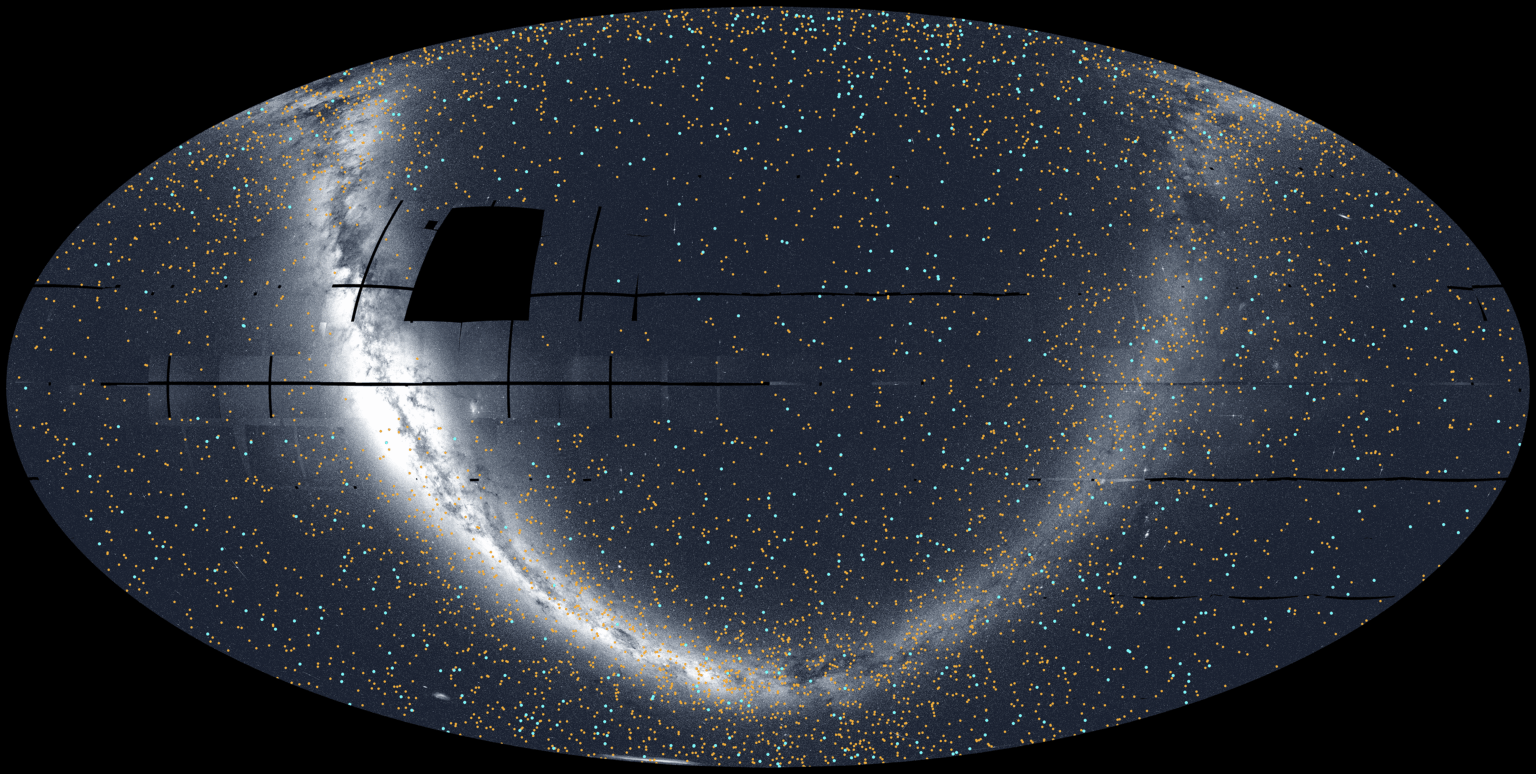
This view of the whole sky was constructed from 96 TESS sectors. By the end of September 2025, when the last image of this mosaic was captured, TESS had discovered 679 exoplanets (blue dots) and 5,165 candidates (orange dots). The glowing arc running through the center is the plane of the Milky Way. The Large Magellanic Cloud can be seen along the bottom edge just left of center. Black areas within the oval indicate regions TESS has not yet imaged.
The blue dots in the image mark the locations of nearly 700 confirmed planets, as of September 9. This menagerie includes worlds that may be [covered by volcanoes](https://www.nasa.gov/centers-and-facilities/goddard/nasas-spitzer-tess-find-potentially-volcano-covered-earth-size-world/), are being [destroyed by their stars](https://science.nasa.gov/missions/tess/caught-in-the-act-astronomers-detect-a-star-devouring-a-planet/), or [orbit two stars](https://science.nasa.gov/missions/tess/for-nasas-tess-stellar-eclipses-shed-light-on-possible-new-worlds/) — experiencing double sunrises and sunsets each day. The orange dots represent more than 5,000 candidate planets that are awaiting verification.
To date, scientists have [confirmed](https://exoplanetarchive.ipac.caltech.edu/) over 6,270 [exoplanets](https://science.nasa.gov/exoplanets/) using missions like TESS, NASA’s retired [Kepler Space Telescope](https://science.nasa.gov/mission/kepler/), and other facilities.
Also captured in the mosaic is the bright plane of our Milky Way galaxy, seen as a glowing arc through the center. The bright white ovals in the lower left are the Large and Small Magellanic Clouds. These satellite galaxies are located 160,000 and 200,000 light-years away, respectively.