
ⓘ NASA – Unsplash
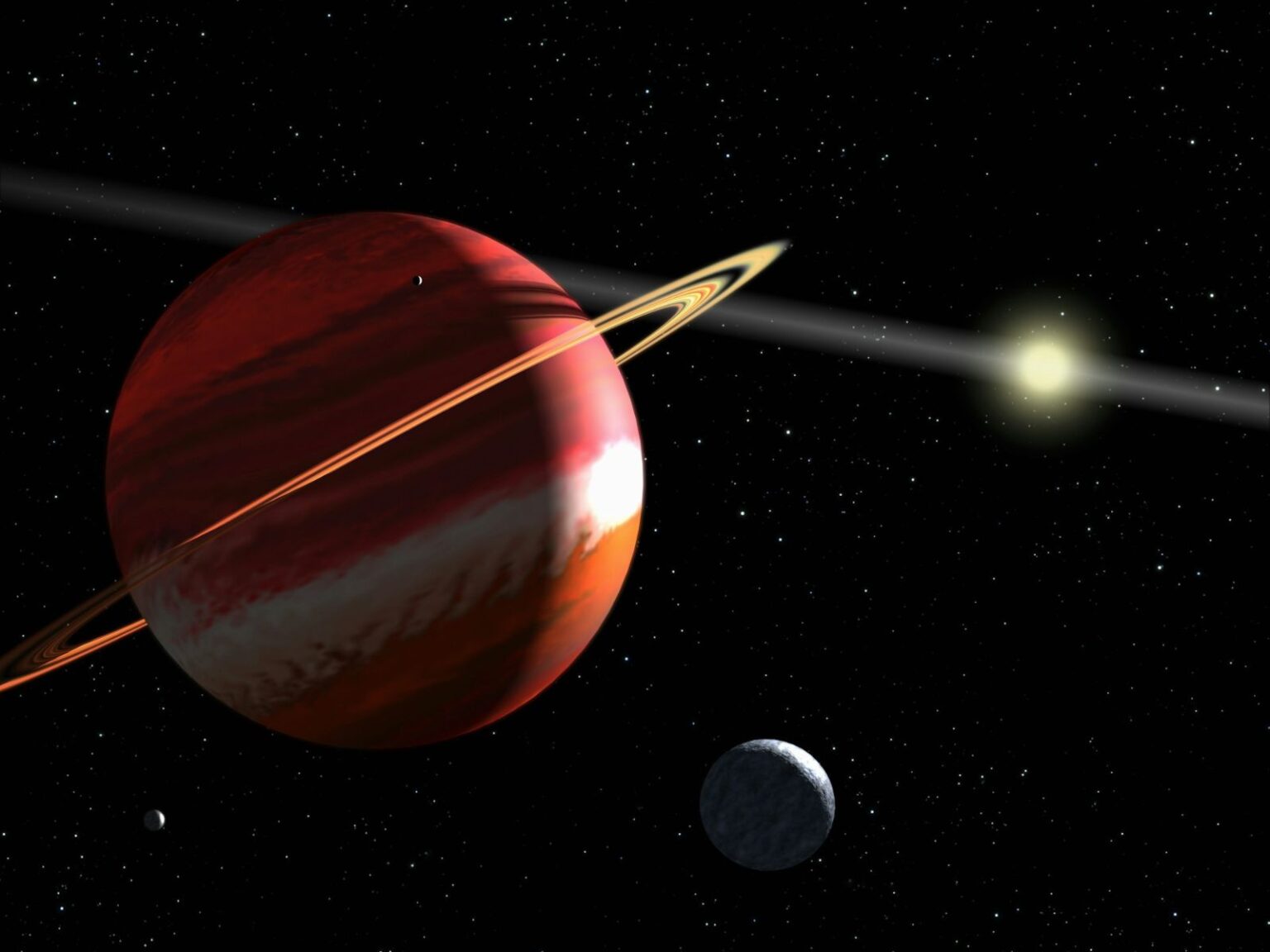
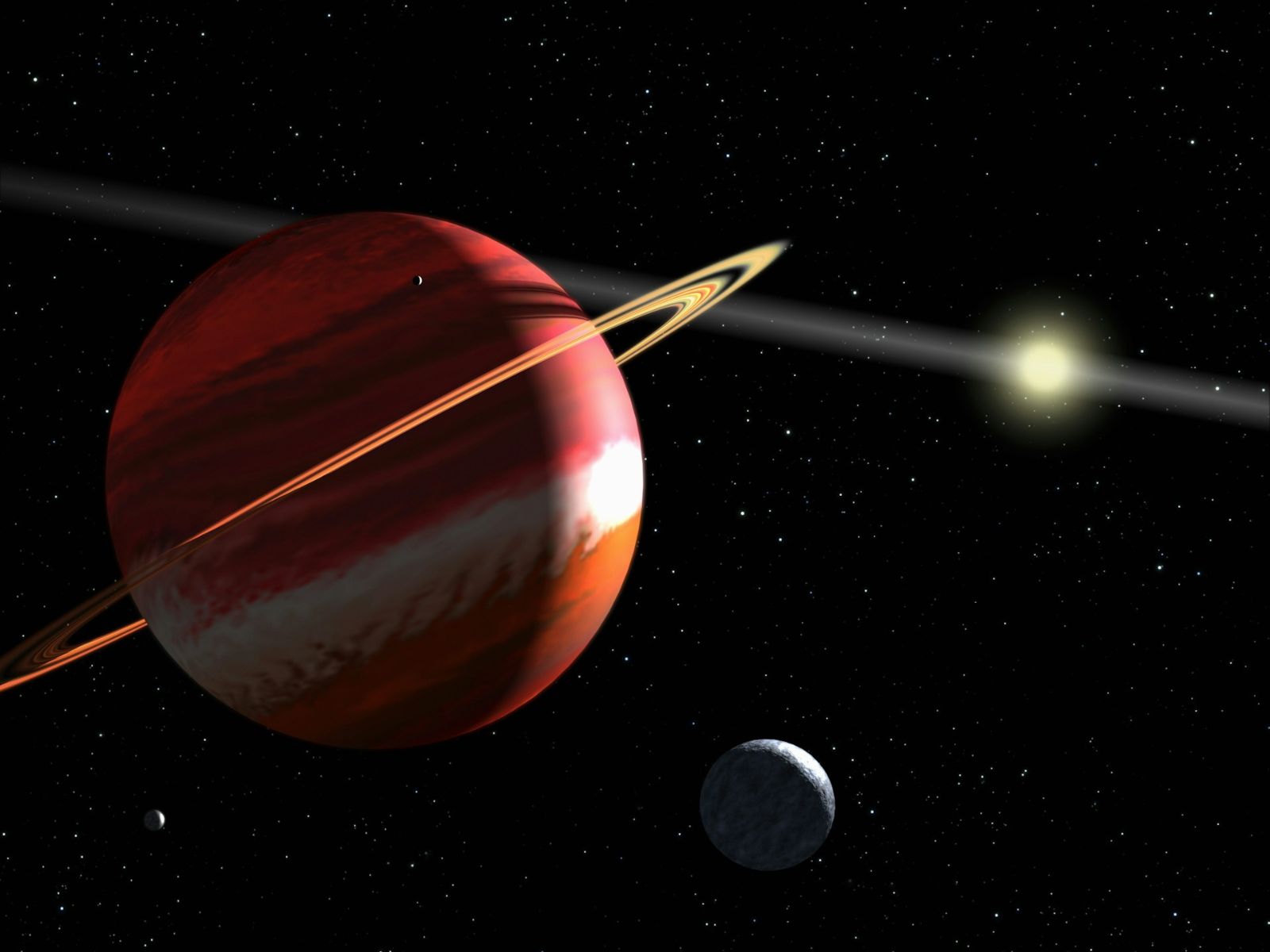
An illustration showing a planet, a moon, and a star.
The TESS satellite has recently unveiled a map of the sky showing about 6,000 exoplanets. And this could help astronomers determine whether life exists elsewhere in the universe, although further studies will be needed.
If life exists on Earth, no one knows if it exists elsewhere in the universe. To answer this question, several missions have been launched over the years, such as NASA’s TESS satellite, which has recently unveiled an image showing nearly 6,000 exoplanets.
This satellite has powerful instruments, and to detect these new worlds, it observes large regions of space for about a month, allowing astronomers to detect changes in the brightness of various stars.
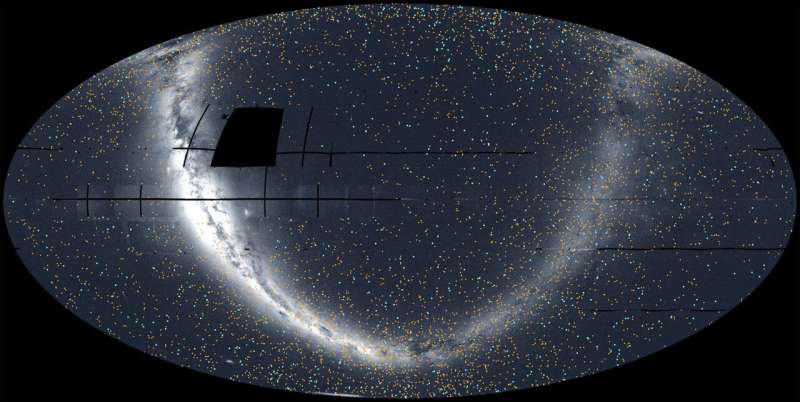
As a result, astronomers combined 96 observations made by this satellite between April 2018 and September 2025, allowing them to discover nearly 6,000 new worlds. Thus, in this image, the blue dots represent approximately 700 confirmed exoplanets. Each of these worlds is unique, and some even orbit two stars. As for the orange dots, they represent more than 5,000 potential exoplanets. In addition, the Milky Way is also visible at the center of this image.
ⓘ NASA
The TESS image showing the universe and exoplanets.
Therefore, the work of TESS is very important, as Rebekah Hounsell, a TESS associate project scientist at the University of Maryland Baltimore County, explains:
“Over the last eight years, TESS has become a fire hose of exoplanet science. It’s helped us find planets of all different sizes, from tiny Mercury-like ones to those larger than Jupiter. Some of them are even in the habitable zone, where liquid water might be possible on the surface, an important factor in our search for life beyond Earth.”
Thus, the discovery of these new worlds could shed light on an important mystery. However, further studies will be needed to find answers.
Image source: NASA Hubble Space Telescope / Unsplash – NASA/MIT/TESS and Veselin Kostov (University of Maryland College Park)
 Alexis Stegmann – Tech Writer – 623 articles published on Notebookcheck since 2025
I’ve been working in the field of web writing for several years, and I’m passionate about keeping readers up to date with the latest news on astronomy, technology, the world of video games and other exciting subjects. In particular, I’ve had the opportunity to work on a number of websites, which has enabled me to cover a wide range of subjects. In my personal life, I’m passionate about a wide range of subjects, including astronomy, video games, history and science. I’m also drawn to psychology, which is a subject that deserves greater documentation and recognition.