
Update: March 4, 2026 – This article, originally written in 2016, has been updated to reflect the latest values for NASA’s Voyager 1 spacecraft, which continues to venture farther into interstellar space. The author, Marc Rayman, has ventured on, too. He retired in March 2026 after a rewarding 39.4 (he gave only one decimal point) years at JPL.
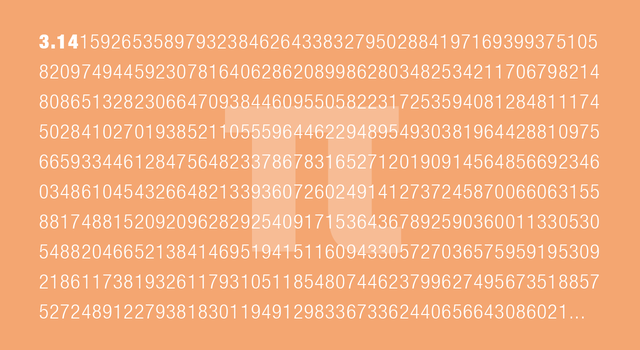
This graphic shows more than 500 of the infinite number of decimals in pi.
Credit: NASA/JPL-Caltech
We received this question from a fan on Facebook who wondered how many decimals of the never-ending mathematical constant pi (π) NASA-JPL scientists and engineers use when making calculations:
“Does JPL only use 3.14 for its pi calculations? Or do you use more decimals, like say [360 or even more]?”
Here’s JPL’s former Chief Engineer for Mission Operations and Science, Marc Rayman, with the answer:
Thank you for your question! This isn’t the first time I’ve heard a question like this. In fact, it was posed many years ago by a sixth-grade science and space enthusiast who was later fortunate enough to earn a doctorate in physics and become involved in space exploration. His name was Marc Rayman.
To start, let me answer your question directly. For JPL’s highest accuracy calculations, which are for interplanetary navigation, we use 3.141592653589793. Let’s look at this a little more closely to understand why we don’t use more decimal places. I think we can even see that there are no physically realistic calculations scientists ever perform for which it is necessary to include nearly as many decimal points as you asked about. Consider these examples:
The most distant spacecraft from Earth is Voyager 1. As of this writing, it’s about 16 billion miles (26 billion kilometers) away. Let’s be generous and make that 20 billion miles (32 billion kilometers), a distance the venerable explorer will not reach until the late 2030s. Now say we have a circle with a radius of exactly that size, or 40 billion miles (64 billion kilometers) in diameter, and we want to calculate the circumference, which is pi times the diameter. Using pi rounded to the 15th decimal, as I gave above, that comes out to a little more than 125 billion miles (about 200 billion kilometers). We don’t need to be concerned here with exactly what the value is (you can multiply it out if you like) but rather what the error in the value is by not using more digits of pi. In other words, by rounding pi off to the 15th decimal point, we would calculate a circumference for that circle that is very slightly off. It turns out that our calculated circumference of the 40-billion-mile (64-billion-kilometer) diameter circle would be wrong by little more than half an inch (about 1.5 centimeters). Think about that. We have a circle more than 125 billion miles (about 200 billion kilometers) around, and our calculation of that distance would be off only by about the width of your little finger.