

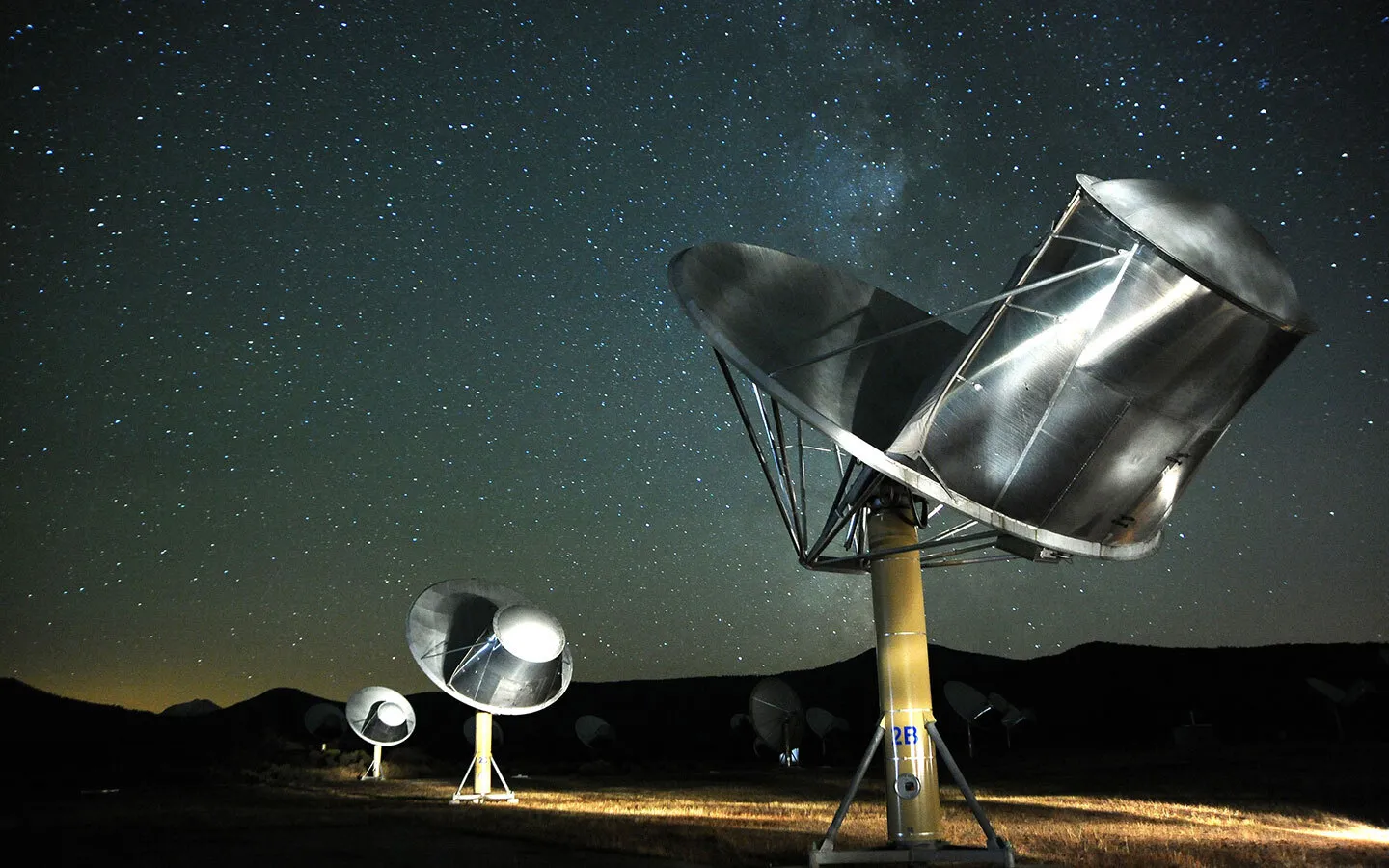
The Allen Telescope Array is designed to listen for signals sent or generated by extraterrestrial life. It has been used in SETI searches since 2007. Credit: Seth Shostak/SETI Institute (CC BY 3.0)
Humanity has spent eons looking up at the stars and wondering whether we’re alone, or if there are others like us out there in the vast unknown. Our curiosity has only increased as we have become a technological civilization capable of scanning the heavens for potential signs or signals from other civilizations, called technosignatures. But despite our advancements and intensive searches, we have yet to receive a definitive signal from intelligent life beyond Earth.
Why is that? What does the silence tell us? And what would it mean if we stopped listening?
 This section of the Great Observatories Origins Deep Survey, imaged by the Hubble Space Telescope and capturing thousands of galaxies, shows just how vast the universe is — suggesting some of the many challenges in reaching out to others. Credit: NASA, ESA, the GOODS Team, and M. Giavalisco (University of Massachusetts, Amherst)
The Great Silence
We have been listening for aliens since the late 19th century, when inventor Nikola Tesla attempted to pick up artificial radio signals from Mars. Since 1984, the SETI Institute has scanned for signs of intelligence beyond Earth. But, despite hundreds of millions of dollars in funding for decades of searching and data analysis, their efforts have been met with silence.
“SETI has had a tumultuous past as a science,” admits Chenoa Tremblay, SETI Institute project scientist for the Commensal Open-Source Multimode Interferometer Cluster (COSMIC). From the 1970s to the 1990s, she says, some of the search was federally funded in the U.S. with requests put in through NASA and the Jet Propulsion Laboratory, but these programs had “a narrow perspective” and remained disparate and uncoordinated. “Since [federal] funding [for the SETI programs] ceased in the 1990s, it has been an endeavor taken on by only a few dedicated individuals and has been under much scrutiny.”
Scientists currently estimate that life began on Earth between 4.1 billion and 4.3 billion years ago. And the Milky Way Galaxy is currently believed to contain hundreds of billions to trillions of planets. Of the more than 6,000 confirmed exoplanets, approximately 200 are Earth-sized. These numbers alone could mean the Milky Way is teeming with life, and even intelligent life.
But the ongoing search for that life has its fair share of skeptics. Many cite the Fermi Paradox, which arose from a 1950 discussion in which physicist Enrico Fermi asked, “Where is everybody?” — meaning that given the age of the Milky Way, aliens should have already visited Earth. And yet they hadn’t.
Over the ensuing decades, the Fermi Paradox — sometimes called the Great Silence — has become central to the debate surrounding SETI. Today the Fermi Paradox encompasses not just the lack of alien visitation, but the general contrast between the likelihood we are not alone and the lack of contact thus far with other civilizations.
Solving Fermi’s Paradox
If we assume that enduring alien civilizations are plentiful in the galaxy, we are left with three general explanations for why they haven’t visited us.
First, perhaps interstellar travel is indeed too steep a challenge to overcome. Even if many of the challenges associated with covering the vast distances between stars can be solved with advanced engineering, biological challenges such as lifespan versus travel times arise.
Second, with the great travel times required between stars or across the galaxy, perhaps interstellar travel is possible but other civilizations that have undertaken it have simply not yet reached us.
And third, it is possible that alien civilizations may be capable of visiting us but have not made the effort. This could be because their society is too disorganized to make a concentrated effort; because it is politically unpopular or the fiscal investment required is undesirable; or even for ethical or other societal reasons, such as a desire not to interfere with other species.

The so-called Fermi Paradox arises from a 1950 lunchtime query posed by physicist Enrico Fermi, pictured here circa that same year. The Fermi Paradox remains a much-debated aspect of the search for extraterrestrial intelligence. Credit: Atomic Energy Commission. Argonne National Laboratory. Office of Public Affairs.
Current SETI searches: just scratching the surface
Many proponents of SETI say the lack of alien signals can hardly be taken as evidence that no alien civilizations exist.
“There is no Great Silence,” says SETI Institute technosignature research scientist Sofia Sheikh. “If you imagine the amount of space to search as the size of all of Earth’s oceans, we have currently searched the equivalent of a small swimming pool’s worth of water.”
That was the conclusion of a 2018 study led by Penn State University astronomer Jason Wright that considered several factors, including the volume of sky that has been searched, the frequencies and bandwidths that have been scanned, and how frequently we’ve looked at a given target.
“We have not seen anything yet, but we have also barely scratched the surface of the search,” says Sheikh, a former student of Wright’s.
“The search so far has only looked through a straw in a few different ways and only a few times,” says Tremblay. “We have not searched enough and in enough ways to even cover the parameter space of what we know a signal could look like if we generated it, let alone thinking far beyond our own understanding of what a signal could look like.”
“Really, the effort for the search has kicked off over the last 10 years, with huge strides in progress,” says Tremblay. “With the development of faster computers and willing collaborations with telescope facilities, we have only just begun a real search.”
Related: The search for aliens levels up.
Recognizing an alien signal
Yet even if we succeed in scanning the entire sky and possible parameter space, it might not be simple to recognize an alien signal with our current technology. What if the nearest civilization is using laser communications or quantum teleportation? What technology would a civilization even 50 years ahead of us be using? What about a civilization 1,000 years beyond us?
“There is enormous difficulty in attempting to diagnose and predict the culture and communication for an advanced alien civilization,” says Stephen Kane, a professor of planetary astrophysics at the University of California, Riverside. “A common issue is that people frequently imagine that technology has peaked, and so conceptualize advanced technology within that same framework, meaning similar technology but on a much larger scale.” But, he points out, “were you using GPS from a cellphone 20 years ago? What technology do you imagine that you will hold in your hand 20 years from now?”
Kane continues: “In many ways, our current civilization is very much an alien entity to our own species of 100 years ago. Would humans of the 1920s have predicted our current culture and communication? How, then, do we anticipate the methods and motivations for a completely different species that is many thousands of years more advanced than us? It is a difficult problem to solve, but ideas on how to solve it will track our own technological progress, and with it our imagination.”

We have discovered more than 6,000 planets in the Milky Way so far, some of which are depicted here in an artist’s rendition. However, there are potentially hundreds of billions or more planets in our galaxy, leading to significant conclusions about how worlds — and life — evolve if we find no other civilizations like our own. Credit: NASA/W. Stenzel
What being alone in the universe means
But say that in the coming decades or centuries, despite our progress, still we find nothing. What would that silence teach us about the evolution of life throughout the galaxy?
If in fact alien civilizations are rare, there are two common scenarios postulated, says Tremblay. “One is that we are the oldest civilization. Life exists, but in a primitive form. Dinosaurs may have been great at survival, but they didn’t build radio communication devices. Maybe there are other worlds out there with dinosaurs. The other is that we are the youngest. In this scenario, we are the last surviving civilization. If this is the case, we would expect to be able to find some form of leftover technology, but we may not know what we are looking for.”
In the latter case, civilizations may not be rare, but short-lived. Numerous studies have attempted to explore the Great Filter, a longstanding hypothesis for why the number of technological civilizations might be limited throughout the universe. Originated by economist Robin Hanson of George Mason University, the Great Filter breaks down the process of any given life-form developing into a spacefaring civilization into nine separate steps. These range from requiring the right type of planet and star system to support life to developing cellular biology, to achieving sentience and ultimately reaching the technological capability to colonize the galaxy. The hypothesis then proposes there must be a “barrier” that life cannot (or can only very rarely) overcome to reach the last stage and initiate travel across the galaxy. Perhaps it is extremely difficult to for life to develop, or for that life to become intelligent — or it is possible to reach humanity’s current level but impossible to take the next step to interstellar travel.
Put simply, either life is rare or civilizations self-destruct before reaching a crucial stage of detection. A June 2024 study published in Acta Astronautica by Michael Garrett, director of the Jodrell Bank Centre for Astrophysics in the U.K., posits that the development of artificial intelligence (AI) is the Great Filter. He suggests that AI limits the longevity of technological civilizations to less than 200 years, ending them before they can achieve interstellar communications or travel: Either weaponization of AI leads to self-destruction, or AI eventually becomes “superintelligent” and its goals no longer align with its creators’, so it eliminates them.
Should we reach out?
Rather than waiting for a signal to come to us, the field of active SETI, sometimes called messaging to ET intelligence or METI, does exactly that, sending messages of our own out into the stars in the hopes that another civilization might see them. The famous Arecibo message, a radio signal sent from the Arecibo telescope toward the globular cluster M13 in 1974, is one example. However, these efforts have not come without criticism.
SETI Institute emeritus board member John Gertz sums up much of this criticism in a 2016 study, writing that current METI attempts are “unwise, unscientific, potentially catastrophic, and unethical.” Because we know nothing about other civilizations, he writes, we have no scientifically sound basis for assuming aliens are altruistic versus malicious. “SETI experiments seek to learn what actually resides or lurks out there in the universe. METI plays Russian roulette without even knowing how many bullets are in the chamber. It would be wiser to listen for at least decades if not centuries or longer before we initiate intentional interstellar transmissions, and allow all of mankind a voice in that decision,” Gertz concludes.
Jill Tarter, longtime SETI scientist and now Chair Emeritus for SETI Research at the SETI Institute, told Business Insider in a 2016 interview that she believes the more advanced a society becomes, the less warlike and more cooperative it becomes as well. So, she posits, advanced alien civilizations are not likely to pose a threat. However, Tarter added that she also thinks we are not yet ready to send signals of our own: “I think that when we grow up and are an advanced technology, and can take on very long-term projects, then we ought to begin transmitting,” she said in the interview. “But at the moment, in our very youthful state as an emerging technology, we should listen first.”
Do we keep searching for aliens?
One simple question that arises is whether we can justify continuing SETI operations if we haven’t found anything. And if we decide to give up, could it hurt or help us as a species? Will it divide or unite us?
“Giving up the search for life definitely hurts us as a species since, in many ways, it means discarding the hope and aspiration for our species,” says Kane. “It would result in the stagnation [of] our society, [which] has little to look forward to other than the next iteration of gaming console or streaming movie. The search for life is a uniting experience that constantly reminds us that our species can and should do amazing things that rise above the humdrum of day-to-day life.”
“The search is progressing much faster now than it ever has in the past due to improvements in telescope and computing technology,” says Sheikh. “I would say that by the end of my career (decades from now), we will be able to actually place meaningful upper limits on the prevalence of radio technology in the Milky Way. Until then, we just have to keep at it!”
“If we continue coming up empty, the public may grow skeptical or apathetic, but scientifically, the search remains valid and necessary,” says Wael Farah, lead communication systems engineer at Cascade Space and a former SETI chair and project scientist for the Allen Telescope Array in northern California, which searches for signs of extraterrestrial life. But, he says, SETI represents an ongoing and rigorously scientific inquiry about our universe: “It’s not simply a binary of ‘we found them’ or ‘we didn’t,’ but a process of placing increasingly strict upper limits on how common technologically advanced civilizations might be. Every nondetection tells us something … that narrows the possibilities and refines our models. But we should absolutely keep searching. Even in silence, we’re learning.”