
Researchers at the University of California Riverside have developed a new model suggesting that planets smaller than 0.8 Earth radii are unlikely to maintain the atmospheres necessary for life. The findings carry significant implications for how scientists prioritize targets in the ongoing search for habitable worlds beyond our solar system.
The study, published as a preprint on arXiv in late April 2026, introduces the Smaller Than Earth Habitability Model, or STEHM. It examines how planetary size affects two critical processes: atmospheric escape driven by stellar radiation, and the gradual loss of volcanic activity as a planet cools.
Two Mechanisms Drive the Size Threshold
The STEHM model identifies a clear boundary between 0.7 and 0.8 Earth radii, below which planets consistently fail to retain their atmospheres over geological timescales. According to the research team, two separate but reinforcing physical processes explain this cutoff.
The first is gravitational. As a planet decreases in size, its mass and surface gravity fall proportionally, lowering the escape velocity needed for atmospheric particles to leave the planet entirely. High-energy molecules undergo what is known as Jeans escape, a process in which particles at the upper tail of the thermal velocity distribution move fast enough to breach the exosphere. For smaller planets, a far greater proportion of molecules reach that threshold.
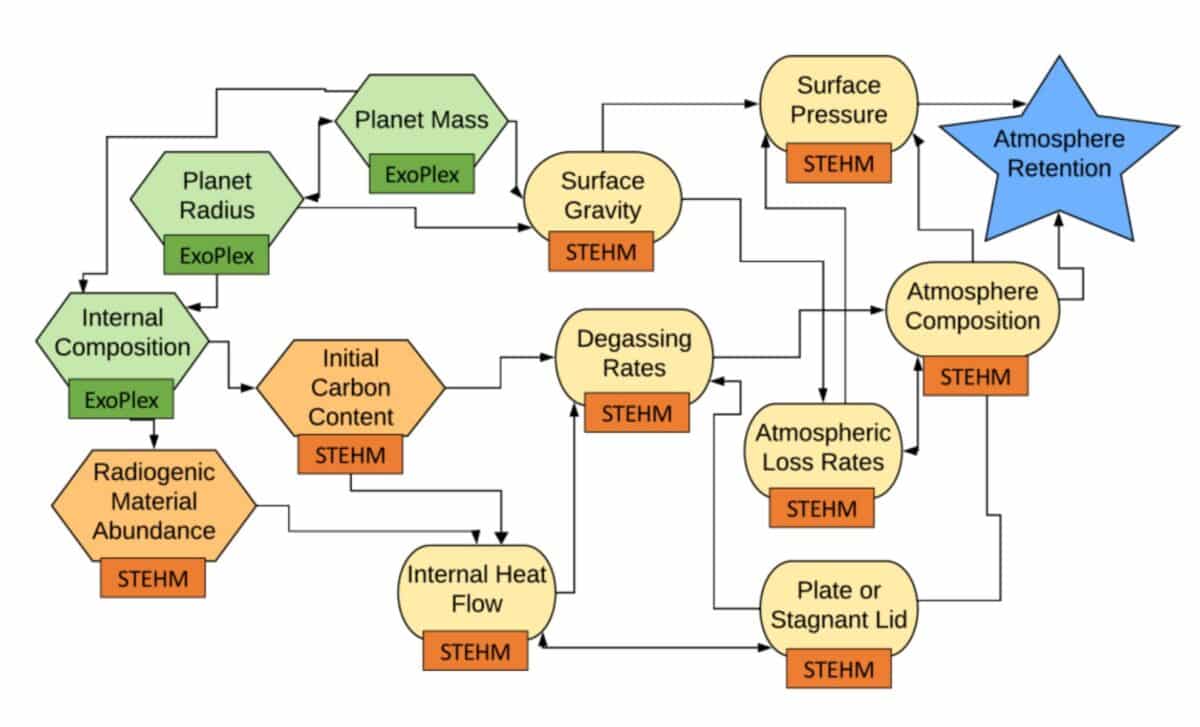
The second mechanism is less intuitive. Smaller planets have a higher ratio of surface area to volume, causing their interiors to cool more rapidly than larger bodies. As the interior temperature drops, the lithosphere (the planet’s rigid outer shell) thickens at an accelerated rate. A thicker lithosphere suppresses volcanic activity, which is one of the principal means by which planets replenish atmospheric gases through outgassing. Once volcanism ceases, there is no mechanism to compensate for ongoing atmospheric loss.
The researchers modeled planets as “stagnant lid” bodies (those with a single, unbroken crust rather than plate tectonics) and used a pure carbon dioxide atmosphere, which they describe as a best-case scenario for atmospheric retention given that CO2 is a relatively heavy molecule and provides radiative cooling that slows escape rates.
Under default Earth-like conditions, the model found that a 0.6 Earth-radius planet would lose its atmosphere within approximately 400 million years, while a planet of 0.5 Earth radii would be stripped bare in as little as 30 million years. Planets at or above 0.8 Earth radii retained atmospheres measured in tens of bars over multi-billion-year timescales.
Exceptions Exist, but Are Considered Rare
The model also identifies three planetary characteristics that can allow smaller bodies to hold onto their atmospheres despite falling below the general threshold. Planets with unusually large initial carbon inventories can sustain outgassing long enough to offset atmospheric loss.
Those with a very low core radius fraction, in an extreme case, no core at all, retain a larger mantle volume and thus a greater reserve of volatile compounds available for outgassing. A third exception involves what the researchers call a “cold start,” in which the mantle heats slowly enough that significant outgassing is delayed until the host star’s intense early radiation has already diminished.
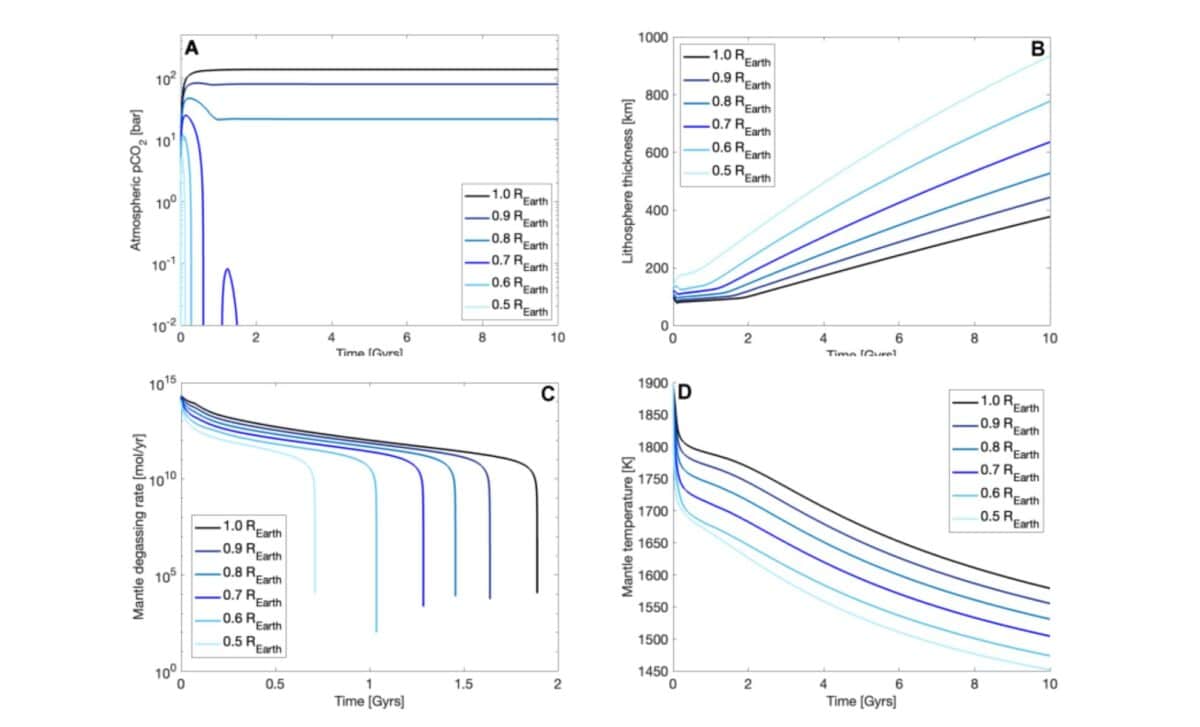 Atmospheric Retention vs. Planet Size: Default Model Results (1.0–0.5 R⊕) ©Arxiv
According to the paper, the initial carbon inventory emerged as the single most influential variable across all model runs. When the carbon budget was set an order of magnitude above Earth’s estimated value, nearly all tested planet sizes (including those as small as 0.6 Earth radii) were able to sustain atmospheres. However, conditions this extreme are not considered representative of typical planet formation.
The research team acknowledges several limitations. The model does not account for non-thermal atmospheric loss processes such as ion pickup or sputtering driven by stellar magnetic fields, nor does it incorporate the effects of coronal mass ejections. These omissions mean the results represent an optimistic estimate of atmospheric retention, real smaller planets may fare worse. Magnetic field effects were also excluded, as their role in atmospheric loss remains contested in the scientific literature.
The study contributes to a growing body of work refining the criteria for planetary habitability. Separate recent research published in Nature Astronomy has suggested that the chemical conditions during a planet’s core formation (specifically the balance of oxygen, phosphorus, and nitrogen) represent another independent constraint, indicating that Earth-like habitability may require a precise convergence of multiple factors rather than any single condition alone.
For astronomers planning observations with future missions such as ESA’s PLATO space telescope, the STEHM results offer a practical filtering criterion: rocky exoplanets below 0.8 Earth radii can, in most cases, be deprioritized as candidates for atmospheric characterization.