
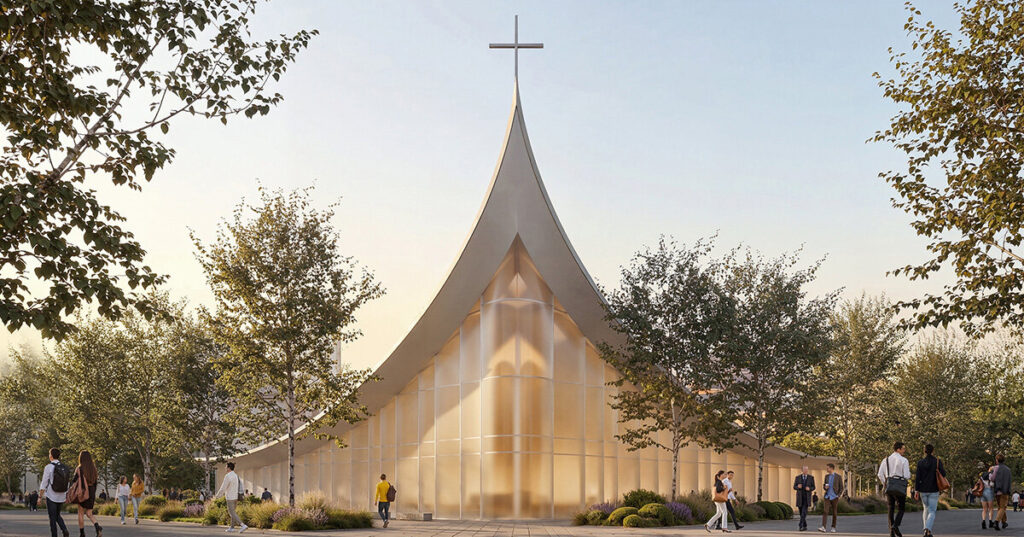
Stefano Boeri’s design for milan’s future knowledge district
At the center of Milan’s rapidly evolving MIND Milano Innovation District, Stefano Boeri Architetti proposes a different kind of civic infrastructure through the Ambrosian Monastery, conceived as a place where a single architectural landscape shields spiritual life, interfaith dialogue, and scientific thought.
Commissioned by the Archdiocese of Milan and presented at the historic Chiaravalle Abbey, the project establishes a symbolic bridge between the monastic traditions that once shaped the territory around Milan and the contemporary culture of research, innovation, and urban transformation, defining MIND today.
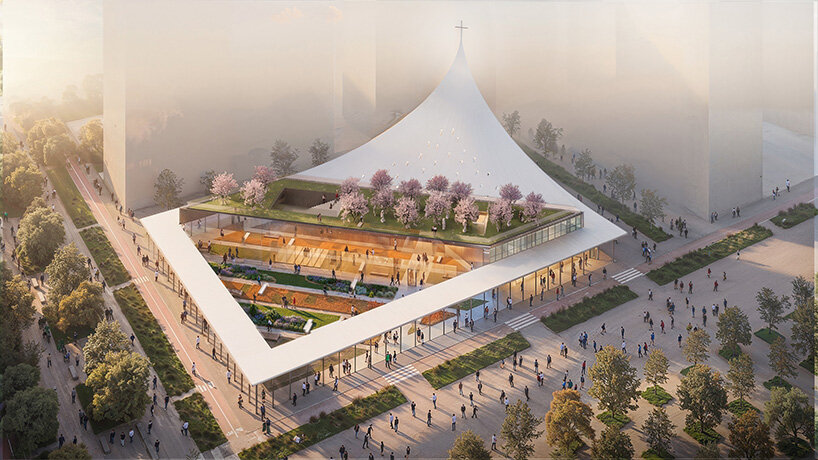
The monastery, located at the crossing of the district’s Cardo and Decumanus axes, is set to occupy a 2,700-square-meter site with an additional 1,100 square meters of open space. The architects’ team envisions the project as a permeable and collective environment for residents, students, researchers, and visitors expected to populate the district in the coming years. By 2030, MIND is projected to host around 70,000 people across its residential, academic, and scientific facilities.
all images courtesy of Stefano Boeri Architetti
rethinking the monastery as a civic space
The proposal reinterprets the archetype of the cloister through a contemporary lens. Stefano Boeri Architetti organizes the project around three core themes: care, dialogue, and spiritual research. At the center is a triangular cloister open to the movement of the city, framed by a colonnade extending along the primary urban axes of the district. The geometry creates a sequence of spaces that feel enclosed and accessible at the same time.
Rising from the cloister is the new trigonal-plan church, designed to host between 300 and 350 worshippers. Its ascending roofline recalls the verticality of Milan Cathedral, transforming the structure into what the architects describe as a large sail-like form embracing the entire complex. The church is accompanied by community spaces and residences for a small pastoral group that will maintain the liturgical rhythm and daily activities of the monastery.
The Italian architect and his team shape the project around the transparent prism of the Library of Religions, conceived as a place for study, education, and exchange between theological thought and the life sciences developed throughout MIND. Study rooms, multifunctional areas, and an open-air amphitheater extend the role of the library, positioning it instead as a platform for collective discussion.
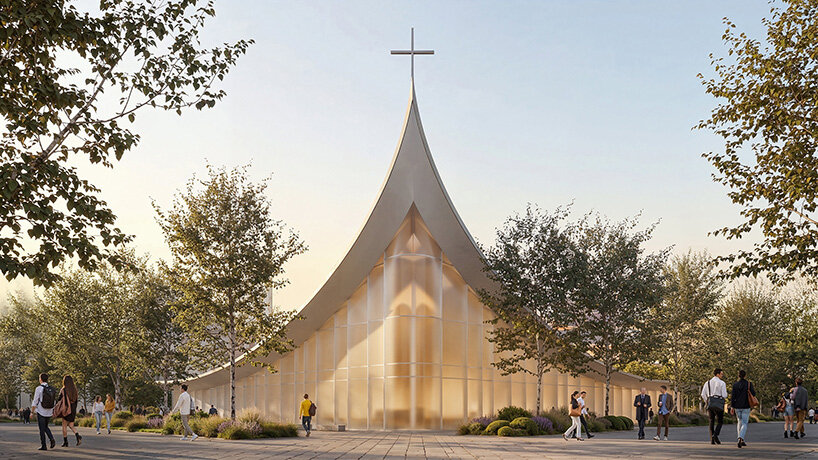
set to occupy a 2,700-square-meter site with an additional 1,100 square meters of open space
a garden of religions inside MIND
The landscape component plays a central role in the project’s vision. The Garden of Religions gathers plant species symbolically associated with the monotheistic traditions present in Milan, with citizens and faith communities expected to participate directly in the garden’s care, thereby reinforcing the civic dimension of the monastery.
One of the more unexpected gestures of the project appears atop the library, where cherry trees will surround a selection of sculptures from the storage collections of the Veneranda Fabbrica del Duomo. Removed from inaccessible archives and relocated into an open grove, the statues create a new relationship between historical heritage and public space. The intervention allows fragments of Milan’s religious and artistic history to re-enter everyday urban life.
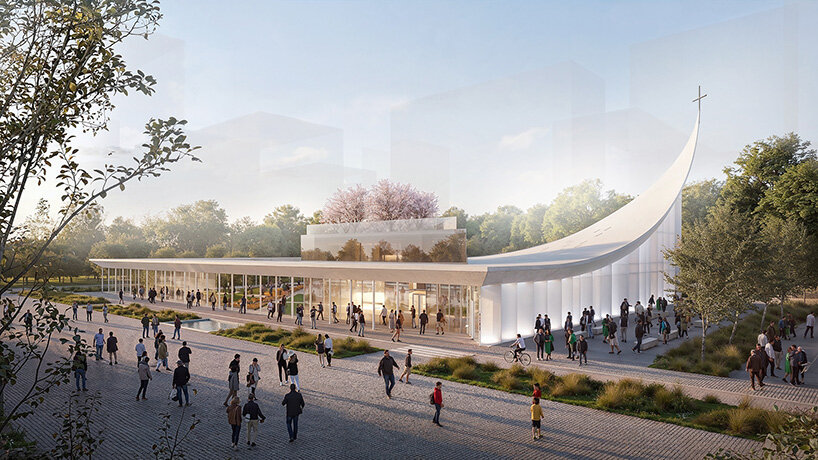
a permeable and collective environment for residents, students, researchers, and visitors
spirituality within the city of innovation
The Ambrosian Monastery emerges from a broader reflection within the Diocese of Milan about how the church can inhabit contemporary urban transformations. The Ambrosian Monastery places itself within MIND’s world of technology and research, opening space for conversations around care, ethics, coexistence, and what progress should actually mean for society.
During the presentation of the project, Archbishop Mario Delpini described MIND as a place where ‘knowledge, research, talent, business, entertainment, nature and life’ converge, arguing that spaces for reflection and transcendence remain essential within rapidly changing cities.
For Stefano Boeri, the project ultimately aims to translate openness into architectural form. ‘We intended to shape the new Ambrosian Monastery with a unified and open architecture,’ the architect explains, ‘whose spatiality would represent the embrace of the new church, the transparent prism of the Library of Religions, and the triangular cloister of the Garden of Faiths.’
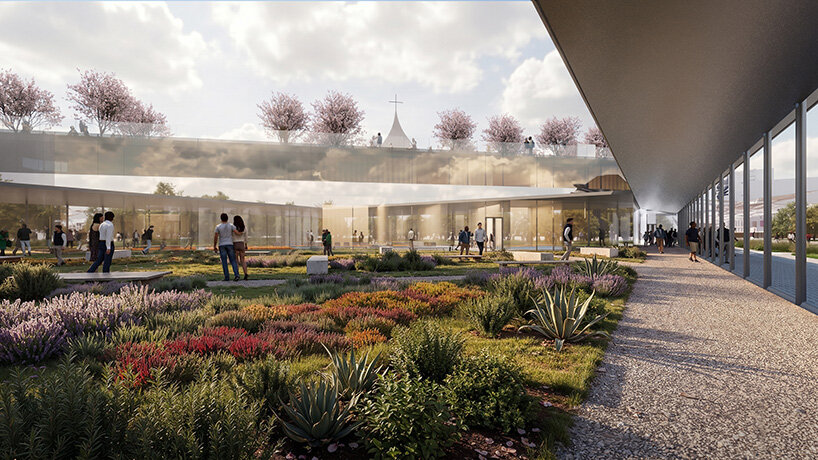
the proposal reinterprets the archetype of the cloister through a contemporary lens
1/2


project info:
name: Ambrosian Monastery
architect: Stefano Boeri Architetti | @stefanoboeriarchitetti
client: Archdiocesan Milan Curia
location: MIND Milano Innovation District
site area: 2,700 sqm
open space area: 1,100 sqm
founding partner: Stefano Boeri
partner in charge: Marco Giorgio
director: Hana Narvaez
design team: Giacomo Calistri, Daniele Barillari, Agostino Bucci, Mohamed Hassan Elgendy