
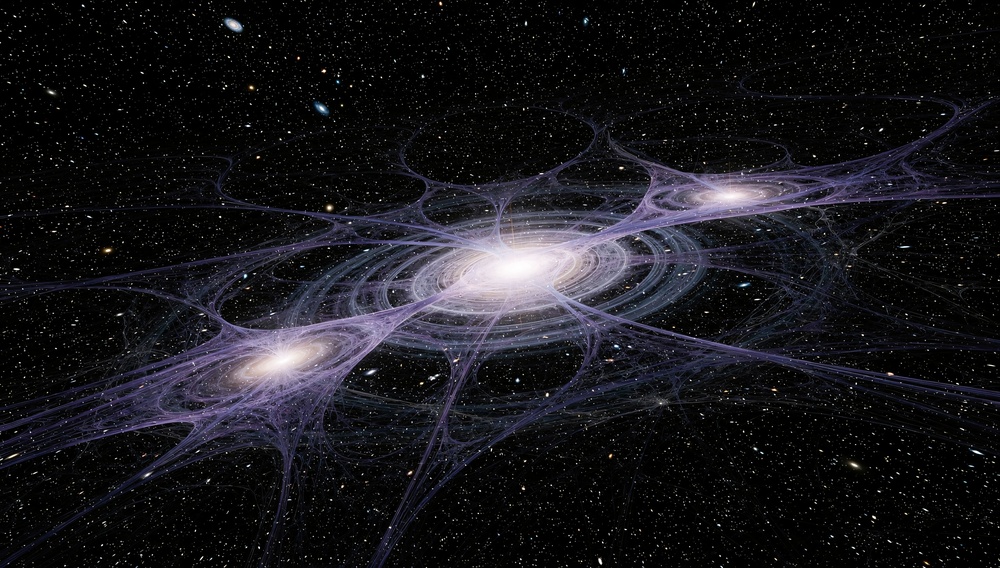
Astronomers using NASA’s James Webb Space Telescope (JWST) have created the clearest map ever produced of the cosmic web, the vast structure that connects galaxies across the universe.
The international research team, led by scientists at the University of California, Riverside, traced this enormous network back to a time when the universe was just one billion years old.
The breakthrough came through COSMOS-Web, the largest survey conducted by JWST to date. Researchers analysed more than 164,000 galaxies to reconstruct how the cosmic web evolved over 13.7 billion years of cosmic history. Their findings were published in The Astrophysical Journal.
The result is a dramatically sharper view of the universe’s large-scale structure than anything previously achieved.
Earlier observations from the Hubble Space Telescope could only hint at these formations, but the new JWST data reveal intricate filaments, clusters, and hidden structures that were previously blurred or invisible.
The project involved scientists from the United States, Denmark, Chile, France, Finland, Switzerland, Japan, China, Germany, and Italy. Funding support included grants from the European Union’s Horizon 2020 research and innovation programme.
What is the cosmic web?
The cosmic web is the universe’s enormous underlying framework. It consists of filaments made of dark matter and gas that stretch across space, linking galaxies and galaxy clusters together while surrounding gigantic empty regions known as cosmic voids.
Scientists describe the cosmic web as the skeleton of the universe because it shapes where galaxies form and how they evolve over time. Rather than being randomly scattered, galaxies tend to gather along these interconnected strands.
Understanding the cosmic web is considered essential for explaining how matter assembled after the Big Bang and how the modern universe developed its present structure.
Why JWST changed the picture
Since launching in 2021, the James Webb Space Telescope has transformed astronomy through its powerful infrared imaging capabilities.
Unlike previous observatories, JWST can detect extremely faint and distant galaxies hidden behind cosmic dust, allowing researchers to look deeper into the early universe.
The COSMOS-Web project was specifically designed to exploit those capabilities. Covering a section of sky roughly equal to three full moons, the survey provides both the depth and wide-field coverage needed to map the cosmic web across cosmic time.
Researchers said JWST’s combination of sensitivity and precision made the new map possible. The telescope detected far fainter galaxies within the same region of space while also measuring their distances with greater accuracy.
That allowed astronomers to place galaxies into precise eras of cosmic history, producing a far more detailed reconstruction of the universe’s structure.
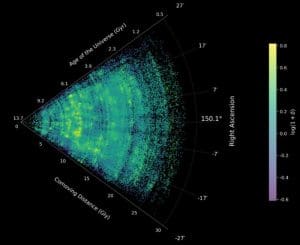 A slice through the COSMOS-Web cosmic-web map, showing galaxies across nearly 14 billion years of cosmic history. The vertex on the left marks the present day; moving outward, each galaxy is placed at its distance in cosmic time, reaching back to when the universe was less than a billion years old. Bright yellow regions show the dense clusters and filaments of the cosmic web, while dark regions mark the near-empty voids in between. Credit: Hossein Hatamnia, UC Riverside.
Earlier cosmic web maps missed key details
The new observations revealed that previous maps had significantly oversimplified the universe’s structure.
Features that once appeared as single formations are now resolved into multiple, connected structures, revealing far greater complexity within the cosmic web.
Scientists noted that earlier Hubble observations lacked both the depth and resolution required to distinguish these fine details, especially in the distant early universe. JWST, by contrast, can observe galaxies from periods that were previously almost inaccessible to astronomers.
The research team said the new data now allow scientists to study how galaxies behave within clusters and filaments at different stages of cosmic evolution.
Public release opens data to global researchers
Aligning with the COSMOS project’s long-standing open science approach, the team has publicly released the cosmic web maps, the analysis pipeline, and the catalogue containing information on 164,000 galaxies and their surrounding cosmic density.
Researchers also released a visualisation showing how the cosmic web evolved over billions of years. Open-access data are expected to support future studies of galaxy formation, dark matter distribution, and the evolution of large-scale cosmic structures.