
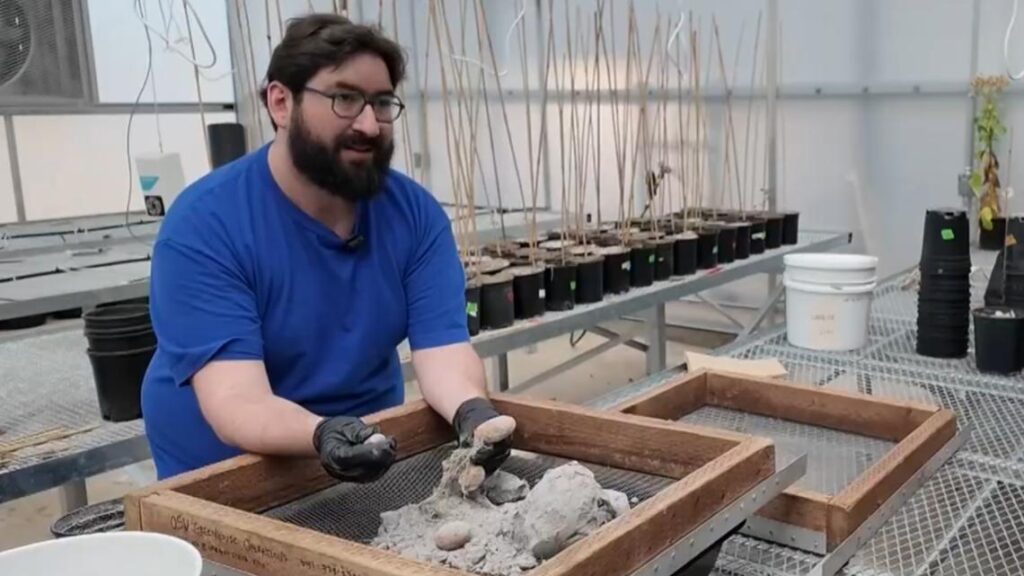
NASA-funded research at Oregon State University reveals successful growth of potatoes in moon-like soil, a breakthrough for sustaining future lunar missions.
CORVALLIS, Ore. — NASA-funded research at Oregon State University is taking a giant leap in feeding astronauts on the moon. Scientists are successfully growing potatoes in soil similar to the moon’s, and it’s research that could play a role in future deep space missions.
Inside an Oregon State University lab, David Handy, a space biologist, is tackling one of the biggest challenges of living on the moon: how to grow where there’s no real soil.
“On the moon, we have what’s called regolith, which is dirt that’s completely lacking with any biomatter,” said Handy.
RELATED: Experts in Oregon reflect on historic Artemis II mission
Unlike soil on Earth, the material on the surface of the moon contains none of the organic materials plants normally need to survive. So Handy and his team used a mix of crushed minerals and volcanic ash, so it would be similar to Earth’s surface: “Think of a very thick kind of silt; it tends to cling a lot.”
So Handy and his team did an experiment.
“… We simply added some worm compost… and after that, the plants were like our Earth soil controls,” added Handy.
That experiment turned out dozens of spuds, and they discovered adding compost made a huge difference.
“I thought it was a perfect crop to choose for different reason for one everyone eats potatoes; we eat them as French fries in many different ways,” said Aymeric Goyer, who’s been part of the research team.
The second reason behind using potatoes, according to Goyer.
“On Earth, it grows everywhere, different latitudes — there’s just very few areas where you can’t grow potatoes,” said Goyer.
Now, they hope this experiment will be taking this team this starchy veggie to new heights.