
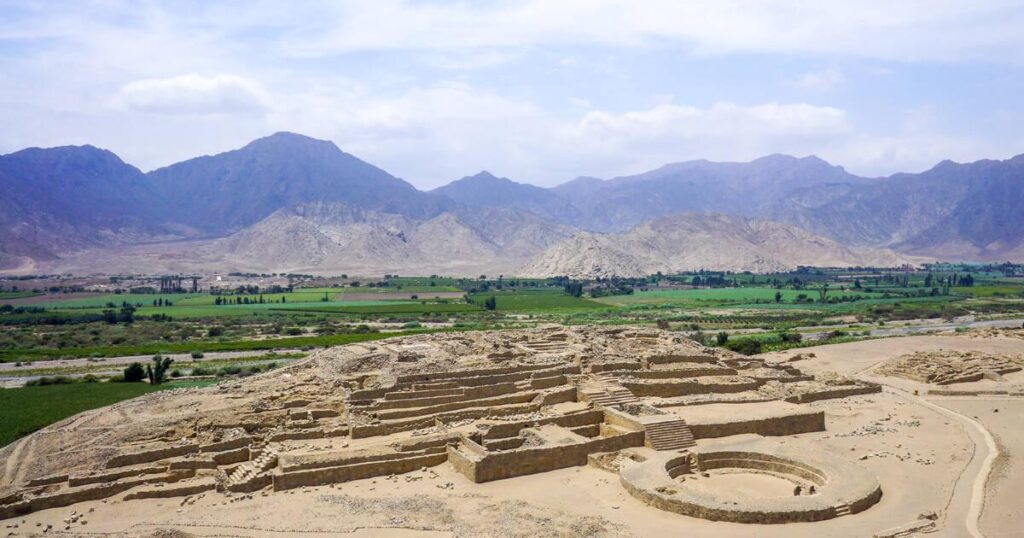
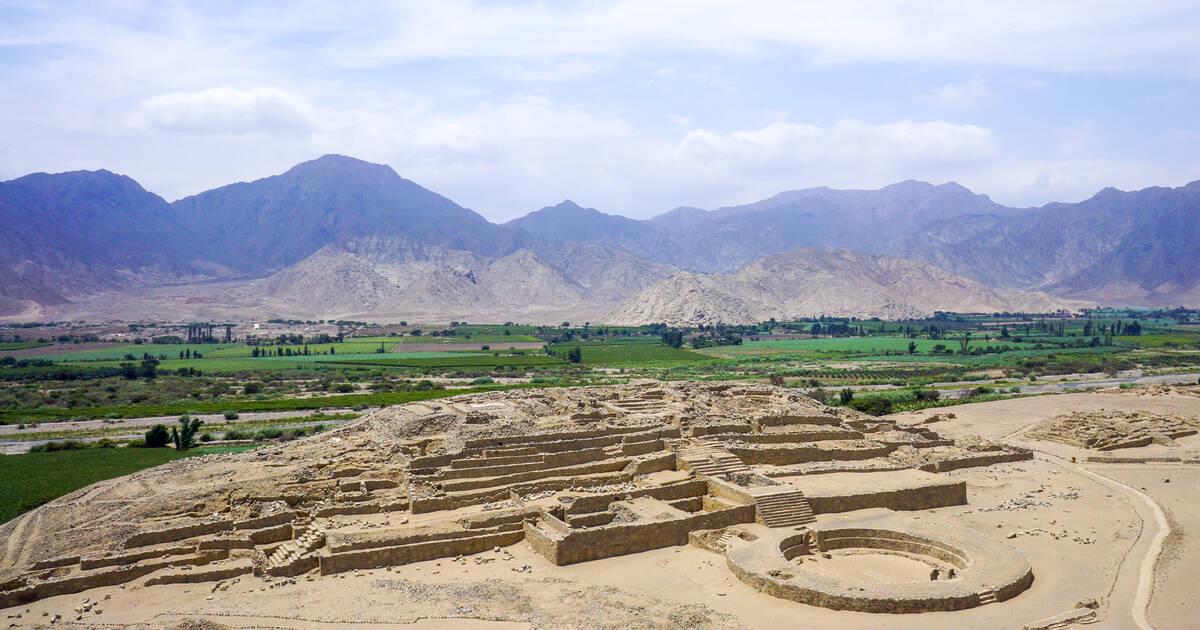
Robert Carneiro's 1970 theory said early civilizations formed where people couldn't disperse; fertile land hemmed in by deserts and mountains, with population pressure forcing political consolidation. The theory has problems (highland New Guinea was just as circumscribed and never produced a state) but the geography it points to is real. A new analysis tries to measure it directly.
The "Geological Circumscription Index" has three ingredients: tectonically active mountains nearby, an arid environment, and proximity to a major river. Combined multiplicatively (all three must be present), they scored every 100×100 km patch of land on Earth — 15,351 patches total, Sahara to Siberia to Antarctica.
The results:
- Indus Valley: 100th percentile. No place on Earth scores higher.
- Mesopotamia: 99.5th
- Egypt: 98.9th
- Caral-Supe (Peru): 93.6th. Partial fit, low on tectonics but high on aridity and river
- Early China, Mesoamerica, West Africa: Each missing at least one ingredient
Monte Carlo test against 100,000 random placements: p < 10⁻⁴.
The interesting part isn't that civilizations formed near rivers in deserts – that's middle-school geography. It's the shape of the result. Three sites in the top 1% of the entire planet, on a metric chosen before the data was looked at. The fourth (Caral) sits clearly above the zero-baseline but lower than the Old World three.
The paper is careful about what it doesn't claim:
- It's a measure of desert-river geometry, not "civilization" generally. China, Mesoamerica, and West Africa formed under different ecological setups. They score zero because the index isn't built to detect them.
- The Monte Carlo null includes Antarctica and the deep Sahara, which makes any habitable river valley look extreme. The authors flag this.
- The geographic pattern doesn't prove a mechanism. The paper separately proposes one — that the same geology that prevented dispersal may also have made environmental feedback unusually testable, so practical knowledge could accumulate more reliably — but treats this as a hypothesis to be tested, not a result.
Currently under peer review. Full write-up with caveats and alternative explanations here.
Preprint with code and data: https://doi.org/10.5281/zenodo.19240284.
Happy to take questions on methodology, case-set construction, or where this fits in existing circumscription literature.
by tractorboynyc
2 Comments
The entire Indus Valley scores in the 100th percentile? It’s far more than 100 km x 100 km. Nor is it hemmed in by deserts or mountains. It is entirely open to a subcontinent to the east that extends nearly a 1,000 miles.
This reeks of a (maybe not so) clever use of statistics to arrive at the premise from a conclusion.
Makes sense.