
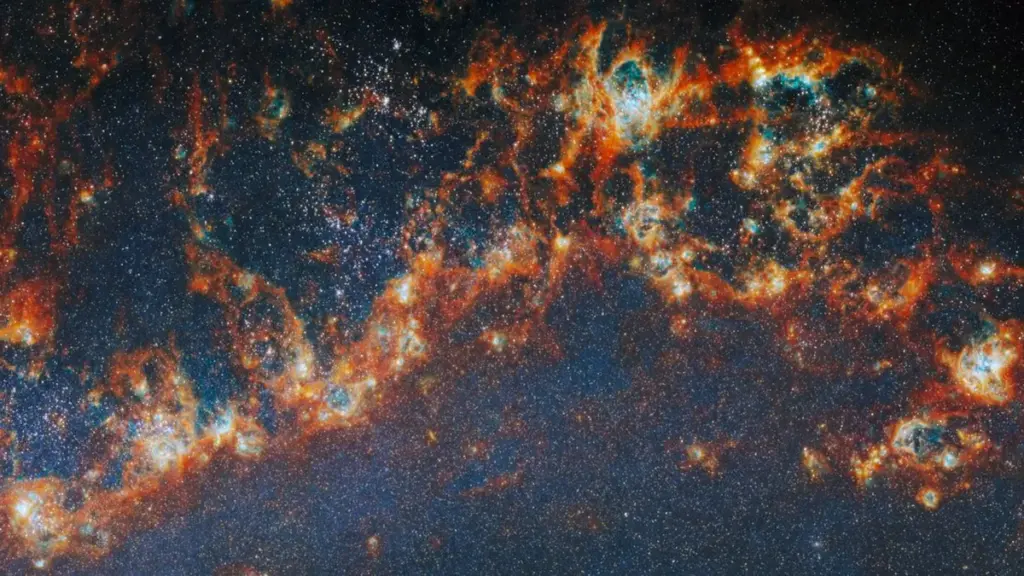
Astronomers have discovered that the most massive clusters of young stars clear away the surrounding gas faster than previously thought. This affects how galaxies form new stars—and even how planets form nearby.
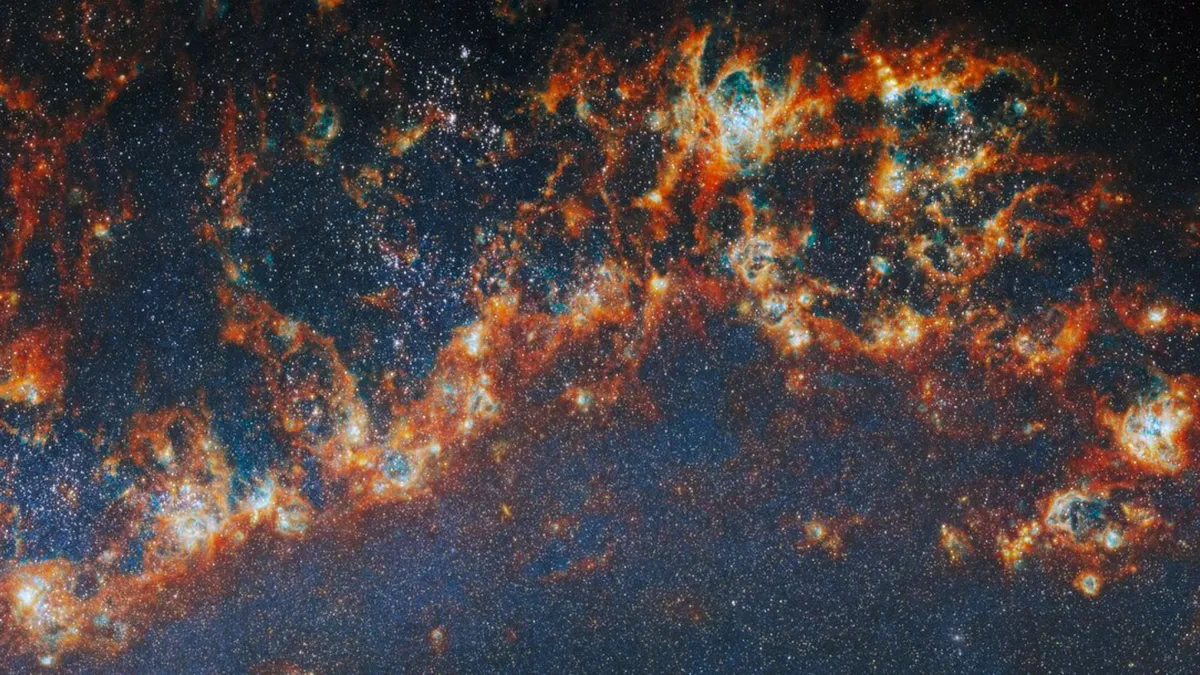 A composite image from the James Webb Space Telescope and the Hubble Space Telescope shows glowing gas clouds and dust structures in regions of active star formation. Source: nasa.gov
Collaboration between James Webb and Hubble
Researchers analyzed nearly 9,000 young star clusters in four neighboring galaxies: Messier 51, Messier 83, NGC 628, and NGC 4449. The data was collected by FEAST (Feedback in Emerging Extragalactic Star ClusTers), an international observational program that studies how young stars influence the galaxies around them.
For the observations, two telescopes were combined: the James Webb Space Telescope observed through dense dust in the infrared spectrum and revealed clusters in their earliest stages, while the Hubble Space Telescope captured fully formed clusters in visible light. Together, they provided the opportunity to trace their entire journey from birth to complete separation from the gas cloud.
Great ones are the first to emerge
The most massive clusters disperse the surrounding gas in about five million years, while smaller ones take up to eight million years to do so. The difference may seem insignificant, but it determines how much cold gas will remain available for the formation of future stars. Cold gas is the raw material for star formation, and the faster a star-forming region clears space for itself, the more significantly it limits this process within its galaxy.
This mechanism is known as stellar feedback. Once freed from the gas cloud, the massive cluster begins to emit intense ultraviolet radiation and stellar winds, which heat and disperse the surrounding gas. Previously, computer simulations were unable to accurately reproduce how and over what period of time young star clusters clear themselves of gas clouds. New research provides specific data on this.
Impact on planetary formation
The patterns identified could change our understanding of planet formation. Young planetary systems forming around stars within massive star clusters are exposed to intense ultraviolet radiation earlier than previously expected.
This radiation disrupts the disks of gas and dust surrounding newborn stars, from which planets form. In other words, in dense clusters, planets may simply not have enough time to accumulate sufficient mass. The study was published in May in the journal Nature Astronomy.
According to space.com