
While the United States spent the last decade consolidating the race for reusable rockets through private companies such as SpaceX, Europe moved more cautiously in a field where technological independence increasingly became a strategic priority. Now, the European Space Agency is attempting to enter a new phase with a project that combines orbital engineering, automation, and an unprecedented recovery system: a reusable spacecraft capable of gliding back to Earth beneath a giant parafoil.
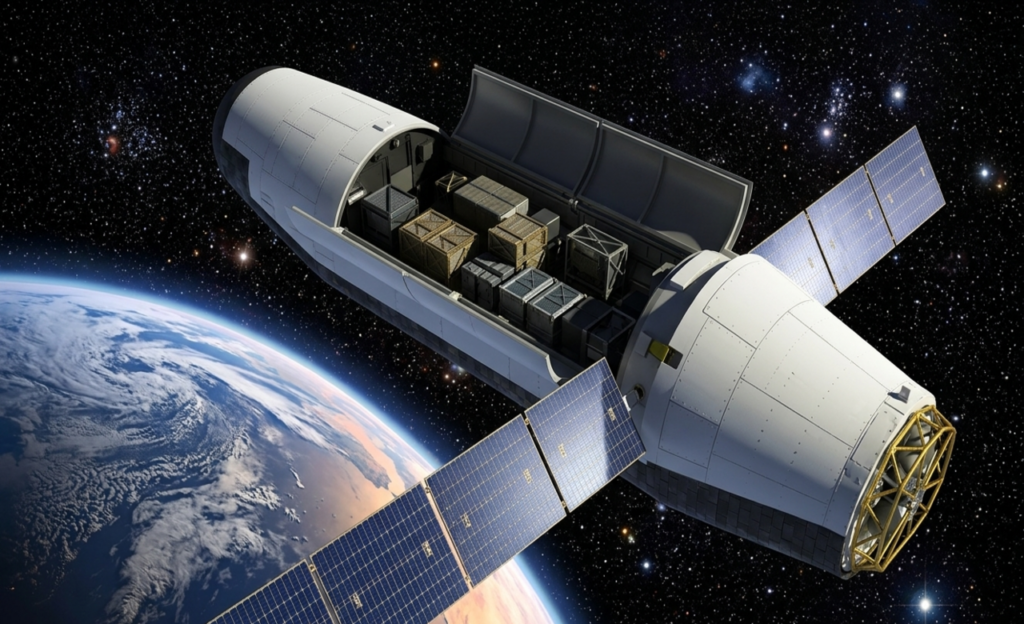
The vehicle is called Space Rider, and it represents one of Europe’s most ambitious aerospace developments in recent years. Designed as an uncrewed robotic laboratory, it will be capable of remaining in low Earth orbit for nearly two months while conducting scientific experiments, industrial testing, and technology missions before returning to a landing strip using a descent system never before operationally deployed on a European orbital vehicle.
The European Space Agency confirmed in April 2026 the completion of the first full-scale model intended for landing trials. The prototype was assembled between Romania and Italy and will undergo a series of helicopter drop tests this year to validate its autonomous navigation system and controlled descent using a parafoil an advanced rectangular glider system commonly employed in military and precision aviation operations.
Unlike traditional space capsules, which typically splash down into the ocean using parachutes, Space Rider is designed for a far more precise return. The spacecraft will descend through Earth’s atmosphere before deploying a large steerable parafoil that will allow it to maneuver toward a runway landing using skid gear. The goal is not only to recover the spacecraft intact, but also to preserve delicate experiments, technological payloads, and scientific materials requiring a carefully controlled return.
The ESA argues that no operational spacecraft has yet been designed to perform an orbital landing guided entirely by an autonomous parafoil, which is why the program is devoting major resources to simulations and descent testing.
Behind the project lies not only an engineering ambition, but also an economic and geopolitical calculation. Europe has historically depended on foreign systems for much of its orbital return capability and crewed spaceflight infrastructure. With Space Rider, the continent is attempting to establish its own reusable transportation system for scientific and technological payloads in low Earth orbit, reducing operational costs while increasing strategic autonomy at a time when space has once again become an arena of global competition.
Industrial development is being led by Thales Alenia Space and Avio, working alongside European universities and research centers. The spacecraft will be launched aboard the European Vega-C rocket and reused across multiple missions. According to technical documents released by the manufacturers, the reentry module could fly several times following refurbishment procedures.
Although the project still falls short of the scale achieved by American or Chinese initiatives, its technological concept carries important implications for the emerging space economy. Space Rider is not intended as a tourism vehicle or a crewed spacecraft. Its primary mission will be to function as a flexible orbital platform for pharmaceutical research, biomedicine, microgravity manufacturing, robotic testing, and scientific experiments requiring prolonged exposure to the space environment.
That capability is especially significant for industries that increasingly view space as a future center for advanced production. Under microgravity conditions, certain pharmaceutical crystals, composite materials, and biological tissues can develop in ways impossible to reproduce on Earth. The ability to send experiments into orbit for weeks and recover them intact represents a market that space agencies and private companies have spent years trying to build.
The spacecraft measures roughly 4.6 meters in length, with dimensions comparable to two minivans placed together. Although modest compared with some modern orbital vehicles, the ESA believes its real value lies in the combination of reusability, automation, and controlled return capability.
The project also reflects a broader cultural shift inside Europe’s aerospace sector. For decades, Europe built a reputation around scientific precision and technical reliability, albeit often with slower bureaucratic timelines than those of its American private-sector competitors. Space Rider now emerges as part of a transition toward more agile, reusable, and commercially competitive systems.
Recent tests conducted in Sardinia illustrate that transition. Experimental models were released from helicopters several kilometers above the ground to evaluate navigation algorithms, trajectory control, and parafoil deployment. Engineers are attempting to solve one of the project’s most difficult challenges: enabling the spacecraft to autonomously calculate the aerodynamic corrections necessary to land accurately after returning from space.
The technical difficulty is substantial. Unlike a conventional aircraft, Space Rider must first survive extreme temperatures during atmospheric reentry before transforming into a gliding vehicle capable of executing highly precise landing maneuvers. That combination requires integrating thermal protection systems, autonomous guidance technologies, and advanced materials that historically only a handful of space powers have successfully mastered.
The program also inherits technological knowledge from the former IXV experimental vehicle, a European reentry demonstrator successfully tested years ago and considered the conceptual foundation for this new orbital generation.
In an industry where reusability has become the new economic standard, Europe is now attempting to prove it can also build spacecraft capable of reaching orbit, remaining there for weeks, and returning ready to fly again. Space Rider is not designed to compete directly with massive American spacecraft. Its ambition is different: to turn orbital return into a frequent, precise, and reusable scientific and industrial service.