
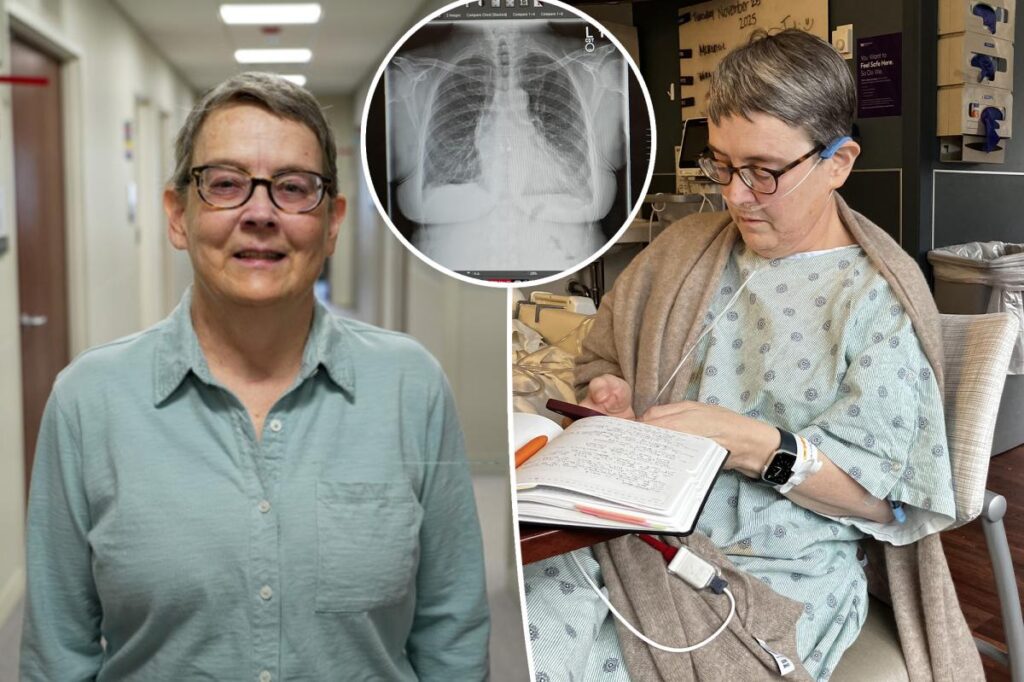
From breathless to breathing freely.
NASA engineer and mother Jodi Graf is grateful to celebrate another Mother’s Day after undergoing an innovative procedure to treat her terminal lung cancer.
Now, the 61-year-old robotic software developer is cancer-free, can breathe easier and walk without an oxygen tank.
61-year-old NASA engineer and mother Jodi Graf underwent an innovative treatment for her advanced lung cancer. Northwestern Medicine
Lung cancer is the leading cause of cancer-related deaths in the US, with cases on the rise in young women and those who have never smoked before.
Graf had struggled with shortness of breath for nearly three decades, having been diagnosed in 2005 with interstitial lung disease, which causes scarring of the lungs, despite having no history of smoking.
She remained relatively stable until her health took a turn for the worse and she had to rely on a supplemental oxygen supply.
“Basic activities required constant supplemental oxygen — sometimes as much as 10 liters,” Graf said in a press release. “Just walking from my car to my office at NASA was a feat.”
But when the Houston-based mom went for a lung transplant evaluation in 2023, doctors discovered something much worse.
A mass was detected in her lungs, and she was diagnosed with advanced lung cancer, making her ineligible for a transplant. While undergoing radiation treatment, Graf’s lung function dropped to 30%.
Despite having never smoked in her life, Graf struggled to breathe easily and was diagnosed with advanced lung cancer. Northwestern Medicine
She didn’t give up hope, though, hoping a lung transplant was still an option and constantly searching for solutions, leading her to the DREAM Program at Northwestern Medicine in Chicago.
Short for Double lung transplant REgistry Aimed for lung-limited Malignancies, the clinical trial is an observational study where select patients with advanced lung cancers receive double-lung transplants.
The program is currently the only system in the country offering the groundbreaking solution for cancer patients with no other options.
However, she was eligible for the DREAM Program at Northwestern University to receive a double lung transplant. Northwestern Medicine
The process involves a full heart and lung bypass, removing the cancer-ridden lungs along with the lymph nodes, cleaning the airways and chest cavity to clear the cancer and then putting new lungs in.
Starting the process with an evaluation to see if she was an eligible candidate last November, Graf underwent the transplant and received her new lungs on Thanksgiving Day.
After the surgery, she was able to walk without her oxygen supply.
Since first starting in 2014, the Northwestern Medicine Lung Transplant Program has performed more than 700 lung transplant procedures.
Many of the patients are those with end-stage diseases such as COVID, cystic fibrosis, chronic obstructive pulmonary disease (COPD) and more.
The wait time is also among the shortest in the country, with an average wait of three days to be matched with new lungs.
Not only has Graf’s case been a success, but doctors hope the procedure has further implications than easier breathing for patients.
“We believe this technique can help reduce the risk of recurrence, which we learned through our experience with pioneering COVID-19 lung transplants in 2020,” Ankit Bharat, chief of thoracic surgery and executive director of the Northwestern Medicine Canning Thoracic Institute, said in a press release.
Now that she’s able to breathe again, Graf has her sights set on traveling and hiking with her husband and two sons, as well as being around to celebrate more Mother’s Days.
“With my new lungs, I’m so glad that I’ll be there for them a while longer,” she said. “They’re grown up, but they still need their mom.”