
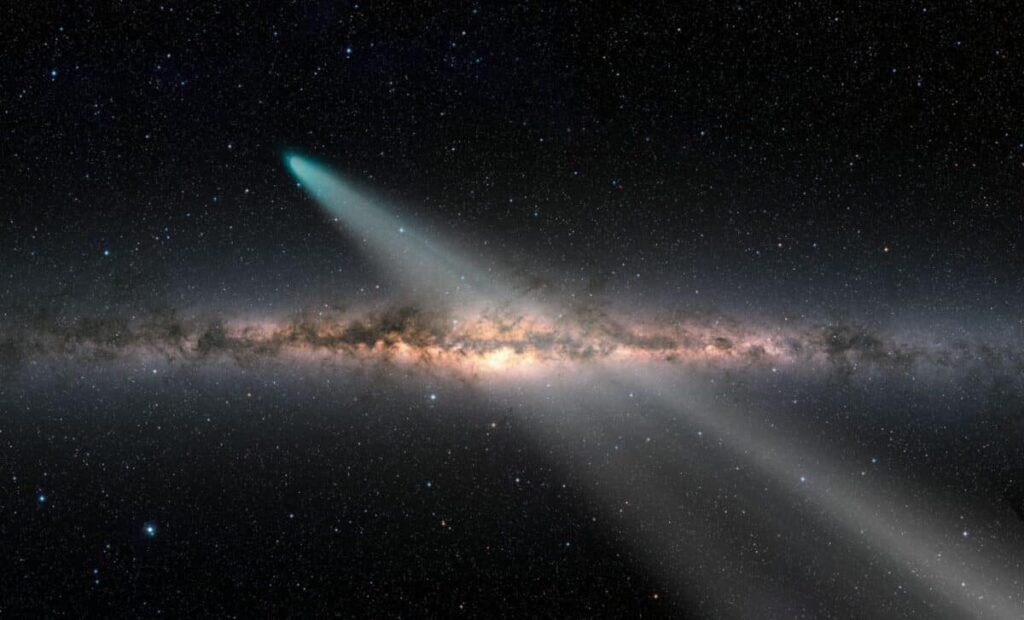
A comet that entered our solar system from interstellar space contains water with an extraordinary concentration of deuterium (a heavier isotope of hydrogen) that far surpasses anything previously measured in comets within our solar system. The object, designated 3I/ATLAS, is only the third confirmed interstellar visitor ever detected, and new findings published in Nature Astronomy suggest it formed in conditions considerably colder and less irradiated than those that produced our own planetary system.
The research was led by scientists at the University of Michigan, with observations conducted using the Atacama Large Millimeter/submillimeter Array (ALMA) in Chile and the MDM Observatory in Arizona. It marks the first time researchers have successfully performed this type of water isotope analysis on an interstellar object.
A Chemical Signature Unlike Anything in Our Solar System
Water molecules are composed of two hydrogen atoms and one oxygen atom. In standard water, each hydrogen atom contains only a proton, but deuterium carries an additional neutron, making it heavier. The ratio of deuterium to ordinary hydrogen in water functions as a chemical fingerprint, encoding information about the temperature and radiation environment in which the water originally formed.
According to the study, 3I/ATLAS carries a deuterium-to-hydrogen ratio in its water that exceeds Earth’s ocean value by a factor of approximately 40, and typical solar system cometary values by a factor of roughly 30. “The amount of deuterium with respect to ordinary hydrogen in water is higher than anything we’ve seen before in other planetary systems and planetary comets,” said Luis Salazar Manzano, lead author of the study and a doctoral student at the University of Michigan.
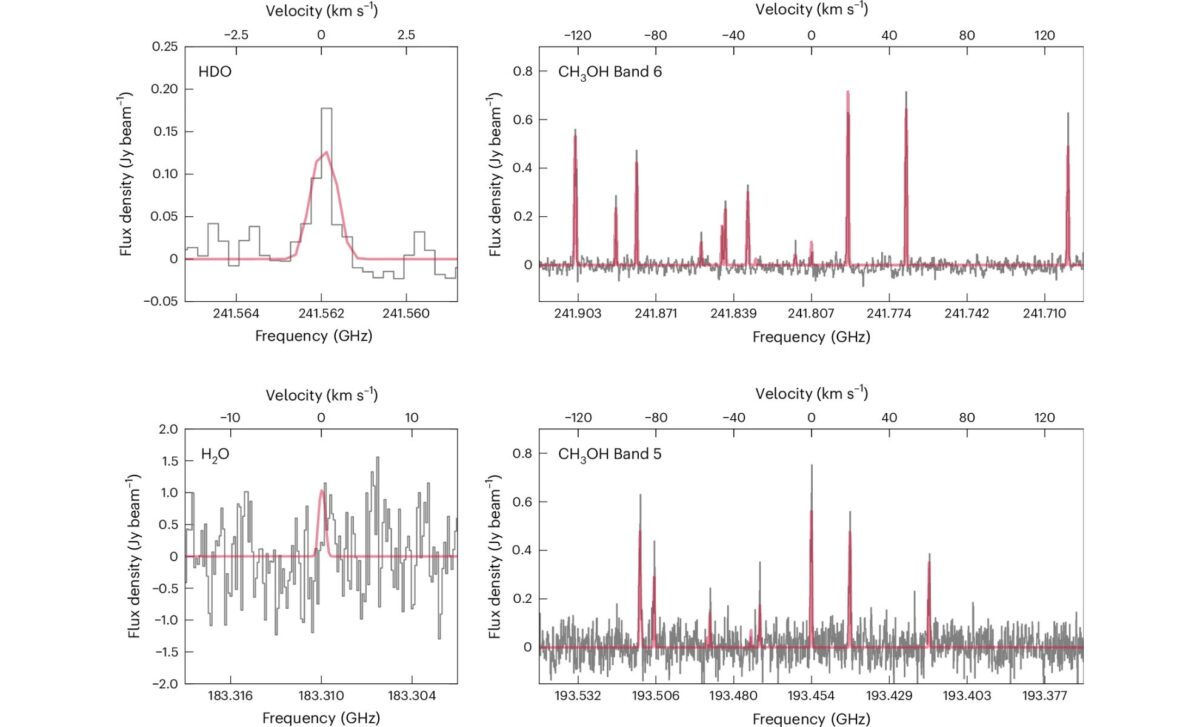 3I/ATLAS coma spectra with simultaneous MCMC SUBLIME 1D best-fit models for HDO, H₂O, and CH₃OH (Bands 5 & 6) ©Nature
The researchers measured this ratio by targeting specific molecular emission lines using ALMA’s Atacama Compact Array, which distinguishes deuterated water (HDO) from ordinary water (H₂O) with sufficient sensitivity to resolve the difference. HDO was detected clearly in the data, while ordinary water remained below the detection threshold, an absence that itself informed the team’s calculations of the deuterium ratio.
The scientific basis for interpreting this measurement rests on well-established chemistry. Deuterium enrichment in water occurs primarily at very low temperatures (below 30 Kelvin) through gas-phase reactions that favor the production of deuterium-bearing molecules under cold, dense conditions. Higher enrichment levels indicate that the water formed in a colder environment with less thermal processing than that which shaped comets in our solar system.
Evidence of a Distinct Planetary Formation History
The findings carry implications not just for 3I/ATLAS itself, but for the broader question of how planetary systems form across the galaxy. “Our new observations show that the conditions that led to the formation of our solar system are much different from how planetary systems evolved in different parts of our galaxy,” Salazar Manzano said.
Co-leader Teresa Paneque-Carreño, an assistant professor of astronomy at the University of Michigan, emphasized that the result confirms something scientists had long suspected but never directly demonstrated. “This is proof that whatever the conditions were that led to the creation of our solar system are not ubiquitous throughout space. That may sound obvious, but it’s one of those things that you need to prove.“
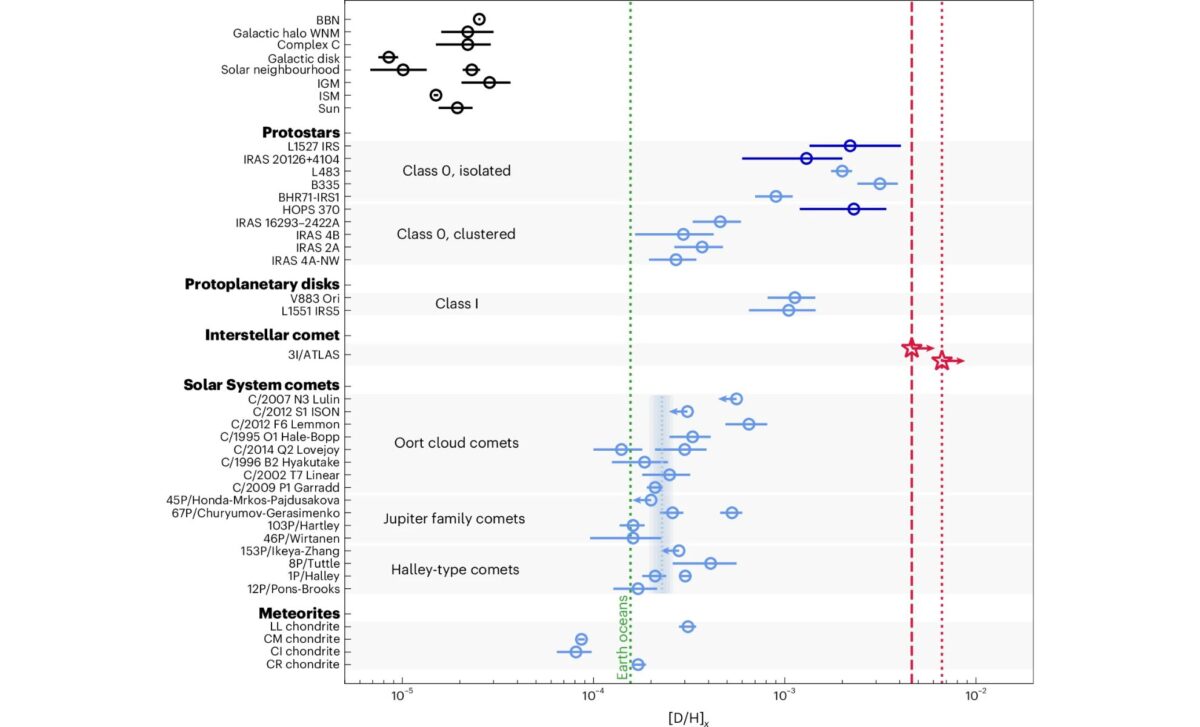 Water D/H ratios across Galactic environments and Solar System bodies compared with 3I/ATLAS ALMA constraints near perihelion ©Nature
The research team considered and largely ruled out alternative explanations for the high deuterium concentration. Variations in bulk hydrogen composition across different regions of the galaxy account for only modest differences in water deuterium ratios, far too small to explain what was measured in 3I/ATLAS. The possibility that the comet accumulated interstellar material after being ejected from its home system was also assessed and found unlikely to account for enrichment of the magnitude observed.
The most consistent interpretation, according to the paper, is that 3I/ATLAS formed under colder prestellar conditions than the solar system’s own birth environment, possibly in a more isolated region, where nearby massive stars did not raise ambient temperatures the way they likely did during the Sun’s formation. An estimated kinematic age of 3 to 11 billion years further suggests the object may be among the oldest interstellar visitors identified to date.
With next-generation observatories expected to detect more interstellar objects in the coming years, researchers say the techniques applied to 3I/ATLAS could be used to build a broader comparative picture of how chemistry varies across planetary systems throughout the Milky Way.