
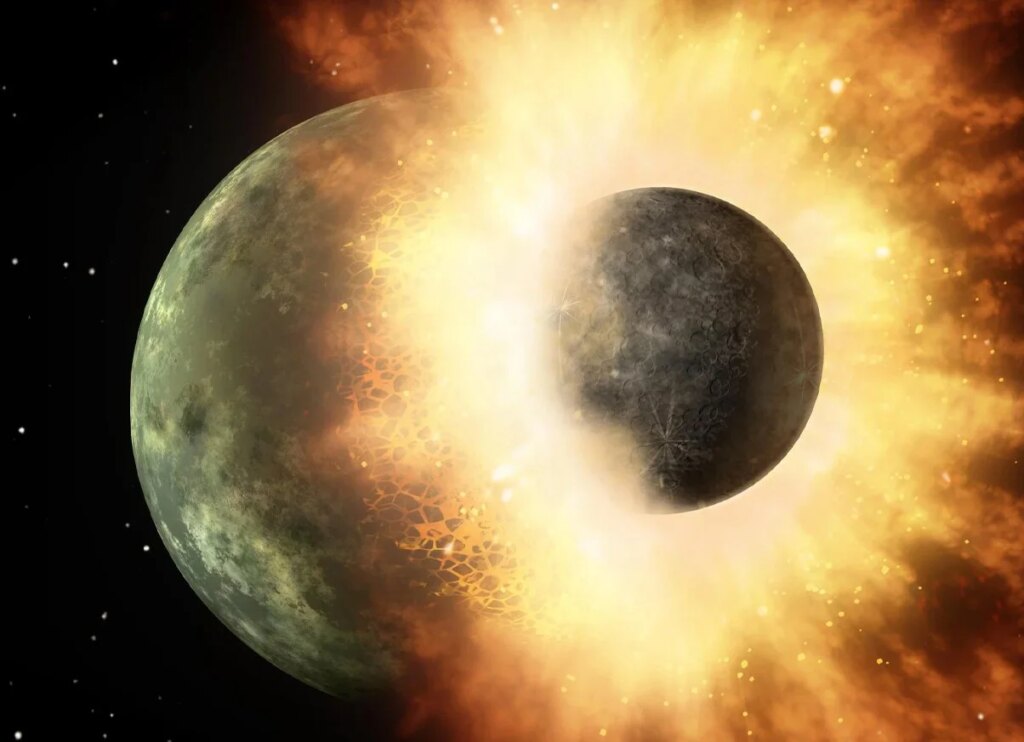
New research suggests Dante Alighieri’s Inferno may have done more than shape literary history — it may also have anticipated concepts in planetary impact science centuries before modern meteoritics emerged.
A new study argues that Dante Alighieri’s Inferno was not only a literary masterpiece, but also a striking thought experiment in impact physics. Research by Timothy Burbery of Marshall University reinterprets the 14th-century epic through the lens of modern meteoritics, proposing that Dante effectively described the mechanics of a catastrophic planetary collision nearly 500 years before the scientific study of meteor impacts began.
– Advertisement –
Traditionally, Satan’s fall in the Divine Comedy has been understood as a spiritual and theological event. Burbery’s analysis, however, presents it as something far more physical: a high-velocity celestial impact in the Southern Hemisphere that drives Satan to the Earth’s core.
According to this interpretation, the resulting displacement of matter forces the Northern Hemisphere upwards, creating Hell as a vast crater-like structure while simultaneously forming Mount Purgatory from the displaced earth.
The study compares the scale of this imagined collision to the Chicxulub impact — the asteroid strike associated with the extinction of the dinosaurs. Burbery models Dante’s Satan as an elongated, asteroid-sized object similar in form to the interstellar visitor ʻOumuamua.
Like the Chicxulub impactor, the collision described in Inferno produces massive geological consequences, tunnelling towards the Earth’s centre and reshaping the planet’s structure. Unlike many meteors that vaporise on impact, Dante’s Satan resembles the Hoba meteorite, remaining intact as a permanent feature embedded within the Earth.
– Advertisement –
Viewed through this scientific framework, the nine circles of Hell resemble the concentric terraces and multi-ring basins observed on planetary bodies such as the Moon and Venus. The research also argues that Dante intuitively anticipated concepts related to terminal velocity, crustal penetration and extreme compression long before modern geophysics formalised them.
Beyond literary interpretation, the study highlights how myths and cultural narratives can preserve early intuitions about natural phenomena before they are scientifically understood. Burbery argues that Dante’s depiction challenged prevailing Aristotelian ideas of a perfect and unchanging cosmos by presenting celestial bodies as capable of violently altering the Earth.
The research ultimately positions the Divine Comedy as both a literary achievement and a proto-geophysical thought experiment — one that offers a surprising parallel to modern theories of planetary impacts and the evolving science of meteoritics.
Header Image Credit : ASA/JPL-Caltech
Sources : EGU
– Advertisement –