
You’re a long-necked Titanosaurs grazing the plains and chomping away on tree leaves about 100 million years ago in the Early Cretaceous in what would eventually become a future Starbucks location. You look up at the night sky and notice a bright dot that seems slightly larger and brighter than usual since you’ve seen it a bunch. You grunt at your cousin (official dinosaur language) asking if he notices it, too. Your cousin grunts back that it does seem bigger and brighter and wonders what’s up.
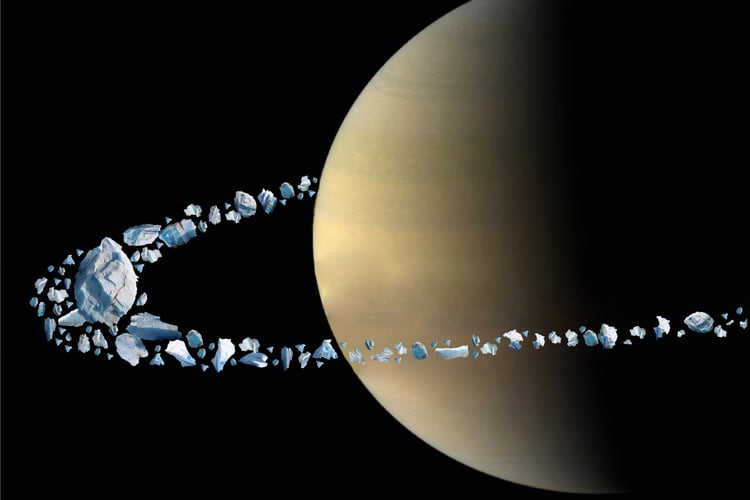
These Titanosaurs cousins might be about 100 million years too early for a good science class, but what they see in this piece of fiction is Saturn after it gets its rings. This is because scientists estimate the famed ringed planet got its most striking feature approximately 100 million years ago. But exactly how Saturn got its rings has been debated for quite a while, but a team of scientists from the United States and China might be a step closer to solving this conundrum. Recently, they presented findings at the 57th Lunar and Planetary Science Conference discussing how Saturn’s rings might have formed from the dismantling of an ancient moon called “Chrysalis”.
For the study, the researchers used a series of computer modes to test a longstanding hypothesis that Saturn’s rings were formed from the breakup of an ancient moon, which astronomers have dubbed Chrysalis. This is because all celestial bodies, including stars and black holes, have what’s known as the Roche limit, which is the safest distance a smaller celestial body can get to a larger celestial body before it’s ripped apart from the latter’s gravity.
For the model, the researchers estimated the size of Chrysalis was about the size of Saturn’s moon Iapetus, which has an estimated diameter of 1,469 km (913 mi). The interior of Chrysalis was modeled to be differentiated, or layered, containing a mixture of water ice and rock. The team used two different ice compositions composed of 50 percent and 80 percent, designed to mimic the compositions of Saturn’s moon Dione and Iapetus, respectively. Chrysalis was modeled to have an elliptical (oval-shaped) orbit, initially starting approximately 200 Saturn radii from the planet, and orbiting as close as 1 to 1.5 Saturn radii, which is the approximate Roche limit for icy planetary bodies.
In the end, the researchers estimated that Chrysalis orbited too close to Saturn during its closest pass, resulting in it becoming stripped apart from Saturn’s immense gravity. While some of Chrysalis escaped Saturn’s gravity, the rest formed what would become Saturn’s immense rings. However, the researchers note the rings could have started out much larger than we see them now (potentially large enough for our Titanosaurs cousins to view), with a portion of them being removed from gravitational interactions with Saturn’s larger moons, specifically its largest moon Titan.
Going forward, the researchers note several questions remain unanswered, specifically regarding the largest piece of Chrysalis and how this could influence the growth of Saturn’s rings. Additionally, they aspire to explore how the pieces resulted in impact craters on some of Saturn’s moons. This study builds on past studies exploring how the shredding of the ancient moon of Chrysalis could be responsible for forming Saturn’s rings, including a 2022 study published in Science that suggested an ancient moon could explain Saturn’s rings.
But Saturn’s rings could help scientists gain greater understanding of not only planetary formation and evolution in our solar system, but for exoplanets, too. For example, several exoplanets have been identified to potentially have a ring system, including J1407b (dubbed “Super-Saturn”), which is located approximately 434 light-years from Earth and is estimated to have a ring system 200 times larger than Saturn.
What new insight into how Saturn’s rings formed will researchers make in the coming years and decades? Only time will tell, and this is why we science!
As always, keep doing science & keep looking up!