
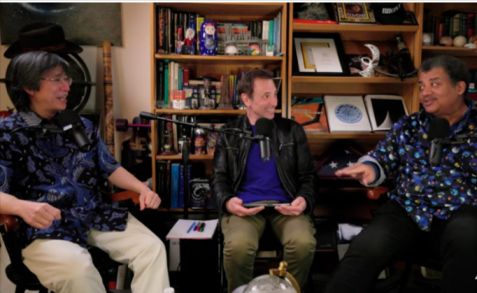
No, I just said that. I do.
NEIL DEGRASSE TYSON: Come on. This is just barely out yet. Take Me to Your Leader.
PAUL MECURIO: Nice.
CHARLES LIU: Wonderful.
PAUL MECURIO: Oh yeah, this is like an early mockup of the cover, but it looks like, you know, it’s got the traditional — why don’t you get your head sticking out there, Charles, and mine, like we’re on the ship and we’ve been taken away.
CHARLES LIU: We can make a show.
PAUL MECURIO: We’ll have looks of anguish and you’ll be really happy as you’re getting probed going to another planet.
NEIL DEGRASSE TYSON: Yeah, so it’s all in here. It’s Take Me to Your Leader. It’s what should you do when an alien walks up to you and says, “Take me to your leader.”
PAUL MECURIO: How do you know that they’re not already here though?
CHARLES LIU: In a form.
NEIL DEGRASSE TYSON: Oh, we know that. We talk about that as well. Yeah, yeah, yeah.
PAUL MECURIO: In a form.
NEIL DEGRASSE TYSON: There’s very little you’re going to think of about aliens that I have not addressed in this book.
PAUL MECURIO: No, I think I’m—
NEIL DEGRASSE TYSON: I’m just saying, because if you’re a fly-by-night alien thinker, I’m a total alien thinker.
PAUL MECURIO: Are you challenging my alien thinking? I totally am. All right, here we go. Now it’s a throwdown.
NEIL DEGRASSE TYSON: So clearly I’m not the only one in the universe thinking about aliens.
PAUL MECURIO: No, this is a trap.
NEIL DEGRASSE TYSON: Congress was thinking about aliens.
CHARLES LIU: Yes.
NEIL DEGRASSE TYSON: All right. And what we care about is not what I think. I want to know what our Patreon supporters think.
CHARLES LIU: Absolutely.
PAUL MECURIO: We got some really great questions on this.
NEIL DEGRASSE TYSON: And this is the entry-level membership in the Patreon club.
PAUL MECURIO: I understand that 10% of those people are aliens. From another planet.
NEIL DEGRASSE TYSON: I’m not authorized to comment on that.
PAUL MECURIO: Ah, here we go.
Question 1: Acceleration to the Speed of Light
PAUL MECURIO: All right. Hello, Dr. Tyson. This is Adam Jones. Assuming an intelligent extraterrestrial society has learned to travel at the speed of light, what would acceleration look like for them? For instance, my car accelerates and I feel it. The space shuttle launches producing an acceleration of 3G. Would something going from 0 miles an hour to full speed of light just be obliterated? What would the power-time curve look like for acceleration?
NEIL DEGRASSE TYSON: In that book I talk about this, because one of the wow factors of flying saucers is that they’re there hovering and then they instantly—
CHARLES LIU: That’s right—
NEIL DEGRASSE TYSON: Hit 1,000 miles an hour.
PAUL MECURIO: But they have mass, so they can’t reach speed of light.
NEIL DEGRASSE TYSON: I’m not even talking about the speed of light, I’m just talking about what people see, like interstellar speeds. If you go from 0 to 1,000 miles an hour in 1 second, you can calculate how many Gs that is. That’s 50 Gs. If you’re made of anything with molecules, you’re a pile of goo at the end of that.
Plus, Charles, people speak of this happening with no sound. Now, we’ve made great progress over the decades with making loud things less loud.
CHARLES LIU: That’s right.
NEIL DEGRASSE TYSON: But I think there’s something we cannot overcome, and that’s if you break the sound barrier.
CHARLES LIU: Yeah, it’s always a challenge because when you are moving faster than sound, or go from slower than sound to faster than sound, you create a shockwave in the medium that you’re traveling.
PAUL MECURIO: And that’s what we hear.
CHARLES LIU: And that’s the sonic boom. So being able to go from below sonic to supersonic, you have to be careful so as not to cause that kind of boom, or to control it in a way that will not—
NEIL DEGRASSE TYSON: How are you going to do that and not make a boom? I don’t think that’s possible. You think there’s a way you can make—
CHARLES LIU: People have been working on it for a really long time, and our astronautic and aeronautic engineering colleagues have much better ways of doing it. But one of the things that we tried to figure out when we made the first aircraft go to Mach 1 — as you get closer and closer to the speed of sound, your vibration increases, your shaking gets worse and worse and worse. You gotta just pop right through it in a quick motion, in order to reduce the amount of damage that your vehicle’s getting when it’s going at the speed of sound.
PAUL MECURIO: What you just said presupposes — are you slowing down a little bit as you get closer to it?
CHARLES LIU: No, you’re trying to speed up more and more and more and more, but if you just—
NEIL DEGRASSE TYSON: Reduce the time it takes before you cross that barrier.
CHARLES LIU: Right. Right, so that speed makes a big difference.
Now, when we’re talking about the speed of light, that’s a whole different dynamic, because we’re traveling in space — you don’t have the atmosphere to worry about. Instead, you do have this acceleration issue. In fictional spaces, like say Star Trek, you have this thing called an inertial dampener, which makes it so that you can stand on the bridge and go to warp speed and not have to worry about falling over. But in real life—
NEIL DEGRASSE TYSON: But at least they thought about that.
CHARLES LIU: That’s right.
NEIL DEGRASSE TYSON: So that it’s a thing to compensate for.
CHARLES LIU: Well, they thought about it after the fandom told them, “Hey, you know what? You have to take into account this.”
NEIL DEGRASSE TYSON: And were you at the front, the top signature on that letter?
CHARLES LIU: Oh no, no, I was too young to be allowed to do that.
NEIL DEGRASSE TYSON: But you would have, had you been.
CHARLES LIU: If I had the chance. But the story with that travel is that we slowly accelerate and go, go, go until we get faster and faster and faster until about halfway. Then you turn the spaceship around and start slowing it down.
NEIL DEGRASSE TYSON: If you accelerate at 1G, when do you get to half the speed of light? It’s pretty quick, it’s like 6 months or something?
CHARLES LIU: It’s not that long.
NEIL DEGRASSE TYSON: Yeah.
CHARLES LIU: So you can get very, very close.
NEIL DEGRASSE TYSON: Because you’re constantly increasing your speed, and you’re just living in 1G as though you’re on Earth.
CHARLES LIU: That’s correct.
NEIL DEGRASSE TYSON: On your spaceship.
Bypassing the Speed of Light
PAUL MECURIO: But to bring this back to the alien, if they can’t reach the speed of light through acceleration, is there any known physics that would bypass that limit?
NEIL DEGRASSE TYSON: You can if you do it steadily enough. Right.
CHARLES LIU: You do it slowly.
PAUL MECURIO: Is that the physics that allow them to bypass that limit?
CHARLES LIU: That’s right. You don’t bypass the speed of light. What you do is you approach the speed of light gently and gradually. That way you don’t get crushed.
PAUL MECURIO: Much like a relationship.
CHARLES LIU: One hopes.
PAUL MECURIO: Yes. Hold my hand.
CHARLES LIU: Some things go right.
NEIL DEGRASSE TYSON: With feet of light. Is not just a good idea, it’s the law.
CHARLES LIU: Okay.
PAUL MECURIO: Stay true.
NEIL DEGRASSE TYSON: Right.
CHARLES LIU: But this idea of speeding up slowly and then slowing down slowly keeps our bodies from being plastered against the back of the wall. But it also gives us an automatic free gravity.
The Barriers to Interstellar Travel
PAUL MECURIO: But is the barrier to interstellar travel like speed or the energy required to sustain acceleration close to light speed?
CHARLES LIU: For me, it’s speed. Once you get to any sustained speed, yeah, you’re traveling at, say, 99% of the speed of light compared to me. You can turn off your engines and you’ll just keep going at that speed as long as you’re not speeding up and you’re not — things slowing you down like you’re hitting asteroids or things like that.
NEIL DEGRASSE TYSON: By the way, no one knew that until Galileo did experiments.
CHARLES LIU: That’s right.
NEIL DEGRASSE TYSON: Everyone before that said everything in motion comes to rest. That was very Aristotelian, without knowing that if you make it really smooth and you reduce the friction, it’ll just continue forever.
CHARLES LIU: So it’s not a matter of being able to get to that speed, it’s a matter of how fast will you get to the next spot, or how long will it take for you to get to the next destination. And even at the speed of light, the nearest star system other than our solar system is more than 4 years worth of travel away. So you just have to be patient.
PAUL MECURIO: Does distance shrink for them if they’re — if time slows enough during their light speed?
CHARLES LIU: That’s a great question. It turns out that space in front of them does shrink for them, but it doesn’t shrink for you. So that when you, me the observer, right, when you the observer are watching them, they don’t seem like that they’re doing less. When they are moving very fast compared to you, that does seem like to them that the distances are less, but then they slow down to match your universe again. And when they are sharing your frame of reference, then their distance has returned to the size that you see because they see it as the same.
NEIL DEGRASSE TYSON: But a consequence of this is that they will not age the 4 years that the time that you see would have occupied. And they did this famously with the Gargantuan planet in Interstellar where you have the different experiences of time. So there’s a — do you live long enough to go the distance you need to go to arrive at your destination before you die, and you have the energy to sustain that acceleration to reach the high speeds that you want.
PAUL MECURIO: But it’s not just the energy, but the environment has to be right to sustain that, right? There can’t be any friction, any of that, right?
NEIL DEGRASSE TYSON: Yeah, well, empty space, that’s not usually a problem.
PAUL MECURIO: Yeah. Well, you never know, there might be stuff that’s out there.
NEIL DEGRASSE TYSON: Space gremlins pulling you back.
Arthur C. Clarke’s Vision of Deep Space Travel
CHARLES LIU: There is a really good science fiction novel called The Songs of Distant Earth that Arthur C. Clarke wrote, where he created an idea where there was a spaceship that could move very, very close to the speed of light, but every once in a while had to stop and pick up ice. It turns out that the energy produced by the engines was being drawn by the zero-point energy that surrounds all of space. And so that fictional thing allowed that spacecraft to travel as far as you wanted with unlimited amounts of propulsion. But they just had to bring ice up and create a big shield in front of the spacecraft so that when micrometeoroids and things like that, the interstellar space stuff, as small as it is, will keep hitting this ice. And that’s like a shield that prevents the spacecraft from being damaged.
PAUL MECURIO: My understanding was he had a cooler of beer and he needed ice.
CHARLES LIU: Only one? That’s incredible.
NEIL DEGRASSE TYSON: Charles? This is an advanced future thing. Yes. And his force field is a hunk of ice? Exactly.
PAUL MECURIO: Is that the best they could come up with?
CHARLES LIU: That is the best I could think.
NEIL DEGRASSE TYSON: Really?
CHARLES LIU: It was a fascinating irony. Obviously, it was a plot device. But that allowed Arthur C. Clarke to imagine a connection with humans that had gone before the spacecraft went. And so almost like another alien civilization, but they were all human biologically speaking. It was very, very interesting.
What Would Aliens Really Look Like?
PAUL MECURIO: Hello, Dr. Tyson. My name is Daniel and I’m in Madeira, California. I’ve heard you talk before about how aliens in movies are too humanoid and that they would likely take a different form. I’m wondering what you think they would really look like or how they’d behave. Gas or liquid form, or something we can’t even see or sense? Thank you.
NEIL DEGRASSE TYSON: Yeah, so in Take Me to Your Leader, I talk about ideas that people have had about non-traditional aliens. But let’s just first start with The Blob. Yeah, love me some Blob. All right, 1958. Stephen McQueen, how he was credited in that film. It’s a non-vertebrate.
PAUL MECURIO: Did we bother to explain what comprises the blob?
NEIL DEGRASSE TYSON: No, because it’s alien and it wants to just eat you.
CHARLES LIU: Okay, just imagine a big amoeba, what we have now on microscopic level, but it’s just big.
NEIL DEGRASSE TYSON: Big. Yeah, it’s big. It’s macroscopic. And it just — yeah, there it is.
PAUL MECURIO: Could you keep doing that? That feels good.
NEIL DEGRASSE TYSON: But the other ideas have come before this. Like Fred Hoyle. Yes. He wrote a short story. Fred Hoyle is infamous for —
CHARLES LIU: The Big Bang.
NEIL DEGRASSE TYSON: For naming the Big Bang pejoratively. ‘Cause he was into the steady state universe. And he said, “You got this Big Bang, it started.” So the name stuck. But so he’s —
PAUL MECURIO: Well, maybe the aliens became — they turned themselves into what they think we can understand. They observed us and said blob is about as much as they could figure out. That’s the best we can do. Okay, yeah.
CHARLES LIU: But except that the blob — the blob ate you. So the blob was not seeking —
PAUL MECURIO: Okay, why are we always assuming the alien either wants to probe us or eat us? Why aren’t they coming and they’re just like, “You know what, I heard you got some nice stuff at Saks.”
CHARLES LIU: I heard that too.
NEIL DEGRASSE TYSON: I’m getting there.
PAUL MECURIO: Why aren’t they coming and they’re just like, you know what, I heard you got some nice stuff at Saks.
CHARLES LIU: I heard that too.
NEIL DEGRASSE TYSON: From childhood, we know that it’s way worse to be eaten than it is to just die. Okay, all of those childhood — not the nursery rhyme — what do you call this?
PAUL MECURIO: Is it the same?
CHARLES LIU: Fairy tales.
NEIL DEGRASSE TYSON: The fairy tales. The fairy tales. There’s Goldilocks, is she going to be eaten by the bear? Yeah. There’s Little Red Riding Hood, she’d be eaten by the wolf. The three pigs. Aliens that eat you is more terrifying than an alien that just kills you. That’s my only point. And this is left over from childhood.
PAUL MECURIO: Yeah, but killing and eating, it’s the same thing.
NEIL DEGRASSE TYSON: It is intellectually, but emotionally, this is why Jurassic Park is so devastating. I know, but emotionally, if you want to be bitten in half, you know, no. So here’s my point.
CHARLES LIU: I would —
NEIL DEGRASSE TYSON: Fred, can I get back to Fred Hoyle?
CHARLES LIU: If you must.
Fred Hoyle’s Cloud: A Life Form Beyond Imagination
NEIL DEGRASSE TYSON: Okay, so Fred Hoyle imagined a life form.
CHARLES LIU: Yes.
NEIL DEGRASSE TYSON: In the form of a cloud.
CHARLES LIU: Yes, he did.
NEIL DEGRASSE TYSON: An interstellar cloud.
CHARLES LIU: Yeah.
NEIL DEGRASSE TYSON: There was a sort of electric — it was electrical synapses within the cloud that constituted its intelligence. Think of the human brain, but just now on the scale of something larger than a solar system.
CHARLES LIU: That’s right.
NEIL DEGRASSE TYSON: It came in and it blocked sunlight. And the scientists, because it didn’t want to harm us, it was just being alive. And the scientists figured out how to communicate with it. And they said, “Look, we’re down here.” And the cloud was incredulous that something so tiny as we could have any intelligence at all. ‘Cause it’s a big cloud. It can’t wrap its head, its cloud around us. But it realized —
PAUL MECURIO: But the cloud doesn’t have a Jiffy Lube, so how sophisticated can it be?
NEIL DEGRASSE TYSON: But the scientists figured out how to communicate and the scientists reason with it. And so it opens a hole between the sun and Earth because it had blocked Earth. And then the humans are skeptical of this relationship that the scientists have put forth and they want to send nukes at it. And so the scientists warn the cloud, which is like treason.
PAUL MECURIO: Yeah, right.
NEIL DEGRASSE TYSON: That’s —
PAUL MECURIO: Yeah, nukes coming up your ass. Up the road.
NEIL DEGRASSE TYSON: And so the cloud in response says, “All right, you know, we could snuff you out like this, but let me just — we’ll just teach you a lesson.” So all the nukes get launched and the cloud redirects them back to Earth. And they all explode on Earth and kill thousands of — not millions, but thousands of people. So this is a life form that is hardly shown in Hollywood ’cause it’s not an actor donning a costume. And it’s not a vertebrate thing with a face. And shoulders and arms and fingers and legs.
Could Aliens Already Be Among Us?
PAUL MECURIO: But here’s the supposition I always have a problem with, which is that we talk about aliens on Earth and there’s the — it’s sort of a black and white sort of discussion, which is if I don’t see them or experiencing them, they don’t exist. How do we know this is not an alien, right? How do I know my Wi-Fi isn’t an alien neighbor?
CHARLES LIU: Hello, hello, are you an alien? Hello, hello?
Hollywood Aliens vs. Reality
NEIL DEGRASSE TYSON: Okay, this is why a lot of your colleagues don’t like you. You gotta be sensitive. IMDb, Internet Movie Database, lists— what is it? It’s 3,000 movies, TV shows, products, games that have alien in the title or alien in the description. Like thousands. Some of them are fun titles, like My Stepmother’s an Alien. My favorite is Cowboys and Aliens. Yes, I saw that movie.
CHARLES LIU: You do? I did not.
NEIL DEGRASSE TYSON: Yeah, yeah, that had Daniel Craig in it.
CHARLES LIU: Harrison Ford.
NEIL DEGRASSE TYSON: And was he in it too?
CHARLES LIU: I believe so.
NEIL DEGRASSE TYSON: Really? Okay, let’s go back to the— if it walks like a duck, acts like a duck, it looks like a duck, it’s a duck. Okay, if your alien looks human, has human organs, and behaves human, it’s not useful to think of it as alien.
PAUL MECURIO: Okay, exactly. See, that’s my point. If an alien shows up and it looks like you or you, I’m going to be bummed out because I’m thinking, oh, this is going to be a sophisticated— how sophisticated can they be if this is the best they can do?
CHARLES LIU: Did you ever watch reruns of My Favorite Martian? Yes, that was an alien that was just kind of hanging out and was just like your funny, cheerful uncle, right?
NEIL DEGRASSE TYSON: But I have to laugh because I’m old enough that I watch My Favorite Martian. You didn’t have to say that I watch reruns.
CHARLES LIU: Okay, well, you know, My Favorite Martian.
NEIL DEGRASSE TYSON: So what passed for an alien in the ’60s, in the early ’60s, was he just had like— he went into Martian mode. He looked human in every other way, but he had two antennae, right? But let’s talk about E.T.
PAUL MECURIO: for a minute. So Steven Spielberg is brilliant, right? And he surrounds himself with brilliant people that make movies. And they still had to give it a head and eyes and a finger.
NEIL DEGRASSE TYSON: That’s my issue.
PAUL MECURIO: You know, and it’s like, really?
CHARLES LIU: I have—
PAUL MECURIO: Really?
NEIL DEGRASSE TYSON: They’re all vertebrate.
CHARLES LIU: Right.
NEIL DEGRASSE TYSON: And vertebrates in the tree of life are kind of the only ones that have faces as we think of as faces. Invertebrates, like the octopus, have eyes, but we don’t think of it as a face in the way we normally—
CHARLES LIU: Right.
NEIL DEGRASSE TYSON: We owe our faces to fish, okay? As our vertebrate ancestors. So that’s our bias. It’s a bias. Powerful bias.
PAUL MECURIO: Okay, but they might evolve with like no faces at all, which basically puts them one step ahead of people on Zoom.
NEIL DEGRASSE TYSON: Exactly, exactly. So that’s why I spent half a chapter just talking about aliens that do not match anything Hollywood has ever thought of.
What Would You Ask an Alien?
PAUL MECURIO: This is Sam Couch. Hello, Dr. Tyson. Sam here from Boulder, Colorado.
CHARLES LIU: All right.
PAUL MECURIO: If an alien species visits our planet, it likely means they found a way to not destroy themselves. What would you be most excited to learn from this alien species? What would be the first question you would ask, assuming we have a way to communicate?
CHARLES LIU: My first question would be, “How did you not destroy yourselves?” Yes. Right?
NEIL DEGRASSE TYSON: I would ask a different question. “How the hell did you get here?” That’s what I would ask.
CHARLES LIU: And they turn out, I bet you, to be quite related. Because it is well known that if you take a system that you can travel some fraction of the speed of light, it is much easier to use it as a weapon than as a mode of transportation.
PAUL MECURIO: Yes.
NEIL DEGRASSE TYSON: Yeah. And anything advanced such as that.
CHARLES LIU: That’s right.
NEIL DEGRASSE TYSON: And humans are really good at making weapons out of new discoveries.
PAUL MECURIO: That’s true. My question would be, did your civilization go through a phase like where the smartest technology you came up with, like a cell phone, was used exclusively to watch cat videos? That would be my question. And then they would immediately—
NEIL DEGRASSE TYSON: That would never happen.
CHARLES LIU: Do they look like cats? Do they look like cats?
PAUL MECURIO: They’re adorable. Well, they’re aliens.
CHARLES LIU: There you go, you’ve got 3 heads and a probe.
PAUL MECURIO: How about, are there any questions you discovered that can’t be answered no matter how advanced?
NEIL DEGRASSE TYSON: So here’s what I do.
PAUL MECURIO: I’d like to see what they think their limits are.
Communicating Intelligence: Math, Language, and the Universe
NEIL DEGRASSE TYSON: Here it is. So I have a section here called Alien Intelligence, and I explore what we could share with them to convince them that we have some intelligence. And one—
PAUL MECURIO: Don’t tell them we pay $80 a shirt to watch sweaty men fight on pay-per-view. Don’t tell them that.
NEIL DEGRASSE TYSON: I won’t tell them that, I promise you.
PAUL MECURIO: That definitely takes us off the list of intelligence.
CHARLES LIU: I would share— the prime numbers.
NEIL DEGRASSE TYSON: Prime numbers should be in there. However, I got a better thing.
PAUL MECURIO: They don’t need prime numbers, they’re more sophisticated.
NEIL DEGRASSE TYSON: Carl Friedrich Gauss.
CHARLES LIU: Yes.
NEIL DEGRASSE TYSON: Gauss, brilliant, top 5 mathematicians ever. Would you agree?
CHARLES LIU: Top 10.
NEIL DEGRASSE TYSON: Top 10.
CHARLES LIU: Carl Friedrich Gauss was an astronomer as well.
NEIL DEGRASSE TYSON: Hmm.
CHARLES LIU: Yes, he did some astronomical discoveries also.
NEIL DEGRASSE TYSON: In fact, the method of least squares was invented by him to predict the position of an asteroid after it disappeared behind the sun. He took these data and said, “Where will it be when it comes out the other side?”
PAUL MECURIO: Well, that’s not that hard, is it?
CHARLES LIU: No!
NEIL DEGRASSE TYSON: If no one has ever done it before, it’s hard. Okay. You have to know that that was something you could do.
CHARLES LIU: Yes.
NEIL DEGRASSE TYSON: And he figured it was Gauss who did that, right?
CHARLES LIU: I believe so.
NEIL DEGRASSE TYSON: Okay. So he said, “Here’s what you do. Let’s go into the tundra where there are no trees and then bring in trees and create a huge triangle.”
CHARLES LIU: 3, 4, 5 triangle?
NEIL DEGRASSE TYSON: Yes. Well, any triangle. Any triangle. Wouldn’t matter. Okay. Create a right triangle. Then create wheat fields and make squares coming off of each side of the triangle. Do you remember your Pythagorean theorem?
PAUL MECURIO: Yes.
NEIL DEGRASSE TYSON: Tell me.
PAUL MECURIO: I can’t remember.
NEIL DEGRASSE TYSON: Okay. A squared plus B squared equals C squared. Okay. These are the sides of the triangle. Remember the hypotenuse? Okay. Since A squared plus B— what is A squared? That’s the area of a square coming off the side of the triangle. So draw a square. Draw a square here. Draw a square there. And then you can at night set it afire, and then aliens on other planets would see this and know that’s not random. This is— people know math. People— and so it’s a way to broadcast in a day when there was no electromagnetic broadcast.
So that’s one way to show that you’re intelligent. And now the prime number thing— Carl Sagan had prime numbers in the original Contact novel. That’s right, where they were embedded in the signals.
CHARLES LIU: 2, 3, 5, 7.
NEIL DEGRASSE TYSON: However, that’s counting in base 10.
CHARLES LIU: If you just have dots, you could count in base 100, just put dots.
PAUL MECURIO: But we’re presuming they count in base 10 and we don’t know this.
NEIL DEGRASSE TYSON: However you count them, that’s whatever you count.
CHARLES LIU: That’s what they are. You don’t have to put numerals.
NEIL DEGRASSE TYSON: Yeah, that’s right.
PAUL MECURIO: Well, I’d like to know how they think about consciousness and purpose. Like, do they see intelligence as purely biological or something more fundamental to the universe?
CHARLES LIU: For that, they’d probably want to read our tort law, right? They want to see what our statutes are.
PAUL MECURIO: Exactly.
NEIL DEGRASSE TYSON: The aliens trying to learn about us. Yeah, yeah, yeah.
CHARLES LIU: I think that’s what you would see. And then you would see all this.
NEIL DEGRASSE TYSON: I’m going to start with science and math. Math is the language of the universe.
PAUL MECURIO: Why are we assuming they don’t have consciousness and purpose like we do?
NEIL DEGRASSE TYSON: There’s later. I’ll figure that out later. I want to know if we have any common language at all. And that’s not going to happen by reading tort law to them.
CHARLES LIU: I don’t know, maybe. This is the point about language, right? You guys know my oldest daughter Hannah is trained as a linguist as well, right? And she is—
NEIL DEGRASSE TYSON: A classicist too.
CHARLES LIU: Yes, she’s a classicist and a religious studies person and speaks Italian, blah blah blah. She’s pretty awesome. But never mind, says Dad.
PAUL MECURIO: Yeah, exactly.
NEIL DEGRASSE TYSON: No question.
PAUL MECURIO: I’m Italian, let me talk to her.
CHARLES LIU: She has told me many times, and including just recently, we’re talking about the movie Arrival. The way that they attempted to show intelligence was to share a language, and the translation of the language was the thing that allowed the greatest connection. Eventually, the protagonist, played by Amy Adams in the movie— as the linguist, yes— learned so much about their language, actually trying to start to understand it, began to understand the nature of time itself.
NEIL DEGRASSE TYSON: Time as they perceive it and experience it.
PAUL MECURIO: Yeah, but let’s talk about music for a minute and E.T. and sort of—
CHARLES LIU: Oh, that’s Close Encounters of the Third Kind.
PAUL MECURIO: I’m sorry, you’re my co-host on this show.
NEIL DEGRASSE TYSON: I don’t confuse Close Encounters and E.T.
PAUL MECURIO: Yeah, it’s all that Spielberg guy.
CHARLES LIU: The theme from Close Encounters was also used in the musical. Yeah, the Five Musical Notes, which is based in math. Yes, right. It was also used in the movie Moonraker, a James Bond movie, as a key code to enter a special secret door.
NEIL DEGRASSE TYSON: I did not know that.
CHARLES LIU: That was for fun. That was a joke.
NEIL DEGRASSE TYSON: Charles, how do you know that? Okay, I got that out of my system.
Could an Alien Encounter Unite Humanity?
PAUL MECURIO: Hello, Dr. Tyson. This is Jonathan Lott from alotofideas.com in Wylie, Texas. A longtime listener and recent Patreon supporter.
NEIL DEGRASSE TYSON: Nice.
PAUL MECURIO: This is my first of many future questions. Sci-fi films like Arrival, Interstellar, and Independence Day suggest humanity unites when faced with a larger external threat. That’s a good point. In reality, do you think lasting global unification is possible? What kind of threat, if any, could sustain it for centuries? Would a more severe pandemic or even an alien encounter override our divisions? This guy’s depressing. Also, if humans had evolved together on a single landmass like Pangea, might we have developed more unified cultures and fewer conflicts? Thanks very much.
Unity, Observation, and the Nature of Intelligence
NEIL DEGRASSE TYSON: Well, there’s a lot going on there. Let me lead off by saying that in 1987, Ronald Reagan addressed the UN, and it was still the Cold War, remember? It might have been ’86, somewhere in the mid-’80s. He’s president, he’s addressing the UN and says, “Imagine how together we would be,” I’m paraphrasing here, “if we faced a threat, an alien threat from outer space. Our differences would dissolve because we’d come together to fight the common enemy.”
PAUL MECURIO: Or would they? See, what I would do is I would sell out a country and then I’d partner with the aliens and I would coexist like that.
NEIL DEGRASSE TYSON: I would sell out. Who invited you on the show? So I think he’s largely correct because that work, that plays out in politics every day. There’s the enemy.
PAUL MECURIO: Yes.
NEIL DEGRASSE TYSON: And they’re our enemy. So we all— it happened in Nazi Germany. Very easy, it happened almost too easily. So to the point where, if everyone is identical on one island, I think we will still find ways to kill one another. And I wrote about that in a different book, in my Starry Messenger book on conflict and resolution, where you can talk about, well, we don’t like you because your skin is dark or because you pray to a different god or because you sleep with different people or because you speak with a different accent. There are all these reasons you can give.
Okay, what was World War I and II about? Those were white Christians slaughtering other white Christians. If they can find reasons to do that, then all these other reasons— it’s just, you’re going to come up with reasons to want to tribalize and kill. That is my absence of confidence in our species.
CHARLES LIU: On the other hand—
NEIL DEGRASSE TYSON: I need an “on the other hand” here, so thank you.
CHARLES LIU: On the other hand, Star Trek does provide an alternative explanation for unification. It is a peaceful visit from the Vulcans in 2063, April 5th, that convinces humans who at that time were still recovering from a world war that we should unite and just be nice to each other. Instead of uniting against the Vulcans as a common enemy, they were like, “Hey, let’s just— clearly we’re not alone anymore. Let’s just get along.” What year was this? April 5th, 2063 was First Contact.
PAUL MECURIO: That’s when I check out. That’s what I’m talking about with that— April 5th, April 5th.
NEIL DEGRASSE TYSON: You know the day of the—
CHARLES LIU: Just watch Star Trek: First Contact. It’s right there.
PAUL MECURIO: Well, it had to be April 5th. The Vulcans had to get their tax returns in on the 15th, so they had to go back. Their accountants were working on them.
NEIL DEGRASSE TYSON: So the issue for me is you’re never going to be enlightened enough to do that?
PAUL MECURIO: No, because— well, the flip side of that question is there will always be part of the species where cohesion is not their main agenda. It’s dominance, right? We see it in the animal kingdom. I don’t think that that ever gets bred out of a species.
NEIL DEGRASSE TYSON: We are the animal kingdom.
CHARLES LIU: We humans have a choice to decide whether or not we want to act on impulse A or impulse B.
PAUL MECURIO: But there are some humans that make that choice consciously, that it is more important to them to be dominant than to try to coexist and get along.
NEIL DEGRASSE TYSON: When you see it in other animals, it’s kind of in their nature. We don’t believe they necessarily have the choice.
PAUL MECURIO: It’s in the nature of human beings now.
NEIL DEGRASSE TYSON: But does the new top lion who comes in, who displaced the other one, really have a choice to not kill all the lion cubs of the previous lion?
PAUL MECURIO: I don’t know, what world are you two guys living in that you don’t see it in our day-to-day life now that there are people that are just so clearly— cohesion, coexistence is not in their agenda, and it’s just sort of dominate.
NEIL DEGRASSE TYSON: It’s very tribal. Yeah.
CHARLES LIU: But are they the majority? Do they hold policymaking power or military power? At any given time, there’s always a give and take in humans, and I don’t see why it wouldn’t be true for any other species.
PAUL MECURIO: With the Uighurs, give and take, because there are times they are the majority, and that’s the problem.
CHARLES LIU: Yes, that’s right.
PAUL MECURIO: That’s how we had World War I and World War II.
NEIL DEGRASSE TYSON: Right.
CHARLES LIU: So one could imagine that after, for example, the Vulcans visit— Star Trek— on, again, April 5th, 2063—
PAUL MECURIO: Okay, I got that marked in my calendar.
CHARLES LIU: Humans basically decided that— the majority of humans decided that they will live in this peaceful coexistence and unification, and then the rest of them still had those impulses, but lived within that society in which the unification was appropriate.
NEIL DEGRASSE TYSON: My daughter’s essay for college was about the United Federation of Planets and how they all came together— because she was active in the Model UN in high school. And that all came together when she saw what happened in Star Trek, and then she imagined this future inspired by the Star Trek model. Right?
CHARLES LIU: Yeah.
PAUL MECURIO: Then she got older and was crushed by reality.
NEIL DEGRASSE TYSON: We’re moving on. All right, keep it going.
Could Aliens Already Be Watching Us?
PAUL MECURIO: Hello, Dr. Tyson. My name is Abdul from San Diego. My question: if a non-human intelligence wanted to watch a young civilization without interfering, what would a scientifically plausible observation strategy look like? And would we even recognize it if it were already happening? This is exactly what I was talking about earlier.
NEIL DEGRASSE TYSON: So here’s the thing. We have already displayed ourselves to the universe by leaked radio waves that have been leaving Earth ever since the Hitler rallies of the 1930s. If you’re approaching Earth, you’re going to see our leaked radio waves first. And it will be Hitler waves, and the story Contact made hay out of that.
CHARLES LIU: That’s right.
NEIL DEGRASSE TYSON: All right, so the aliens first saw Nazis, right? And then the early radio broadcasts— you have like Howdy Doody and Amos ‘n’ Andy, all right? And then you have the first TV broadcasts, because TV goes straight out. That’s why they try to keep it down, but it’s—
CHARLES LIU: It’s—
PAUL MECURIO: Then they saw the Kardashians and stopped watching early TV.
NEIL DEGRASSE TYSON: Kardashians is mostly cable. That’s not broadcasting. That’s my point.
PAUL MECURIO: That’s true.
NEIL DEGRASSE TYSON: It’s got to be like Beavis and Butt-Head is mostly contained on Earth because it’s cable TV. So it’s the broadcast TV. So you have—
PAUL MECURIO: What about Hulu, which goes over Wi-Fi, which is internet? They probably get that.
NEIL DEGRASSE TYSON: Well, yeah, we’ll have to think about that.
CHARLES LIU: You get some perception.
NEIL DEGRASSE TYSON: You get some of that. Let’s take off the gloves and just take on the aliens in the most exotic way possible. Here’s my favorite alien— the one who lives in 4 dimensions.
CHARLES LIU: Ah!
NEIL DEGRASSE TYSON: And they just hover over us in their 4th dimension. We won’t even know they’re there. It’s like us hovering over the surface of a desk. The two-dimensional surface of a desk— and the creatures in the desk, they can’t see out of the desk because they’re locked in the two dimensions, and I see and know everything they’re doing. So give me some four-dimensional aliens and they’ll know everything.
CHARLES LIU: As long as they can get close enough without penetrating our three dimensions.
NEIL DEGRASSE TYSON: Yeah, if they come into our three dimensions, we’ll know.
CHARLES LIU: That’s right.
NEIL DEGRASSE TYSON: But if they stay out of it— so a four-dimensional alien has got to—
PAUL MECURIO: But them staying out of our three dimensions— does that limit what they can know?
NEIL DEGRASSE TYSON: If you have something inside a box, no one in that two-dimensional world can see inside that box unless you pry it open. We three-dimensional people see right into that box because it has no roof, because a roof needs a third dimension. So the four-dimensional aliens can see inside your body. They can see inside any 3D enclosure. So they would know everything.
CHARLES LIU: In order to see though, they would have to receive some sort of electromagnetic radiation or other kinds of signals.
NEIL DEGRASSE TYSON: A signal.
CHARLES LIU: They would need a receiver, just like we have our eyes to be able to look on the surface of the Earth.
PAUL MECURIO: Yeah, okay, so something would have to be transmitting to them.
CHARLES LIU: That transmission has to happen. And so there is some exchange of energy or subatomic particles of some kind or another. So the detection issue is actually important to know whether or not we can see somebody, whether it’s in 3 dimensions or in 4.
PAUL MECURIO: But in that transmission, couldn’t we then become conscious that something is detecting that transmission?
NEIL DEGRASSE TYSON: It just leaks out and you don’t even know or care.
CHARLES LIU: Right, right. So we have an alien that’s far away and they see our I Love Lucy and My Favorite Martian reruns, right? They could have these wonderful radio antennae or something and they could watch with their radio eyes, and then we wouldn’t know. But the moment that they tried to interact or send some sort of a beam or radar signal or something, then we could detect them.
PAUL MECURIO: We should move on.
NEIL DEGRASSE TYSON: Keep it going.
Is the Universe Itself a Form of Intelligence?
PAUL MECURIO: Yeah. Brian Raul. Hello, Dr. Tyson. Brian from San Antonio. Is it possible that the universe itself behaves like a form of intelligence— with patterns, self-correcting systems— rather than intelligence being something that only emerges within?
NEIL DEGRASSE TYSON: Are you serious? Okay, so here’s the thing. The bigger you are, you’re still limited by the speed of light. So if you have something the size of the universe and you want it to act as an intelligence, there’s a limit to how quickly or efficiently it can move decision-making thoughts across itself. Because it’s limited by the speed of light. And what’s the diameter of the universe now? Is it 90 billion light years?
CHARLES LIU: Depends on whether you count co-moving or not.
NEIL DEGRASSE TYSON: Today’s diameter of the universe— about 92 billion light years. So if you’re an entity that size and you have the proverbial bald head and you have an itch, you have to tell your fingernail, which is over here, to scratch it. How long is that going to take to respond? The point is, above a certain size, what we think of as active functioning, intelligence, metabolism, is just not realistic. Because you’re limited by actual laws of physics that apply across.
PAUL MECURIO: But then how do we distinguish between a universe that actually has some form of intelligence or one that’s just following consistent physical laws?
CHARLES LIU: Well, that depends on your definition of intelligence, right?
NEIL DEGRASSE TYSON: If following the law is intelligence, then you’re Spinoza’s God. That’s right, right there.
CHARLES LIU: Yeah, the rationalists had a different opinion compared with the existentialists, compared with anybody else. But I think it would be illustrative to think about Earth as a possible intelligence, right? The Gaia hypothesis suggests that in fact Earth is alive in its own way, but in a way that we can’t understand it, just like an ant cannot understand human intelligence.
NEIL DEGRASSE TYSON: The idea was— which I thought was kind of thin and weak in its scientific foundations, but it was a nice New Age thought— that Earth somehow is self-regulating. If you’re self-regulating, maybe there’s some intelligence going on in there.
CHARLES LIU: We’re self-regulating too.
NEIL DEGRASSE TYSON: Yeah, we keep our body temperature. You get hot, you sweat, it cools you off. It’s an automatic response.
CHARLES LIU: And the thing is, that’s nothing that we think about. I mean, I don’t think about myself getting warm and then I warm up. My whole body does it without my consciousness.
NEIL DEGRASSE TYSON: So check this out.
PAUL MECURIO: So meaning your body is its own separate intelligent organism, separate from your mind? Well, again, it depends on how you use the word intelligence.
CHARLES LIU: There you go.
PAUL MECURIO: But how do you know it’s not necessarily necessary to have your mind for your body to be self-regulating?
CHARLES LIU: Because there are plenty of people who self-regulate and have no thoughts at all.
NEIL DEGRASSE TYSON: Yes, it’s a matter of whether you’re conscious of it or not. Your body’s doing it all by itself. Yes, maybe you need the brain, but if you’re not conscious of it—
The Dark Forest Theory and the Fermi Paradox
PAUL MECURIO: But the brain could be feeding it through subconscious.
NEIL DEGRASSE TYSON: Sure, I’m just saying that in either case, I’m just trying to get us up to the understanding of the Gaia hypothesis. So here’s an interesting feature of the Gaia hypothesis. Forest fires burn because there’s oxygen in the air. There’s a limit to how much the forest will burn because at one point there’s not enough oxygen to sustain it and it’ll put itself out.
PAUL MECURIO: Hence self-regulation.
NEIL DEGRASSE TYSON: Then, okay, then forests pick up again. And what do trees give off?
CHARLES LIU: Oxygen.
NEIL DEGRASSE TYSON: Oxygen. Okay, so it’s self— so if the oxygen level gets too high, all the forests would burn and you’d have nothing left to replace the oxygen. So it’s self-regulating in that way. That’s one example of a Gaia hypothesis. One thing feeding that hypothesis. So you want to call that intelligence? Okay.
CHARLES LIU: That’s an interesting point, right? So Paul was leading, in my opinion, toward a very good point. Do you need the intelligence that exists there in order for us to have such a good self-regulating system, right? In other words, if we were not intelligent, does that mean also we would not be as well regulating of ourselves, right? The answer seems to be no on a biological system.
NEIL DEGRASSE TYSON: Yeah, look at all the other life forms.
PAUL MECURIO: Example.
CHARLES LIU: Let’s just pick the amoeba, right? The little microscopic blob.
PAUL MECURIO: Sure. Right?
CHARLES LIU: It regulates. It has little organelles inside it. It gloms around a little—
PAUL MECURIO: But how do we know it doesn’t have a mind, not as we define the mind? This is the larger point that I’m making, right? We have all of these terms and rules and things that we’ve figured out on Earth up to this point in 2026. How do we know that the amoeba doesn’t have something that’s comparable to a human mind, but it’s not called a mind, doesn’t look like a mind, but can function in a way? So how can you say that with certainty?
NEIL DEGRASSE TYSON: I think that on that level is semantic.
CHARLES LIU: From a scientific perspective, we cannot prove absolutely that it has it. But we can prove, and we’ve shown already, that it doesn’t exhibit it. It doesn’t show it, and no amoeba we’ve ever seen has ever held up a sign saying, “Hey, I’m here,” right?
Roaches, Parasitic Wasps, and Biological Intelligence
NEIL DEGRASSE TYSON: And I’ll show you something else. I used to live in a roach-infested apartment, like when I was in graduate school.
PAUL MECURIO: I did too in law school.
CHARLES LIU: I did in DC.
NEIL DEGRASSE TYSON: And I studied roaches, and it’s fascinating, okay? So they will respond to air currents. So if an air current comes in here, it immediately goes this way, which is— so this is how you do it. So the roach is there. If you blow air to its left and just get the thing to its right, and you can— it runs right into your thing. Otherwise, you go to where you go because it feels the air coming down, and you miss it. You will never squash it.
PAUL MECURIO: Where were you in law school? I had so many of them.
NEIL DEGRASSE TYSON: So my point is, I would read up on roaches, and apparently their reaction time is— they have, if what I read is correct, their legs— I’m saying their feet— their legs have air sensors that immediately trigger to the leg and don’t go through the roach’s brain.
CHARLES LIU: Are you familiar with the parasitic wasps that will actually drill a hole into the brain of a cockroach until it follows it around like a zombie? Then you bury it into a little pit and then feed the—
NEIL DEGRASSE TYSON: I thought it did that with worms.
PAUL MECURIO: You are freaking me out right now.
NEIL DEGRASSE TYSON: I thought it did that with worms.
CHARLES LIU: Oh, they do with everything. Yeah, there are thousands and thousands of species of parasitic wasps. That’s how they survive.
NEIL DEGRASSE TYSON: And they have to eat away in such a way that the organism is still alive. That’s right. So it keeps the nervous system intact. Okay, tell me one more.
The Dark Forest Theory and The Three-Body Problem
PAUL MECURIO: Okay. Hello, Dr. Tyson. I am Aikya, a regular listener from India living in San Francisco. I wanted to know your thoughts on the dark forest theory presented as a solution to the Fermi paradox in the Three-Body Trilogy. Spoiler warnings for others. The Dark Forest principle says that when each civilization discovers the other, there exists no solution where they do not end up attacking each other. So the universe is teeming with intelligent life, but they are silent to avoid being attacked. That book has raised the bar for first contact theme stories for me, and I cannot enjoy other alien movies anymore.
CHARLES LIU: Wow.
NEIL DEGRASSE TYSON: Okay, so she’s referring to the novel, which of course became the TV series.
CHARLES LIU: Yes, The Three-Body Problem.
NEIL DEGRASSE TYSON: Which is still— they’re waiting for the next season to drop.
CHARLES LIU: Yes, absolutely.
NEIL DEGRASSE TYSON: Yeah, yeah, so what do you— take us there.
CHARLES LIU: I usually think of the context in which The Three-Body Problem was originally written. The author is from mainland China, who is under a pretty repressive regime. Challenges to authority are routinely smacked down, right? That is one interpretation.
NEIL DEGRASSE TYSON: He’s from mainland China.
CHARLES LIU: That’s correct.
NEIL DEGRASSE TYSON: The original author. So some of these themes were— I didn’t read the book, I’m sorry, but I saw the series. These themes are captured in the early storytelling in the series.
CHARLES LIU: And this is why, for example, the dark forest idea is so strong in this series, right? The Three-Body Problem is indeed that the assumption is that if you get any kind of advantage, you must be smacked down. Now, the opposite is like the Vulcans in First Contact, what we were talking about, right? Which happens again April 5th, 2063. Okay, now when that happened, instead it was a benevolent reaction. Everybody got along and everybody enjoyed each other’s company. And so the dark forest idea doesn’t have to be the only way, but it is a very interesting way in the story because the story unfolds with that as a key plot point.
PAUL MECURIO: But this question is written in absolutes. So the universe is teeming with intelligent life, but they are silent to avoid being attacked. Now, that presumes, I assume in the question, that they don’t choose to be silent, but they’re smacked down, as you put it.
CHARLES LIU: Anyone who doesn’t stay silent is smacked down.
PAUL MECURIO: But why does one civilization dominate over another? Why is that? How do we reach that conclusion? How do you know?
NEIL DEGRASSE TYSON: Who smacks down the dominant civilization? Why doesn’t it just keep smacking everybody else down?
CHARLES LIU: Without overly spoiling the situation— what basically happens is that other species observe more powerful species smacking down other species, and it becomes learning because they’ve learned that as soon as a spacecraft comes up from some civilization or some species, some other species shows up and wipes them out. And so if you’ve learned and you’ve seen that, you go, “Oh, we’re not going to reveal our presence.”
PAUL MECURIO: Or you take a preemptive strike.
CHARLES LIU: Or you take a preemptive strike.
NEIL DEGRASSE TYSON: So someone is playing whack-a-mole.
CHARLES LIU: That’s right.
NEIL DEGRASSE TYSON: On anybody who rises up.
CHARLES LIU: You become the one that smacks anybody else down.
PAUL MECURIO: But then ultimately that person with the mat who’s controlling whack-a-mole, inevitably they in principle could take over everybody. But that’s all in sort of our language, our culture, in movies and TV and in books. There is a presumption, right? Because then the story peters out because there’s nowhere to go. So that person that’s dominant ultimately has to be taken down. But we don’t know if that’s true in action.
NEIL DEGRASSE TYSON: By someone more dominant.
PAUL MECURIO: By someone that’s more dominant. But we don’t know if that’s actually true.
NEIL DEGRASSE TYSON: So I think the takeaway—
PAUL MECURIO: Okay, the 3 of us, okay, and I’m the dominant one. You guys aren’t taking me out ’cause I got a pocket protector and you ain’t kicking my ass, period.
CHARLES LIU: I would never try, Paul.
PAUL MECURIO: Oh, see the way you said that? That means you could kill me with 2 fingers. You gave me that deadly look.
NEIL DEGRASSE TYSON: With the heart eyes. Heart explosions. Exploding heart. I think the takeaway here is if the Dark Forest Hypothesis is accurate, nothing prevents the galaxy from being teeming with life, yet no one knowing anything about it for those reasons given.
PAUL MECURIO: Right, knowing anything about each other.
75 Explanations for the Fermi Paradox
NEIL DEGRASSE TYSON: Because it’s one of— I give a list of several dozen reasons why we might not have been visited by aliens, and that’s one of them. If you don’t believe we have actually been visited yet, then you already have the answer. We haven’t been visited. So you can make up anything as long as at the end nobody’s visited us, and that’s one of them, the Dark Forest Hypothesis.
Another one is interstellar space is just really hard to travel, okay? Another one is intelligent life as we think of it is rarer than we ever imagined, and we could be unique in the galaxy, even if the galaxy’s teeming with life. Someone wrote a book with 75 explanations to account for the Fermi Paradox and no one having visited yet.
CHARLES LIU: Wow, so “where are they” can be answered 75 different ways.
NEIL DEGRASSE TYSON: 75, at least 75. My favorite answer, let’s call it 76, is from our colleague Stephen Soter.
CHARLES LIU: Ah.
NEIL DEGRASSE TYSON: Works up here on the 6th floor. I’m on the 5th floor of the Hayden Planetarium. He’s on the 6th floor.
CHARLES LIU: I remember this.
NEIL DEGRASSE TYSON: Steve Soter co-wrote the original Cosmos with Carl Sagan and the first of the two Cosmoses that I hosted. Brilliant guy, knows everything about everything. Okay, he offered a hypothesis. You know what it is?
If you’re a species and you want to colonize the galaxy, you’ll set up a Mayflower-style colony. They’ll go find a planet, they’ll build a rocket factory and send two rockets out and they’ll build a rocket factory, say 2. So go from 1 to 2 to 4 to 8 to 16.
PAUL MECURIO: Propagate.
NEIL DEGRASSE TYSON: If you do this 37 of these trips, you will have enough civilizations to populate every habitable planet in the galaxy. Okay, you can run the math. 37, that’s not very many.
PAUL MECURIO: No.
NEIL DEGRASSE TYSON: And if it takes you— so what if it takes you 100,000 years to travel to the next planet? Okay, 37 of those is well within the lifetime of the galaxy.
PAUL MECURIO: Okay, so in the context of this discussion about aliens, where does that take us?
NEIL DEGRASSE TYSON: I’m getting you there. Okay, so what Steve Soter asked was, if you want to colonize planets that badly and it’s deep within you, then it is self-limiting because you start running out of planets.
PAUL MECURIO: Not because you run out of knowledge, science.
NEIL DEGRASSE TYSON: No, no, no, we’re running out of planets. And then I’m saying I want that planet, but you already have that planet.
PAUL MECURIO: Here we go. Now they got the civilization.
NEIL DEGRASSE TYSON: Okay, you already have that planet, or the other planet’s too far away, and you come and I’m like, bring it, bring it.
PAUL MECURIO: I know you wrestled in high school and college, but you ain’t that wrestler now.
NEIL DEGRASSE TYSON: Okay, so what he’s suggesting is if you’re that hungry for planets, that works at the beginning, but as that continues, you end up fighting each other over the more and more limited real estate, and the entire operation collapses under its own greed.
Colonization, Conflict, and the Collapse of Empires
PAUL MECURIO: Okay, and isn’t that going west and what the Native Americans experienced?
NEIL DEGRASSE TYSON: This is— forget the whole world experienced this when you had your big colonizing powers, what was England and France and Portugal and Spain and the Netherlands, and that’s just Europe. And then you had the Japanese Empire and the Ottoman Empire, and everybody’s carving up the world. That works until you want a piece of land that the other colonist already has, and then they fight each other.
PAUL MECURIO: Yeah, that’s called Russia and the Ukraine.
NEIL DEGRASSE TYSON: Yes, yes. It’s Spain and Portugal. It’s England and France. How long did England and France fight each other?
CHARLES LIU: 100 years.
NEIL DEGRASSE TYSON: 100, okay, all right. So we’ve already seen that because the real estate on Earth is finite in the same way the planets in the galaxy are finite.
PAUL MECURIO: So this is inevitable.
NEIL DEGRASSE TYSON: So, and the whole system imploded. There’s not really any colonization going on anymore.
PAUL MECURIO: No.
CHARLES LIU: There’s just one problem with that argument.
PAUL MECURIO: There’s actually been decolonization.
NEIL DEGRASSE TYSON: What’s that? That’s right. Decolonizing.
CHARLES LIU: If a decolonization catastrophe happened like that, we should see the results by now.
PAUL MECURIO: We are. It’s been happening slowly over time. This woman is from India. This is the perfect appropriate— like India was under dominant of the BRICS.
CHARLES LIU: Let’s say in the alien civilization mentality, okay? We imagine the Milky Way galaxy and there was a British-style colonial situation going on and there was an Indian-style place happening. If that happened at any reasonable time, we would have seen the results of them destroying each other. We would have seen a war. We would have seen flashes of this and that.
PAUL MECURIO: But this presupposes that we’re sophisticated enough to see it. That’s right. That we were not sophisticated enough to see it yet.
CHARLES LIU: Well, in that case, we should watch and wait, and maybe we will.
NEIL DEGRASSE TYSON: Oh.
CHARLES LIU: That hypothesis is one that can be tested through observation. If we ever see the remnants of a civilization or of a society or a whole bunch of aliens that caused that problem, then we will know it happened.
PAUL MECURIO: I know we have to wrap. Good point. I want to bring full circle. If that happens, we should put it on pay-per-view and charge for it.
CHARLES LIU: $80.
PAUL MECURIO: That’s money right there.
CHARLES LIU: There you go.
PAUL MECURIO: You know what I’m talking about? All right.
NEIL DEGRASSE TYSON: No, the octagon. I’d like the octagon.
CHARLES LIU: As long as it has probes sticking out from the side.
PAUL MECURIO: There you go.
A Cosmic Perspective on Aliens
NEIL DEGRASSE TYSON: I think we gotta end it there.
PAUL MECURIO: This is an endless—
NEIL DEGRASSE TYSON: I’m feeling a cosmic perspective though. Will you give me a cosmic perspective? Can I just touch on— I’m feeling one.
PAUL MECURIO: Yeah, absolutely.
NEIL DEGRASSE TYSON: I’m feeling one. Some of the most successful stories that involve aliens involve aliens that want to harm us, that want to skin us alive, that want to eat us, that want to destroy civilization, that want to get rid of everything we care about and value. And I had to ask myself, “Where does that come from? Why are we thinking this?”
Is it— it’s our worst nightmare that something more powerful than us descends on Earth and has its way with us. Then I thought, what’s it based on? It’s based on what we think the aliens will do. It’s based on what we suspect they think of us on arrival.
But really, really, when you part the curtains, it’s not what we think the aliens will do to us. It’s what we know we will do to ourselves in exactly that situation. When a higher technological civilization confronts one of lesser technological prowess, it has never boded well for the lesser technologically advanced civilization ever. They’ve been slaughtered, enslaved, imprisoned. All the worst things humans have ever done to one another have manifested when there was a mismatch in the technological prowess of one civilization encountering another.
And so we look up at aliens and we want to think the aliens are going to be evil when all we’re doing is holding up a mirror to ourselves. And that is a cosmic perspective. This has been StarTalk, the alien edition of Cosmic Queries. Charles, always good to have you.
CHARLES LIU: Thank you so much.
NEIL DEGRASSE TYSON: And we’ll look for your quantum physics book.
CHARLES LIU: Thank you so much.
NEIL DEGRASSE TYSON: And you’re on stage. Yeah, yeah.
PAUL MECURIO: Touring the country, paulmercurio.com.
NEIL DEGRASSE TYSON: So that website has all your appearances?
PAUL MECURIO: Got all my tour dates coming out for my stand-up show and my off-Broadway show, Permission to Speak, so yeah. All right, all right, you got it.
NEIL DEGRASSE TYSON: This has been another installment of StarTalk: Cosmic Queries, Alien Edition. We gotta do this again, gentlemen. Neil deGrasse Tyson here, as always, bidding you to keep looking up. Paul, love me some aliens. That was a good episode.
PAUL MECURIO: Oh my God, we could talk about that all day.
NEIL DEGRASSE TYSON: But why are you trying to convince us that you are one?
Related Posts