
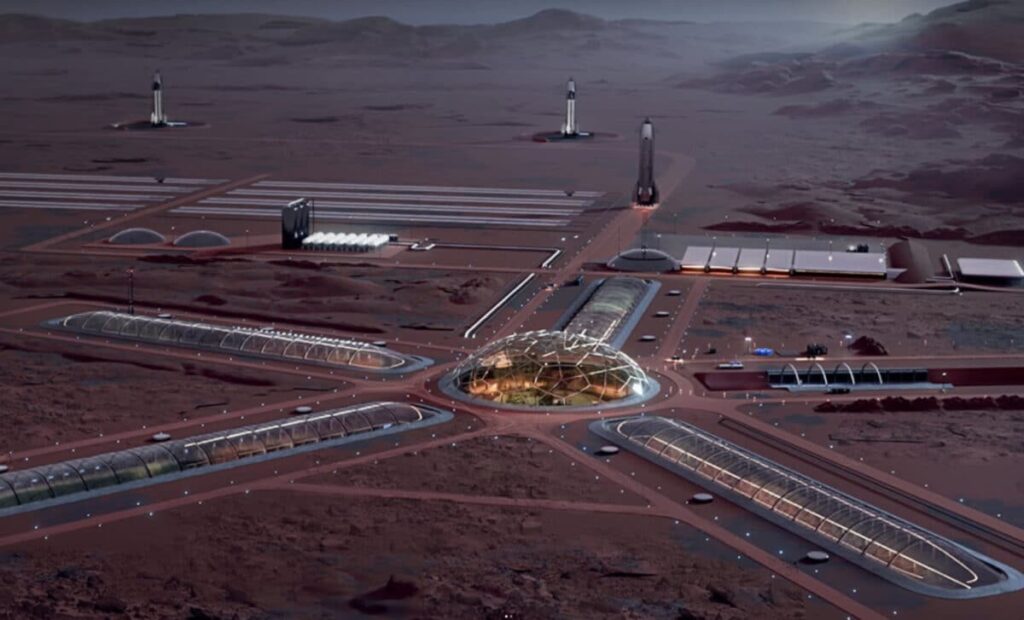
The ambition of establishing a lasting human presence on Mars has long been central to the visions of both NASA and SpaceX. Yet behind the launches, the timelines, and the bold announcements lies a constraint that no rocket can override: Mars is, by most industrial measures, a poor planet. It lacks the concentrated mineral deposits that made large-scale construction possible on Earth, and the cost of shipping materials from our planet across tens of millions of miles is, in practical terms, absurd. A new preprint study on arXiv, led by researcher Serena Suriano, is now forcing a serious reckoning with this reality.
The study’s answer is, on the surface, straightforward. Instead of sourcing materials from Earth or relying exclusively on Martian soil, future missions should mine the Main Belt asteroids, the ring of space rocks orbiting between Mars and Jupiter. In practice, however, the execution of that idea runs headlong into some of the most unforgiving laws of orbital mechanics.
Mars: A Planet Short on Raw Materials
The starting point of the problem is geological. Unlike Earth, Mars never benefited from prolonged tectonic activity, the very process that concentrates metals into rich, mineable veins deep within a planet’s crust. Iron is present on Mars, it is, after all, what gives the planet its red color, but it is diffuse and diluted. Extracting it locally would demand enormous amounts of energy for comparatively modest returns.
The situation is even more stark when it comes to materials critical for advanced construction. As reported by Universe Today, Mars is notably lacking in elements like boron and molybdenum, both of which are essential for manufacturing high-performance materials. The concept of in-situ resource utilization, or ISRU, extracting oxygen from the Martian atmosphere or water from subsurface ice, addresses some survival needs, but it does nothing to solve the metals problem.
Meanwhile, the alternative of supplying materials from Earth is not merely expensive; it is, according to Les Numériques, physically prohibitive. Sending the quantities of iron and metal needed for a genuine city would require thousands of Starship launches from Earth’s surface, each fighting against a delta-v, the measure of velocity change needed to travel between two points in space, of between 12 and 15 km/s.
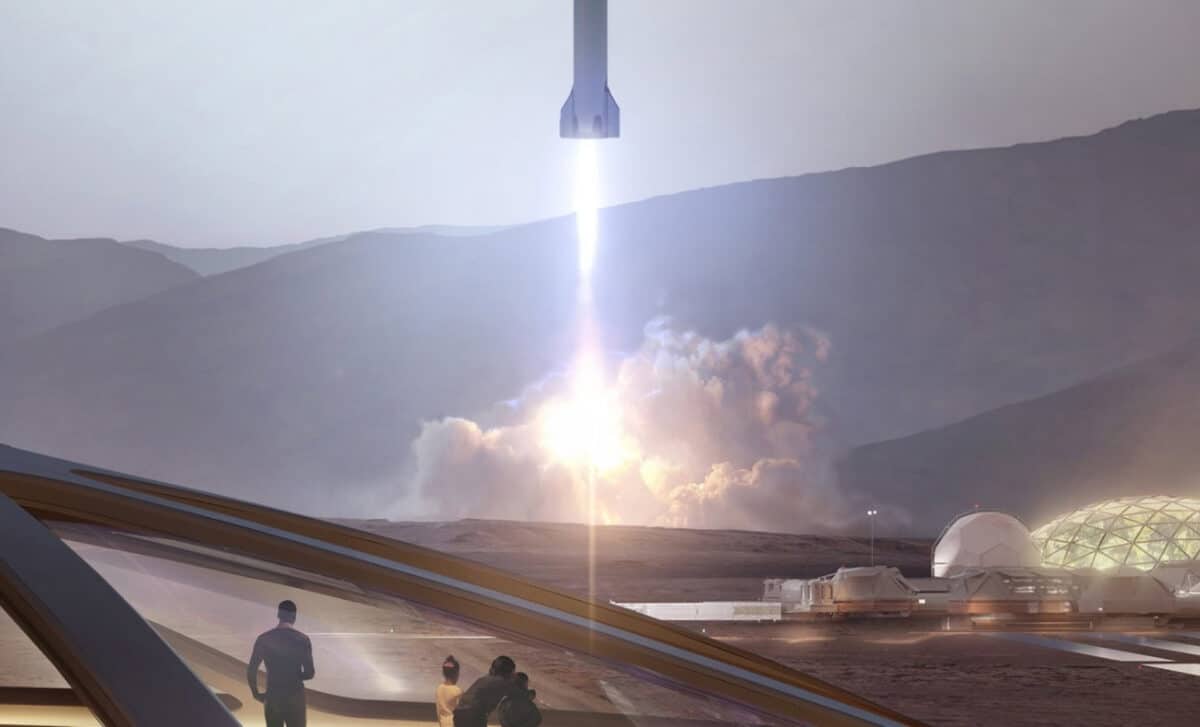 A City on Mars – SpaceX
The Orbital Logic of Asteroid Mining
This is precisely where the Suriano study pivots. According to the research, the delta-v required to redirect resources from the asteroid belt to Mars is only 2 to 4 km/s, a fraction of what it costs to leave Earth. That single figure is what makes the entire proposal worth taking seriously.
The study grounds its logistics in a spacecraft modeled on SpaceX’s Starship: a theoretical vehicle with a dry mass of 120 tons, a payload capacity of 115 tons, and a fuel capacity of 1,100 tons. The gap between payload and fuel capacity is itself a testament to what engineers call the tyranny of the rocket equation. Fully fueled, this vessel can generate a maximum delta-v of 6.4 km/s. The catch: according to the authors, there are precisely zero metallic asteroids close enough to Mars that a spacecraft could mine and return to Low Mars Orbit on a single tank. Most trips would require between 10 and 12.8 km/s, roughly double the vessel’s capacity.
The solution the researchers propose is a two-stop supply chain. The spacecraft would first travel to a metallic, or M-type, asteroid to collect iron and other metals. It would then proceed to a nearby C-type asteroid, rich in water and hydrocarbons, to refuel using a technique called in-situ propellant production, or ISPP. From there, it would complete the journey back to Mars. The study identifies 22 distinct pairs of M-type and C-type asteroids whose orbits align with the 6.4 km/s delta-v constraint over a twenty-year launch window beginning in 2040.
A Painfully Slow Machine, but a Functioning One
The architecture works, in theory. The scale of what it can actually deliver, however, demands some adjustment to expectations. According to the study, a single spacecraft operating this two-stop route over twenty years could bring approximately 200 tons of metal back to Mars. That may sound reasonable until one considers that each individual trip would take around a decade to complete, due to the combination of slow orbital alignments and the grinding pace of in-situ propellant production.
On that last point, the numbers are particularly sobering. Based on Robert Zubrin’s Mars Direct 2.0 plan, the average rate of ISPP is approximately 2 kilograms per day. Filling a 1,100-ton propellant tank at that rate would take over 1,500 years. Scaling up ISPP capability, which is primarily constrained by available power, is therefore identified as one of the key technical hurdles the entire system depends on.
Non-chemical propulsion technologies, such as solar electric propulsion or solar sails, could theoretically reshape the math entirely, and the authors acknowledge their potential. But as Universe Today notes, these technologies are still in early stages, and the prospect of having them ready for a Mars resupply mission within 14 years is, at best, optimistic.
What the Suriano study ultimately demonstrates is that mining the asteroid belt for Mars is not science fiction, it is physics. The logistics are painful, the timelines long, the technical gaps real. But the pathway exists. Mars, in this vision, would not be an isolated outpost sustained by an endless supply chain from Earth, but the anchor of its own industrial hinterland, the first world to exploit the resources of its own spatial backyard.