
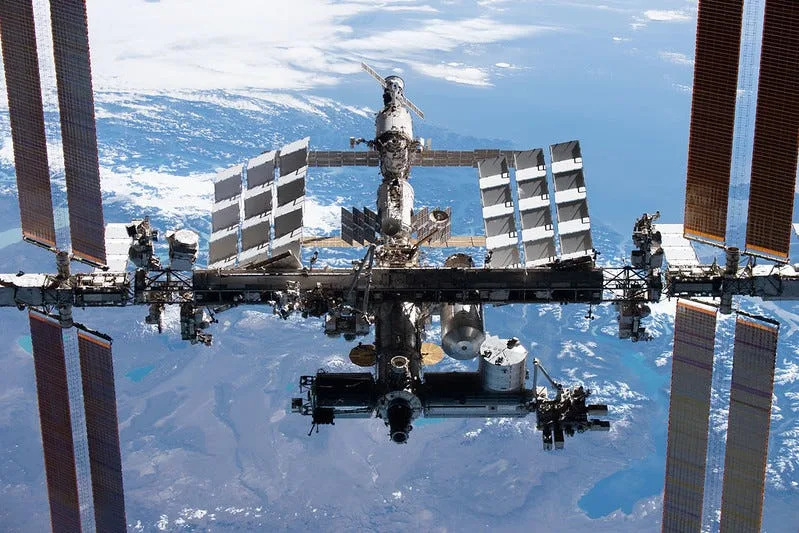
Whether you’re an early riser or a night owl, you can catch the International Space Station soaring over Michigan skies several times each day.
The ISS orbits Earth 16 times per day, and will offer multiple viewing periods for Michigan sky gazers, weather permitting, according to NASA. Best visibility occurs in the hours before and after sunrise and sunset, the space agency advises.
You can track the space station’s path with NASA’s “Spot the Station” app on your phone, offering a live look at the ISS’s location in the sky.
Here’s what to know about viewing the International Space Station.
When can you see the International Space Station from Michigan?
The International Space Station, which completes 16 orbits of Earth per day, is regularly visible to Michigan spectators.
The best time to spot the orbital outpost is within a few hours before or after both sunrise and sunset, according to NASA. That’s because the station reflects sunlight just like the moon, but isn’t bright enough to see during the day.
Cities across Michigan have a daily visibility window, when there are clear skies, in the early morning, evening and late night hours, according to NASA.
The NASA website allows users to enter in numerous cities across Michigan and see forecasts for when the spacecraft will be viewable across multiple days. In the Lansing, Detroit and Marquette, NASA says the ISS will be visible through much of May for 1-7 minutes each day.
How can you track the ISS? There’s an app for that
NASA’s “Spot the Station” mobile app allows users to receive notifications for when the International Space Station passes over their respective locations. The app also provides real-time tracking data.
The mobile app is available to download for free in Apple’s App Store for iPhone users and, for Android users, on Google Play.
The European Space Agency has also developed an online tracker you can bookmark on your desktop that shows where the station is at any given time. The tool even shows the station’s path in the previous 90 minutes, as well as its path 90 minutes ahead.
How to get best look at the ISS
Make sure you have an unimpeded view of the sky to catch the ISS passing overhead. The station’s orbit makes it appear as if it is traveling from west to east.
The “Spot the Station” app will tell you exactly where in the sky the ISS will appear and how high in the sky it will be.
No special equipment is needed to spot the station, which can easily be seen with the naked eye. Binoculars and telescopes, though, will provide an enhanced view that could even unveil details like the station’s solar arrays and individual modules, according to the Planetary Society.
How bright is the ISS? What does it look like from Earth?
The International Space Station can under certain conditions be among the brightest objects in the sky – outshined only by the sun and moon. That means it’s even brighter than Venus, the brightest planet in the sky.
This isn’t because the ISS gives off much of its own light, but because – with its array of solar panels – it is exceptional at reflecting sunlight off it, according to the Planetary Society.
If you spot it, the space station should appear as a solid bright light whizzing across the night sky.
What is the International Space Station?
The International Space Station has been stationed in low-Earth orbit for more than 25 years, typically about 260 miles high, where it has been home to astronauts from all over the world. Throughout its lifespan, the station has served as a test bed for scientific research in microgravity and has in years past opened itself up to private commercial missions.
The orbital laboratory is operated through a global partnership of space agencies, including NASA, Roscosmos, the European Space Agency, the Japan Aerospace Exploration Agency and the Canadian Space Agency.
More than 290 spacefarers from 26 countries have visited the International Space Station, including 170 from the United States alone, according to NASA.
USA TODAY contributed.
Contact Jenna Prestininzi: jprestininzi@freepress.com.
This article originally appeared on Detroit Free Press: Michigan astronomy buffs can see the ISS fly past. How to track, view