
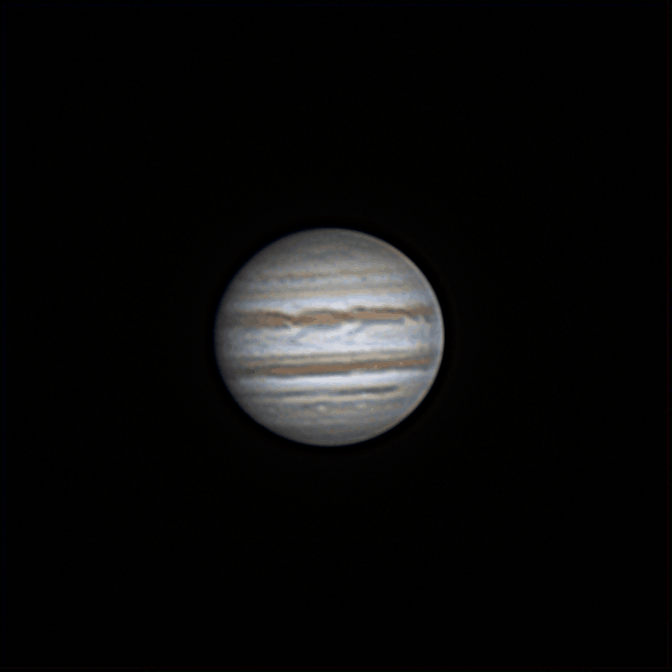
This is why theres a 2min video standard when doing lucky imaging of Jupiters. With Its 10hour day it rotates super fast.. The seeing was Great and steady. Initially I was testing and experimenting with exposure time. 1.6ms,2.7ms, 3.6ms etc with same focus and Histogram as fast as I could do the 2 min videos, averaging less then a minute turn over between 2min videos to set the Exposure settings longer and match Histogram. This represents a 20mins rotation total of 2 min captures, turned into imagies, with less then a minute between each 2minute capture that creates the imagies. This shows just how fast and why that 2 min rule exists. Anymore you get a smearing effect. Keeping in mind if you are doing winJupos or another de rotation program this doesnt apply. The conclusion, on a night with great seeing 1.5ms to 3.5ms with 147fps and a 23% stack is the close in quality as 13ms to 14m 64fps to 80fps 23% stack. Everything in between was not as good. Take this conclusion for what its worth noting I used the exact same settings on all imagies. There's room for possibilities of spending time on each individual picture, structured to that specific picture could yield different results. Also seeing was very consistent, but never perfect. So this is by no mean set in stone. I will continue to experiment.
Skywatcher 200p Classic dob hand tracked small ROI
2x svbony barlow
Svbony uv/ir cut filter
ZWO ASI662MC camera
Sharpcap
PiPP
Autostackert4
Regarding and AstroSurface
Gif maker
by mrstorm1983