
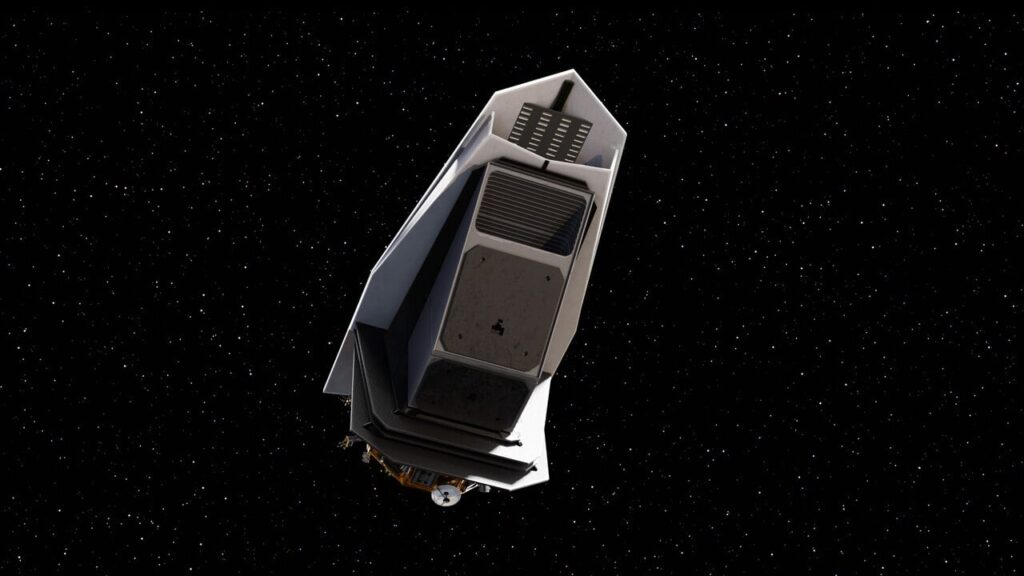
Here’s a sobering thought. Right now, there are asteroids and comets in our Solar System that could pose a genuine threat to Earth and we usually can’t see them. Some are as dark as coal while others hide in the glare of the Sun where our telescopes simply can’t look. A few are small enough to slip past our detection systems entirely and this is the problem NASA’s NEO (Near Earth Objects) Surveyor has been designed, from the ground up, to solve.
The numbers are not reassuring since scientists estimate there are around 25,000 near Earth asteroids larger than 140 metres across. That’s big enough to devastate an entire region if one were to strike. So far, we’ve found fewer than half of that number. Go larger to the truly civilisation threatening rocks over a kilometre wide, and our catalogue is more complete but still not finished. Comets add a further wildcard since they are faster moving, harder to spot, and often arriving from the outer Solar System with very little warning. The uncomfortable truth is that we are living on a planet in an astronomical shooting gallery, and we’re still trying to count the bullets.
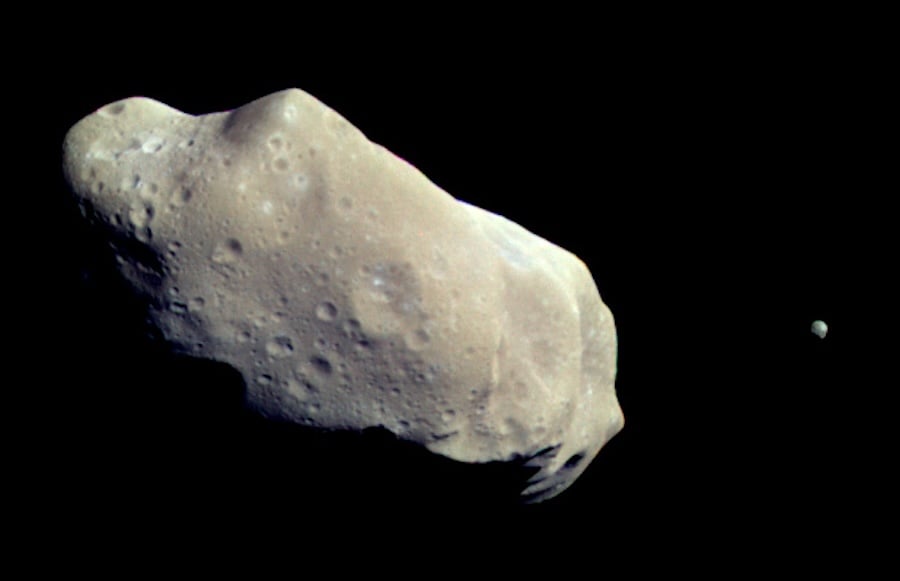 Asteroid 243 Ida captured by the Galileo spacecraft 14 minutes before its closest approach (Credit : NASA/JPL Caltech)
NEO Surveyor is the first space telescope built specifically to hunt potentially hazardous near Earth objects, and it’s currently being assembled in facilities across the United States ahead of a planned launch in September 2027. Congress first tasked NASA with tracking these threats back in 2005, and after nearly two decades of relying largely on ground based surveys, a dedicated space based solution is finally taking shape.
Rather than detecting the light an asteroid reflects which is what ground based telescopes do and generally isn’t all that much, NEO Surveyor detects the heat an asteroid emits as the Sun warms it. This infrared approach works on even the darkest, most light absorbing objects, and crucially, it can peer close to the Sun where conventional telescopes are blind.
To do that job properly, the spacecraft will travel roughly 1.5 million kilometres from Earth to a gravitationally stable sweet spot between our planet and the Sun, known as the L1 Lagrange point. From there, it will spend at least five years continuously scanning the sky, building up a catalogue of objects that no previous survey has been able to find.
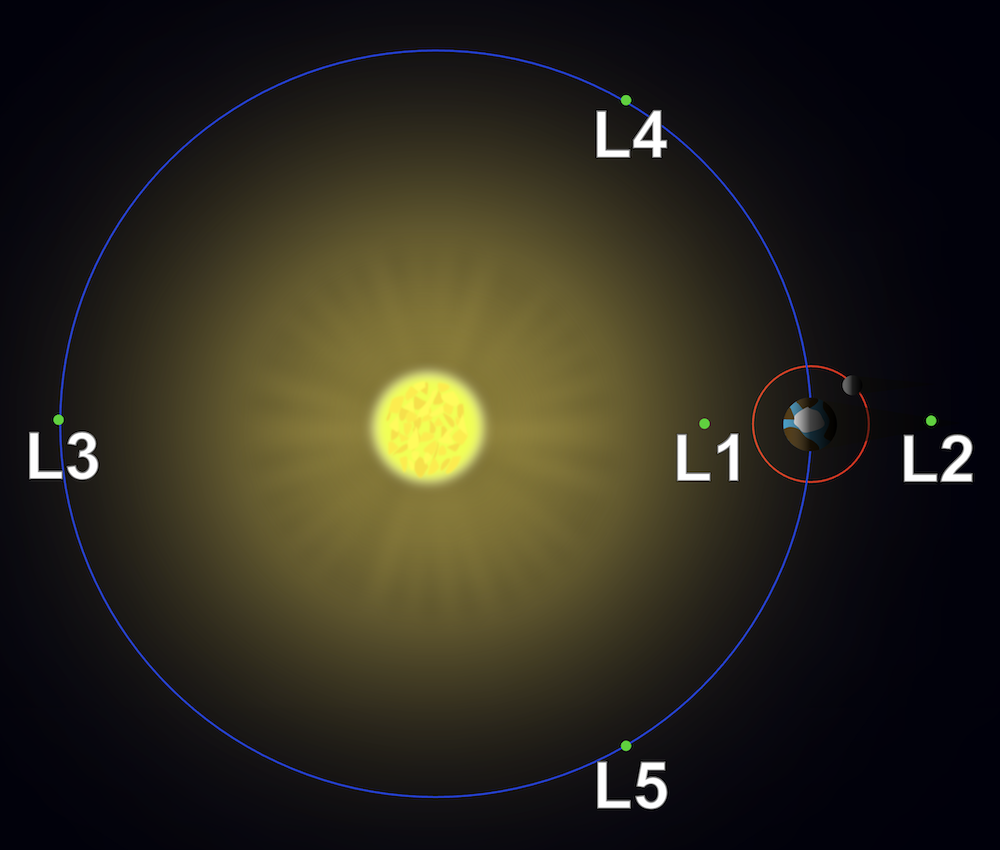 Lagrange points in the Sun Earth system (not to scale). This view is from the north, such that Earth’s orbit is counterclockwise (Credit : Xander89)
The telescope itself is paired with a camera made up of two detector arrays, each one tuned to a different infrared wavelength. By imaging the same patch of sky through both, scientists can measure the temperature of whatever they’re looking at and from that, work out the size of anything they find. Each detector produces a 16 megapixel mosaic of the sky and all of that data will flow back to Earth via NASA’s Deep Space Network for processing, cataloguing, and ultimately feeding into planetary defence calculations.
The mission also carries a massive 6 metre sunshade, by far its most striking physical feature which blocks solar glare from the telescope while simultaneously generating electricity from solar panels on its Sun facing surface.
Planetary defence sounds like the plot of a blockbuster film and indeed Bruce Willis in Armageddon proves that point however the reality is quieter, more careful, and far more important. Teams of scientists and engineers are right now building our first dedicated eye in the sky, one that looks not at the stars, but for the rocks that might one day come for us.
Source : NASA’s Next-Gen Near-Earth Asteroid Space Telescope Takes Shape