
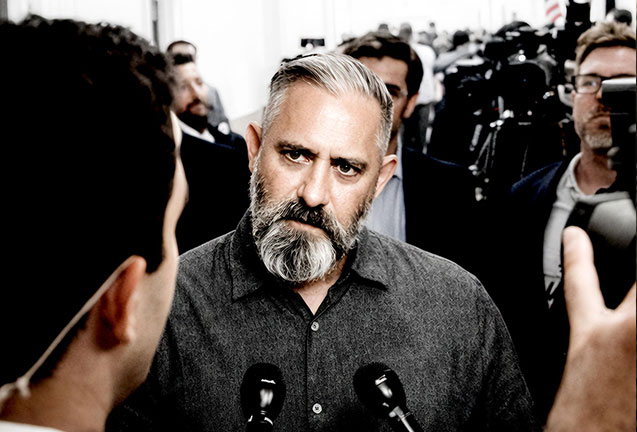
“People will embed themselves in my life from intelligence agencies.”
For Jeremy Corbell, that’s not paranoia — it’s the reality behind Sleeping Dog, the new documentary from director Michael Lazovsky. Opening May 8 in select theaters before becoming available digitally on May 12, the film follows Corbell’s evolution into one of the most visible figures in the UAP (aka UFO) disclosure movement after releasing military-filmed footage and whistleblower testimony that later became part of Pentagon investigations and congressional hearings.
From horror to reality
Lazovsky, who studied at the American Film Institute and comes from a narrative horror background, first contacted Corbell through a class assignment that required students to cold-call someone they admired. At the time, Lazovsky says there also “was just not a lot of work out there,” so when he saw Corbell and veteran investigative journalist George Knapp had launched their Weaponized podcast, he reached out.


“I remember I first came to the studio and I was originally their editor,” Lazovsky says. “And I guess I sort of worked my way up.”
Lazovsky eventually became a producer on Weaponized, but he admits he wasn’t sure what he was walking into when he first met Corbell and Knapp. “I thought, ‘OK, what if this is all BS? What if they just shut off the cameras and start laughing at each other?’” he says of driving to the studio for the first time.
That skepticism didn’t completely disappear, but over time Lazovsky says his instincts as a filmmaker started telling him something else. “I’m very good as a director at catching a lie or a performance,” he says. “Jeremy has not lied to me.”
As Lazovsky became more involved in Corbell and Knapp’s work, he says the story stopped feeling like science fiction. “At a certain point, it became a real-life horror film,” he says. The pressure surrounding Corbell’s reporting became so intense during filming that Lazovsky says he even recorded a contingency video in case something happened to him.
“In the case of Jeremy’s passing, what would happen to the movie?” he recalls. “I was not trained for this … it was a very scary experience.”
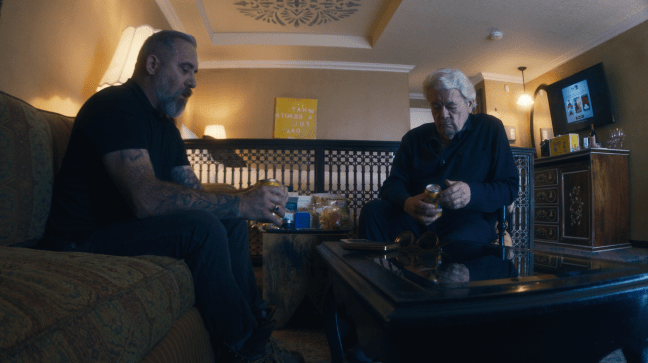 Jeremy Corbell and George Knapp in ‘Sleeping Dog’Falcon Scout Media
Kicking the Sleeping Dog
The film’s title comes from a warning Corbell says he received from intelligence officials: “Don’t kick a sleeping dog.”
According to Corbell, the “sleeping dog” refers to deeply compartmentalized legacy programs connected to UAP technology and alleged “biologics” — programs some people would rather keep buried.
Corbell says becoming a central figure in the disclosure movement wasn’t something he planned. “It wasn’t a choice,” he says. “There comes a point when you know you’ve been lied to and you kind of bear the weight of telling people.”
That eventually led to private meetings with Congress and helping whistleblowers come forward publicly. In one instance, Corbell says he even brought a whistleblower into the halls of Congress disguised as part of his camera crew because the source was too afraid to be identified.
“A lot of what George and I get, we don’t ask for,” Corbell says. “That’s what pisses me off when people say, ‘Oh, you’re CIA.’ That’s not by magic. That’s by hardcore investigative journalism.”
Corbell points to incidents like the 2019 swarms around the USS Omaha and USS Russell — where more than 100 UAP were observed around Navy warships across a roughly 100-mile radius — as proof the conversation around UAPs is becoming impossible to ignore. He notes that the Department of Defense later confirmed footage released by him and Knapp was authentic and officially designated as UAP footage.
“That was a crazy move,” Corbell says of the Pentagon publicly validating the videos. “That’s never happened in history with journalism before.”
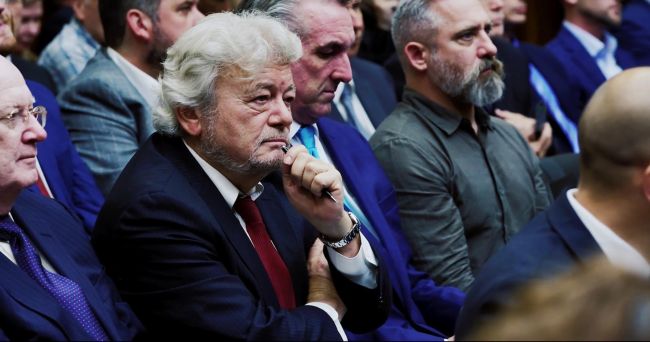 ‘Sleeping Dog’ Falcon Scout Media
The Limits of Disclosure
The secrecy surrounding the programs discussed in Sleeping Dog also begs a bigger question: who actually has access to this information?
Corbell argues that the answer is far more limited than most people realize. “There are a very finite number of people that are read into the reality of UAP,” he says. “The craft themselves, the technology.”
According to Corbell, the compartmentalization is so extreme that even presidents may not know the full story. He points to former President Bill Clinton, who publicly said on Jimmy Kimmel Live! that he tried to get answers about UFOs while in office. “It’s not the first time a president would’ve been lied to,” Corbell says, referencing Clinton’s remarks.
Corbell compares the secrecy to nuclear programs, where information is distributed on a strict need-to-know basis across intelligence agencies. “We all know nuclear science exists, but not everybody can make an atom bomb,” he says. “Some people are read in, some people are not.”
When asked whether former President Barack Obama likely knows more than he can publicly say, Corbell points to the culture surrounding classified programs. “There are certain programs that are protected where you’re supposed to deny even to Congress,” he says. “That is part of the protection program.”
The conversation naturally turned to whether a president like Donald Trump would ever choose to publicly disclose that information. “Come on,” Corbell says with a laugh. “It’s the greatest PR move of all time.”
Still, Corbell argues the issue goes beyond politics and into national security. He says intelligence agencies view the potential reverse-engineering of unknown technology as a strategic advantage worth protecting.
“The real goal here is to create weaponry and defensive technologies that would be beneficial to the United States of America,” he says. Corbell points to whistleblower testimony from former intelligence official David Grusch, who testified under oath before Congress that the government possessed recovered “biologics” tied to UAP programs.
“That is the closest held secret in the American intelligence agencies,” Corbell says. “Not everybody’s exposed to that, but it happens to be true.”
The Human Cost of Truth
For Lazovsky, the film became less about UFO sightings and more about the people carrying the weight of the information. “The conversations when we would record Weaponized… when we turned off the camera were way more interesting than what was actually going out,” he says.
That shift pushed the documentary into more personal territory. Corbell initially resisted including scenes where the pressure of the work became visible on camera. “I didn’t want that stuff in there,” he says. “I was getting a lot of pressure to not bring people to Congress … a lot of pressure about our reporting. Whether that pressure was perceived or real, it’s all the same to you.”
Corbell says that pressure has fundamentally affected the way he interacts with people. “It’s hard for me to make new friends,” he says. “People will embed themselves in my life from intelligence agencies … three, four years down the line, they’re trying to get you to solicit to entrap you.”
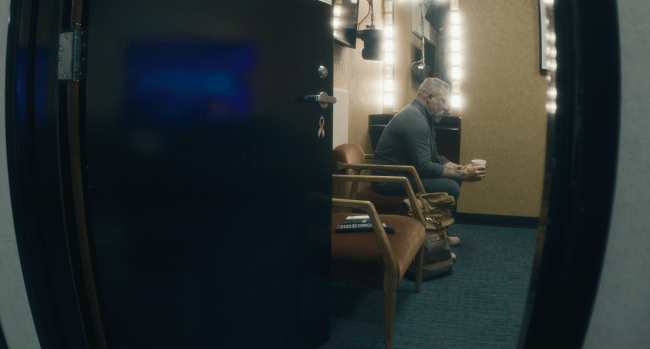 Jeremy Corbell in ‘Sleeping Dog’Falcon Scout Media
Lazovsky ultimately decided to keep those moments in the film because they showed the emotional cost behind the reporting. Corbell has described Sleeping Dog as “the most difficult thing I have ever allowed people to see, personally.”
For Corbell, the bigger issue goes far beyond UAPs themselves.
“Michael’s movie’s about journalism,” he says. “It’s about freedom of speech, which means freedom of thought, because if we don’t know what we’re supposed to be talking about, we don’t have freedom of thought.”
Corbell says he hopes Sleeping Dog ultimately pushes audiences to think beyond the fascination of the subject itself and ask bigger questions about secrecy, transparency, and who controls access to information.
“More importantly, this is a topic that they don’t want you to be able to have open, scientific, philosophical discussions about,” he says.