
Project aims to be the first to measure volatile gases by heating lunar soil while on the Moon.
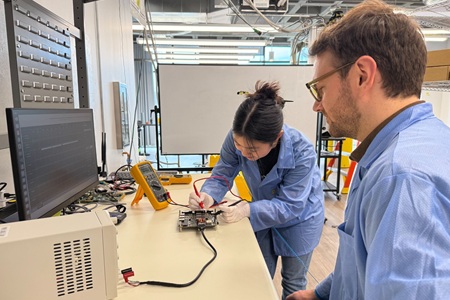
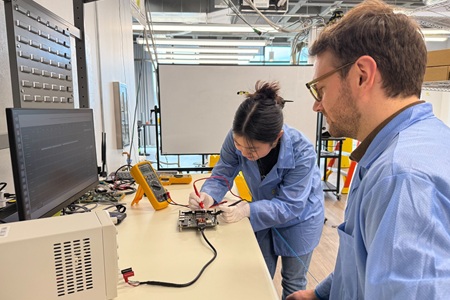 Interlune mechanical engineer Jessica Wu (left) and senior electrical engineer Jonathan Lee (right) test avionics subsystems in the lab at the company’s Seattle headquarters. Photo credit: Interlune
Natural resources company Interlune has been awarded a $6.9m Small Business Innovation Research (SBIR) Phase III contract from NASA under its Space Technology Mission Directorate’s Game Changing Development program to support the development of lunar resource extraction technologies.
The 18-month, firm-fixed-price contract will fund the design and development of a payload suite capable of capturing on-site measurements of gases trapped within lunar regolith while demonstrating technologies to extract valuable resources such as helium-3 and hydrogen. The project marks a significant step toward supporting long-term human presence on the Moon and building a sustainable lunar economy.
Rob Meyerson, co-founder and CEO of Interlune, said: “We’re gathering data and advancing technologies that serve multiple purposes across industry and government. NASA’s continued investment in space technology enables technology development projects like this one to ensure America’s leadership in building the lunar economy.”
According to Dr Elizabeth Frank, the mission will be the first to measure volatile gases by heating lunar soil directly on the Moon, offering scientists new insights into the composition and extraction properties of lunar regolith. She noted that the data will also help determine the energy required to recover resources such as helium-3 from the lunar surface.
The payload, targeted for launch in 2028, builds on earlier work carried out through NASA’s Flight Opportunities programme and the National Science Foundation, where Interlune tested prototype systems aboard parabolic flights simulating lunar gravity. The system is designed to fly aboard one of the robotic landers being developed under NASA’s Commercial Lunar Payload Services initiative.
Under the contract, Interlune will design, build, and test engineering development units and flight hardware capable of collecting lunar soil samples, sorting particles by size, extracting solar wind gases through thermal and mechanical processing, and measuring the released gases. The payload will include a robotic arm and scoop, particle sorting technology, gas extraction systems, a multispectral camera for estimating helium-3 concentrations, and a mass spectrometer based on NASA’s Mass Spectrometer Observing Lunar Operations technology.
Data collected during the mission is expected to provide valuable information for NASA and the broader lunar science community on solar wind volatile concentrations and lunar mineralogy. The findings will also support the development of Interlune’s planned full-scale helium-3 harvesting system and technologies that could contribute to the construction of future lunar infrastructure, including the Artemis programme Moon Base.
Interlune said its long-term business model centers on harvesting helium-3 from the Moon and supplying it to customers on Earth, with revenues helping fund additional lunar resource extraction systems and infrastructure services. The company currently holds nearly $500m in binding helium-3 purchase orders, including agreements with the US Department of Energy and companies in the quantum computing sector.
NASA’s Game Changing Development programme focuses on advancing next-generation technologies that support the agency’s future lunar exploration and long-duration space missions.