
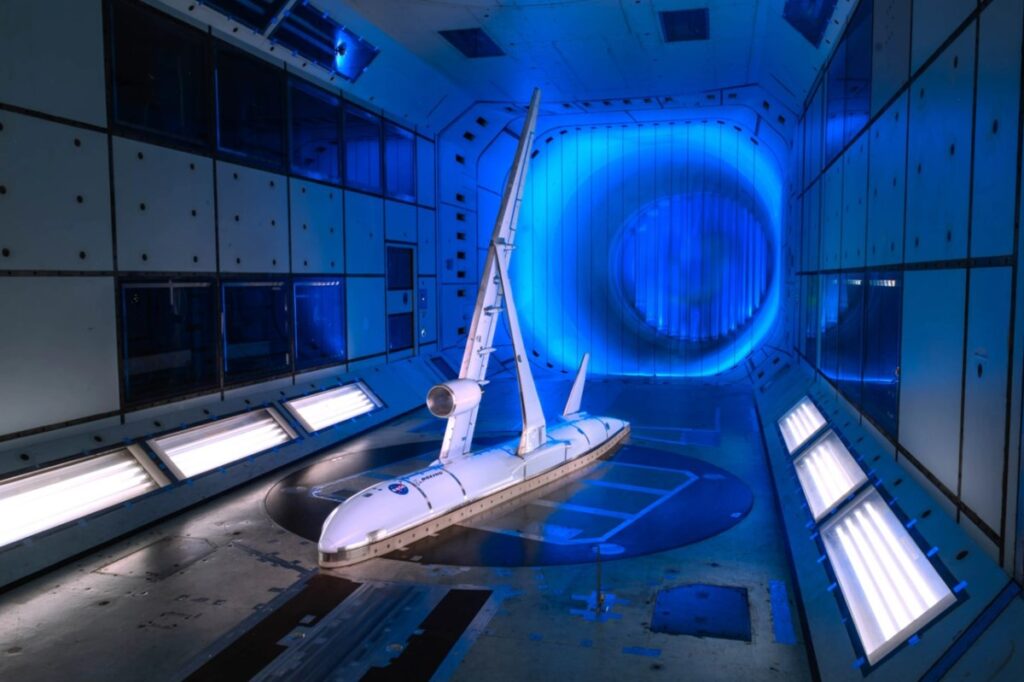

A scale model of Boeing’s Subsonic Ultra Green Aircraft Research concept undergoes testing in a 5-meter wind tunnel operated by the company QinetiQ in December 2025. Source | QinetiQ
NASA (Washington, D.C., U.S.) and Boeing (Arlington, Va., U.S.) have completed wind tunnel testing on the truss-braced wing (TTBW) configuration, an advanced aircraft design intended to improve aerodynamic efficiency.
Working on this together for more than a decade, the TTBW involves a long, thin wing with aerodynamically shaped structural supports for reducing fuel and operational costs for future airliners. Because it requires a major redesign for aircraft the size of a passenger jet, the concept requires extensive study.
The most recent round of testing used a complex wind tunnel model to collect data on how air flows around a truss-braced wing model and the forces that would be exerted on such a wing in flight. The test used a semispan model — essentially half an aircraft mounted on a wind tunnel floor. The model has features built in to simulate the mechanisms that increase the amount of lift a wing produces. By adjusting the model’s slats, flaps and other moving control surfaces, the team can configure it to the low-speed, high-lift settings of takeoff and landing conditions.
The model is part of a collaboration to test what’s known as Boeing’s Subsonic Ultra Green Aircraft Research (SUGAR) concept.
CW gave an extensive report on the TTBW in 2023. Read more about the vision behind this design and how it relates to future single-aisle ambitions.
In December 2025, teams completed testing of the model wind tunnel operated by QinetiQ (Farnborough, U.K.). This large wind tunnel uses pressurized conditions to predict airplane behavior in takeoff and landing conditions. The tunnel’s large size gives the model fidelity to better predict the behavior of a plane in flight.
NASA and Boeing research teams analyzed data in real time to ensure the model performed as expected. Researchers are still reviewing the full results, but the test has already added valuable information to a growing body of research aimed at reducing fuel use in future aircraft designs.
Moreover, the testing was just the latest stop for this research. NASA and Boeing have tested the concept at multiple NASA facilities to collect data as the partners work to build a comprehensive understanding of this advanced airframe concept.
NOTE: Work began in NASA’s Advanced Air Vehicles Program and continues as part of the Subsonic Flight Demonstrator project under the Integrated Aviation Systems Program in the agency’s Aeronautics Research Mission Directorate.