
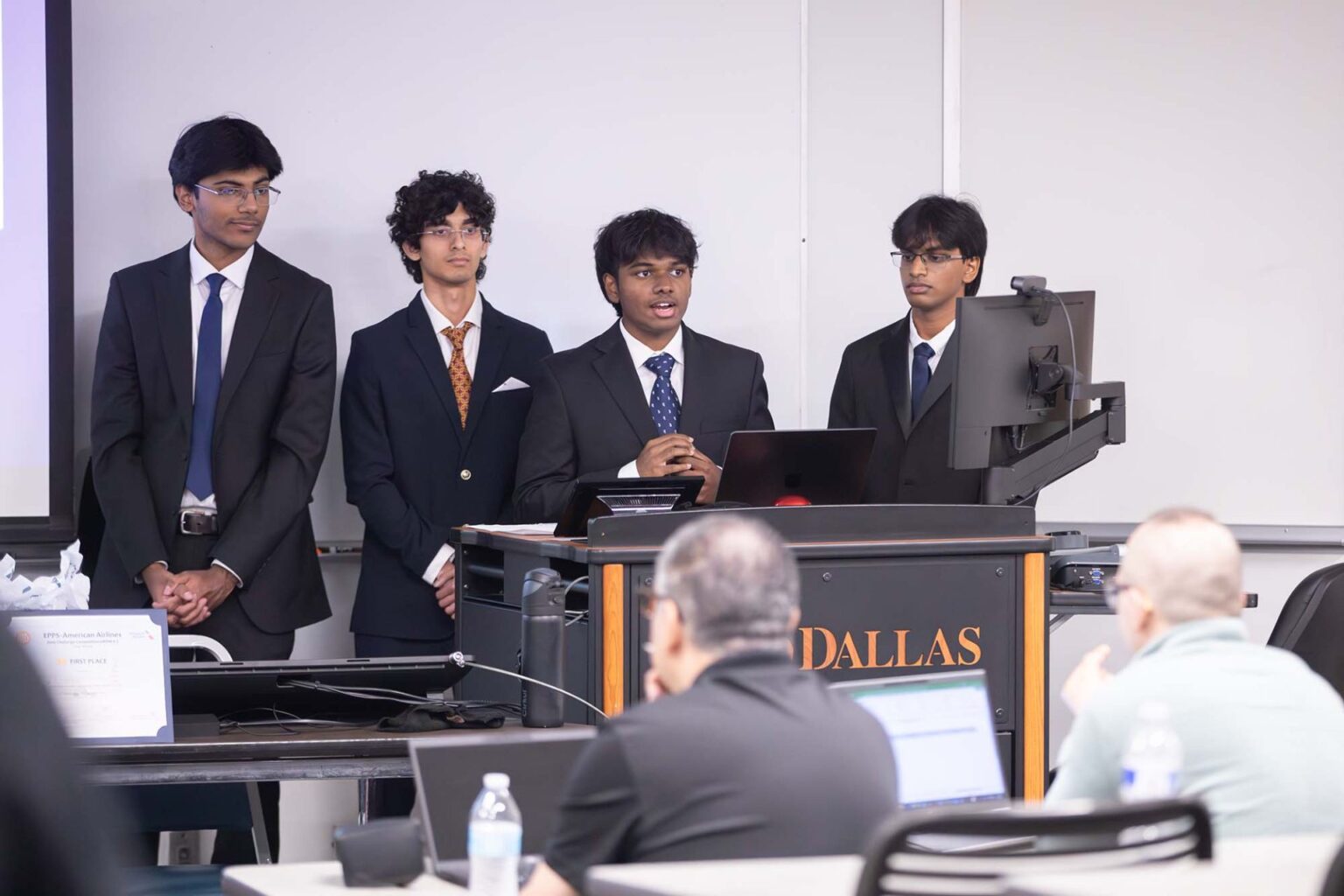
From left: Fawaz Jamshed, Arpit Khavate, Nandhan Alahari and Lokesh Reddy Penugonda were part of the first-place team at the EPPS-AA Data Challenge Competition.
University of Texas at Dallas students competed in an American Airlines data analysis challenge April 24 in which they were tasked with how to manage flight sequences during bad weather.
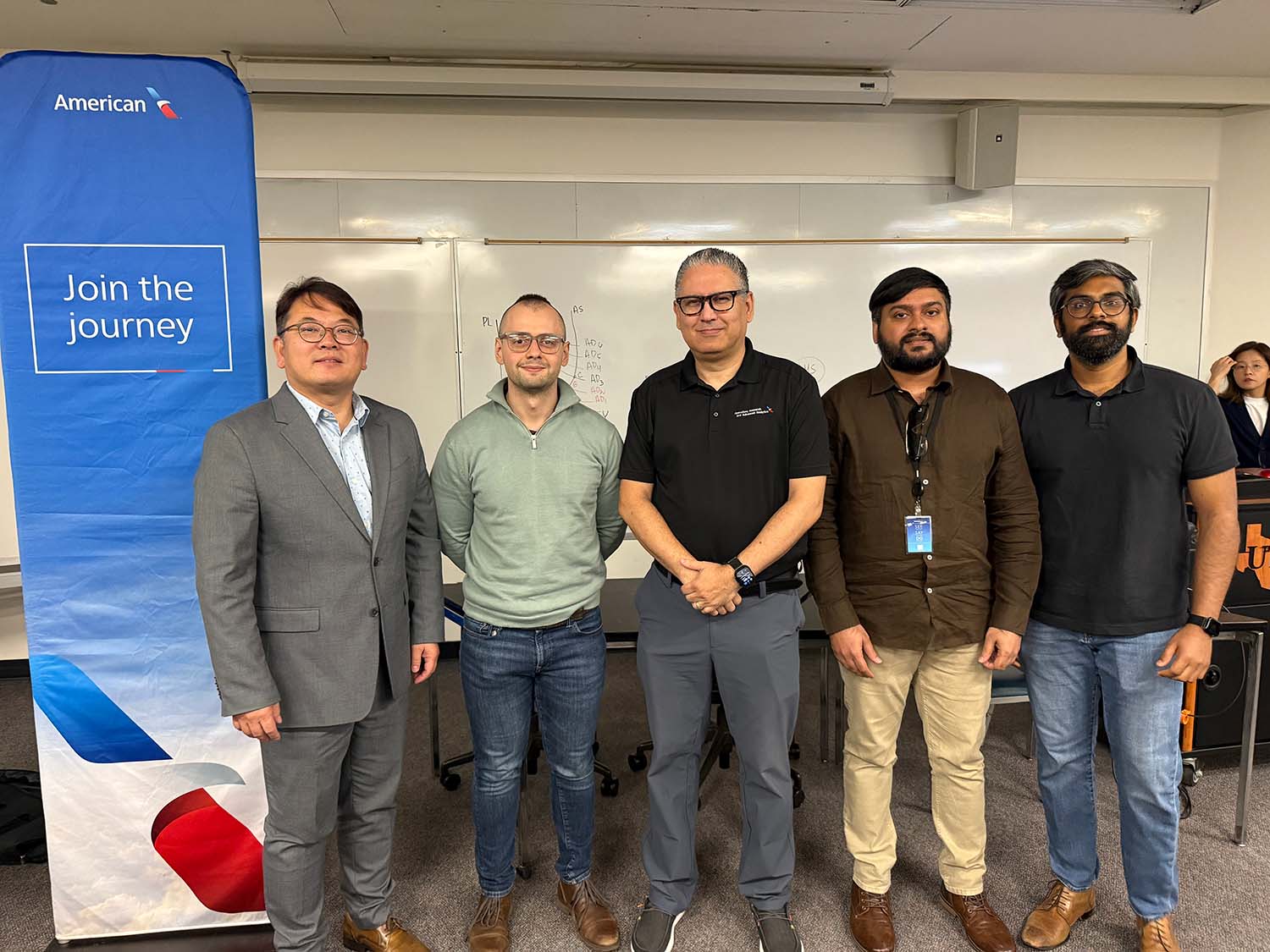
From left: Dr. Dohyeong Kim of UT Dallas and American Airlines representatives Dr. Samuel Rodriguez-Gonzalez, operations research scientist; Dr. Jose A. Ramirez-Hernandez, senior lead operations research consultant and data scientist; Dr. Viswanath Potluri, lead operations research scientist; and Dr. Shreyas Ravishankar, operations research scientist.
The School of Economic, Political and Policy Sciences (EPPS) partnered with the airline for the EPPS-AA Data Challenge Competition, which was organized by Dr. Dohyeong Kim, Robert E. Holmes Jr. Professor of public policy, geospatial information sciences and social data analytics, and Dr. Jose A. Ramirez-Hernandez, a senior lead operations research consultant and data scientist at American Airlines.
The airline devised the authentic industry challenge, and EPPS managed the recruitment and organization of students, Kim said. A team of American Airlines data scientists and other industry professionals judged the entries.
Public health sophomore Rishitha Duggi, who placed third along with her partner, computer science freshman Vedant Joshi, said the inspiration for their project, which addressed pilot fatigue and its relationship with flight delays, came from looking through an interdisciplinary lens.
“The basic idea is that when one flight runs late, it doesn’t stop there,” she said. “What made our idea different was that we calculated transmission and absorption of delay across airport sequences, taking inspiration from epidemiology. We wanted to build a score that could identify which flights were most at risk of triggering that chain reaction and include the flight crew’s fatigue levels at different times of the day.
“Vedant and I realized that delay propagation isn’t so different from how a disease spreads. Once we got that connection, we knew that was our topic.”
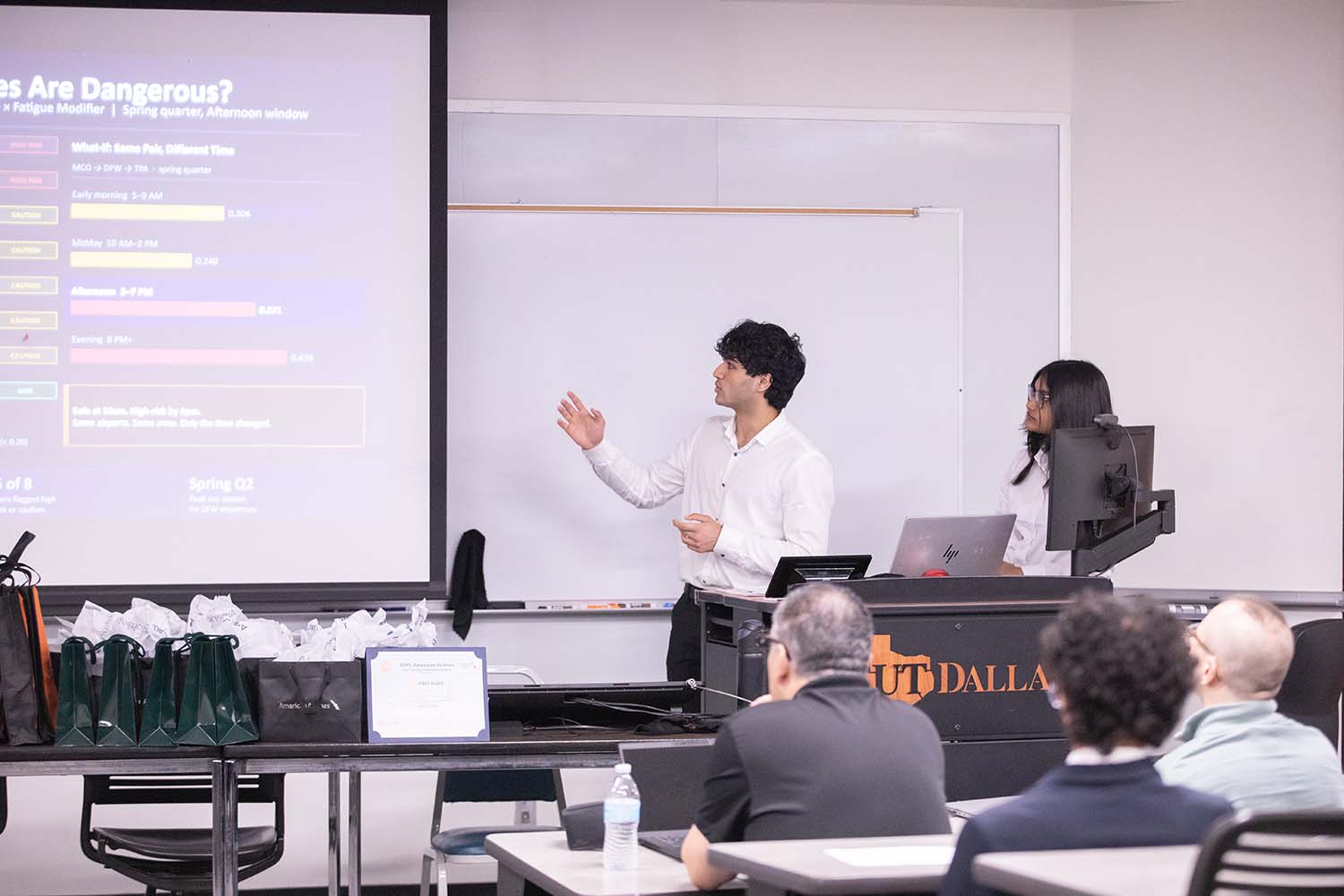
Computer science freshman Vedant Joshi (left) and public health sophomore Rishitha Duggi placed third for their project, which focused on pilot fatigue and its relationship with flight delays.
Corporate-partnered events provide a rare bridge between academic curriculum and industry practice by granting students access to complex, real-world problems that classroom environments often lack, Kim said.
“By fostering interdisciplinary collaboration and concluding in a professional showcase, UT Dallas ensures its students build a ‘proof of work’ portfolio that carries significant prestige in a competitive job market,” he said.
Competitors were recruited through a campuswide campaign targeting both undergraduates and graduate students. Twenty-three teams successfully submitted detailed case reports. A panel of EPPS judges reviewed the submissions based on their analytical depth, and the top seven finalists were invited to give seven-minute presentations. The top three teams were awarded prizes and certificates.
Teams were not given any proprietary files, Kim said. Instead, they used diverse public data sources to inform their reports.
EPPS plans to make these challenges a regular fixture of its curriculum and extracurricular offerings, Kim said.
“Our goal is to establish a recurring pipeline of industry-sponsored data challenges that keep our students at the forefront of the field,” he said. “By providing outlets like the American Airlines data challenge, we ensure our students aren’t just learning from textbooks, but also solving the actual operational constraints faced by leading global industry partners today.”
Challenge Winners
First place
Nandhan Alahari, computer science sophomore
Harshavardhan Bala, computer science sophomore
Fawaz Jamshed, electrical engineering junior
Arpit Khavate, computer science freshman
Lokesh Reddy Penugonda, computer science junior
Second place
Zeeshan Ahmad, information technology and management graduate student
Sai Kiran Krishna Mohan, cybersecurity technology and policy graduate student
Prashanth Reddy, business analytics and artificial intelligence graduate student
Vighanesh Sharma, computer science graduate student
Third place
Rishitha Duggi, public health sophomore
Vedant Joshi, computer science freshman