
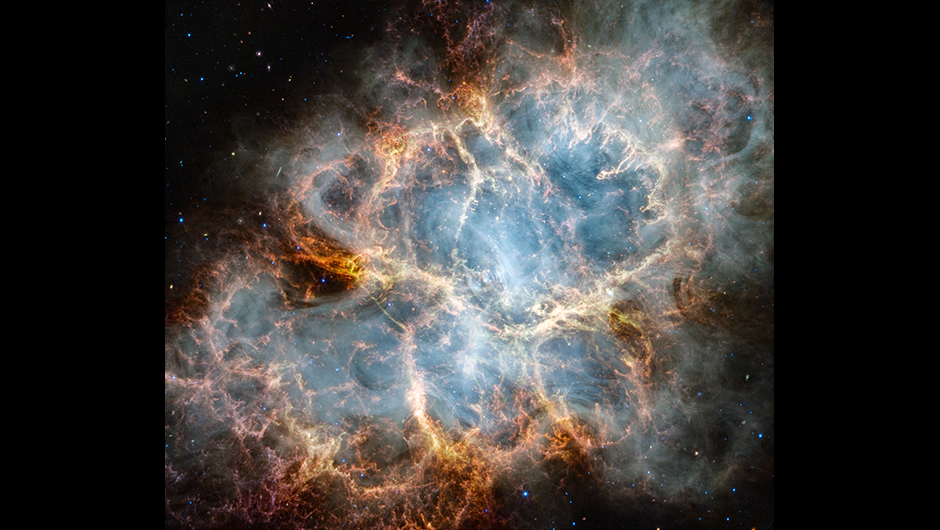
People must remember that God is big enough to care about them and their day-to-day cares when they look at the size the of the universe and feel small, according to Jesuit Brother Guy Consolmagno, president of the Vatican Observatory Foundation.

Consolmagno, a former director of the Vatican Observatory, offered the third annual Bishop Kevin Birmingham Lecture April 20. The event was hosted by the Illinois Patrons of the Arts in the Vatican Museums and Holy Name Cathedral.
“There are about 10 billion stars in our galaxy, and there are about 10 billion galaxies visible to us in the universe,” Consolmagno said at the beginning of his lecture titled “Exploring Wonder, Science, Beauty and Faith.” “I will say those are just the ones we can see. … In a universe that big, how can God actually pay attention to our tiny world? … What kind of relationship do we possibly have?”
The answer, Consolmagno said, has more to do with the nature of God than with the nature of the universe.
Those who doubt the ability of God to know and love each individual person are making God small, like a human being who can’t pay attention to two things at once.
“God is big enough to make everything important,” Consolmagno said. “We’re limited; God’s not. God can make everything in the universe important, and that’s what God does, because God made it, and God found everything good.”
Indeed, Consolmagno said, clues to the nature of God are found in the creation story in Genesis.
While modern science contradicts the cosmology of Genesis, Consolmagno said, whoever wrote it was working with the best science at the time, adding that the book of Genesis dates from the Babylonian captivity in the sixth century BC, he said.
It contrasts with the Babylonian creation myth that the exiled Jews would have heard. That myth tells of a quarrel between a dragon and supernatural dogs creating the universe, leading, eventually to what they saw as the pinnacle of the universe, the city of Babylon, with humans as a sort of byproduct, Consolmagno said.
“The experience of the Babylonian captivity provoked a spiritual crisis in the Jews, which then led to a deeper faith in God,” Consolmagno said. “They took the Babylonian story and said, ‘Well, that’s what everybody knows, but here’s what’s different.’”
The creation story of Genesis turns the Babylonian myth on its head with several notable differences, starting with the idea that God existed before the universe and thus is not part of the universe, and that God saw creation as good, and that humanity was the last and most loved part — except, Consolmagno joked, for the real last step of creation: the weekend.
It’s also notable, he said, that the first thing God created was light, making the rest of creation visible for those who wish to observe it, and that “creation is the deliberate word of the creator. It is something that God wanted to do.”
Because God created the universe and all of its laws, and created in light so that it would be observable, and created people with the ability to observe and reason, God created a world where science is possible.
“All of these aspects are necessary for science to have any chance of actually happening,” Consolmagno said.
Humans, he added, are natural scientists, wired to look at the sky. Who, he asked, has seen the craters on the moon or the rings of Saturn through even a small telescope, and has not said, ‘Wow!’?”
Scientists go wrong when they seek to find God inside the workings of the universe, he said, as enlightenment-era scientists did, trying to demonstrate the existence of God in natural phenomena they could not explain.
“The ‘God of the gaps’ was an issue when Isaac Newton thought that he could use science as a way of proving why there had to be a God, because, ‘Hey, I’ve got all these things that I can explain, but here’s this spot where I can’t. I guess God must be responsible for that.’ And that sounds great until you realize, ‘Oh, I can explain that. I guess I didn’t need God.’ After a while, you close the gaps and you don’t need God anymore. … A lot of modern scientists who don’t have very good basis in philosophy have fallen into that trap.”
Their mistake is in looking for God, who created the universe, inside of creation, Consolmagno said, adding that God can be found in the things that cannot be measured with science, such as love and beauty.
Science, on the other hand, does not define God, but does help people to know God.
“Regardless of how you picture the universe or the details of its creation, the universe was created by a God outside the universe, acting deliberately on love,” Consolmagno said. “And that always stays true. And the questions we ask remain: Who are we? Where did we come from? What are we doing here? These are questions that a scientific cosmology can help inform, but not questions that a scientific cosmology can answer, because they’re not that kind of question. They are mysteries for contemplation.
“The exploration of God’s creation is the response to an invitation we’ve been given, to spend this time with the Creator. We get to play with them. We uncover these wonderful puzzles that he has set for us. We marvel at the way the universe fits together with a logic that’s harmonious and elegant. And that’s how we begin to know God’s personality. And even if you’re not a professional scientist, you can still be fascinated by the workings of the universe. Anybody can take part in this game.”