
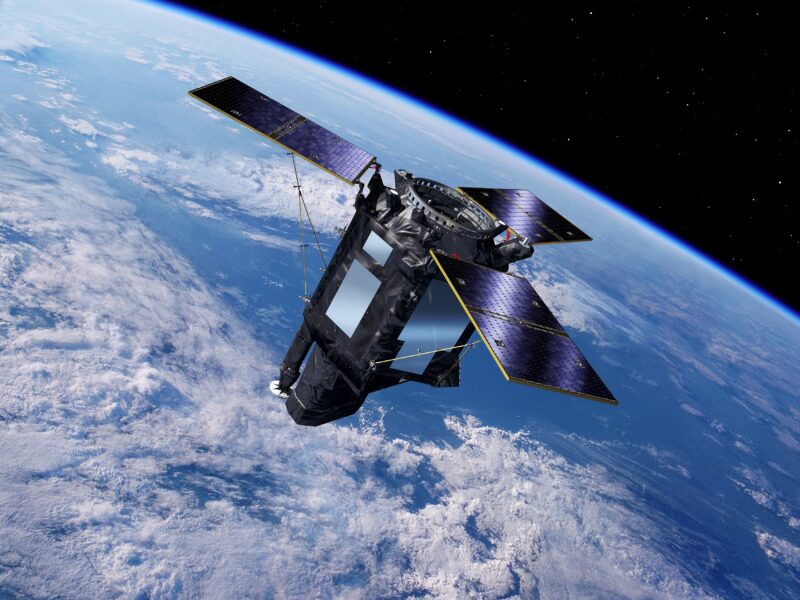
(CN) — Seeking to boost Europe’s space industry and help it catch up with the United States and China, the European Union is developing rules to prevent more junk from clogging Earth’s orbit, safeguard satellites from hackers and create a traffic control system for space.
The proposed EU Space Act is an attempt to craft the world’s first chapters of space law that would set some guardrails around a revolution taking place in outer space — its rapid commercialization.
Last year, 4,544 spacecraft were launched into orbit, twice as many as 2024 and a five-fold increase from a few years ago, most of them from Elon Musk’s SpaceX and Starlink companies.
The global space economy is growing about 9% a year and it’s projected to triple by 2030, potentially reaching $1.9 trillion by 2035.
But the commercialization of space is bringing new problems: Does outer space need a traffic management system, like airports have, for the more than 14,000 satellites whizzing by overhead? What about pollution and junk in outer space? What are the rules there? Who’s making sure satellites sent into orbit don’t get hacked, causing serious harm to vital tasks back on Earth?
The EU Space Act seeks to answer these questions and provide domestic space companies a common set of rules across the 27-nation bloc. At the same time, it would force outside competitors, particularly American ones, to play by European rules in the race for the stars.
Broadly, the law seeks to set up a traffic management system for spacecraft; lay down rules to ensure things launched into space don’t end up as dangerous floating junk or cause preventable pollution; and compel satellite operators to install heavy duty safeguards against cyberattacks.
“The EU is recognizing the importance of the space economy for the EU,” said Jonathan McDowell, an astronomer and space expert at Durham University in England.
“It is a shift from seeing space as a governmental activity to seeing it as a commercial activity,” McDowell said, speaking by telephone. “That’s a shift that happened in the U.S. some years ago, decades ago.”
However, this attempt at bridging the gap with the U.S. is opening a new front in spiraling trade tensions with Washington.
American policymakers contend the EU law would put unfair burdens on U.S. companies doing business in the EU, especially for the vast communications satellite constellations being built by Musk’s Starlink and Jeff Bezos’ rival Amazon Leo.
“It has a number of provisions in it that function more like a trade barrier and less like just neutral space policy,” said Kristian Stout, an expert on space policy at the International Center for Law & Economics, an Oregon-based think tank. “This is really just industrial policy where the European Union is trying to favor its domestic operators.”
The U.S. doesn’t have an equivalent to the EU Space Act and American space operators generally abide by internationally-developed guidelines or rules set down by U.S. agencies when it comes to space debris, orbital traffic management and cybersecurity.
The White House has threatened to hit back with countermeasures if Brussels passes the law, which could happen before the end of the year.
“Caring about debris and caring about space junk and all of this stuff, no one’s saying that’s unreasonable,” Stout said. “The abnormality comes that the EU is creating a standard that’s different than where a lot of the world consensus has been.”
Bringing rules to space
The EU, though, sees itself as a much-needed sheriff in space.
“Space is a new frontier,” Andrius Kubilius, an EU commissioner in charge of defense and space, said in June 2025 as the bloc rolled out the proposals. “With the Space Act, we’re bringing law and order to the frontier.”
 Andrius Kubilius, the European Union commissioner for defense and space, speaks at the Govsatcom conference in Luxembourg in February 2026. (Mathieu Cugnot/European Union via Courthouse News)
Ursula von der Leyen, the EU’s chief executive, said the law would “make the skies safer, protect our satellites and strengthen our space economy.”
It’s not true there are no laws in space — but many of them date to the Cold War and the cosmic struggle between the United States and the USSR.
The most important international agreement was the 1967 Outer Space Treaty, sometimes called the Magna Carta of space law.
The treaty established the use of outer space must benefit humanity and that countries cannot stake claim to it. It also forbade placing nuclear weapons or other weapons of mass destruction in space. It made states both responsible and liable for their space activities and called on them to not pollute space.
“Space has changed so much in the past 50 years that there’s really a desperate need for a new look at the Outer Space Treaty,” McDowell said. “Yet the international political situation is not favorable for making any progress.”
Anna Blechová, a space law researcher at Masaryk University in Czechia, agreed.
The main purpose of the Outer Space Treaty was “to stop space wars” and ensure space was not militarized, she said.
“They didn’t react to any of the new threats we are facing currently,” she said. “It had nothing about cybersecurity or space traffic management.”
The EU Space Act would create a set of rules for all 27 EU nations. As it stands, 13 EU states have their own national space laws.
“The harmonization is a good thing to make the European space market more clear and more coherent,” Blechová said. “If you had each European country taking a different approach to regulation, countries could try to take advantage, undercut other countries.”
Clémence Poirier, a space expert at the Center for Security Studies at ETH Zurich university, said the hope is that replacing the existing “inconsistent and scattered regulatory framework” will smooth the path for EU companies to build spaceports, launch satellites and license space services. “It remains to be seen whether it will make things easier or more complicated and bureaucratic.”
Tackling the space junk quandary
Space junk is already a big problem. The EU Space Act aims to ensure Europe isn’t adding even more into Earth’s orbit.
Tens of millions of pieces of junk are circling the Earth and only a fraction — mostly objects bigger than a softball — are large enough to be tracked. But even debris smaller than an inch can destroy a large satellite.
About 44,870 pieces of junk — dead satellites, spent rocket stages and pieces of spacecraft that exploded or broke up in space — are under surveillance, according to the European Space Agency.
The EU Space Act would require operators to draw up detailed plans to ensure they don’t create more debris in space.
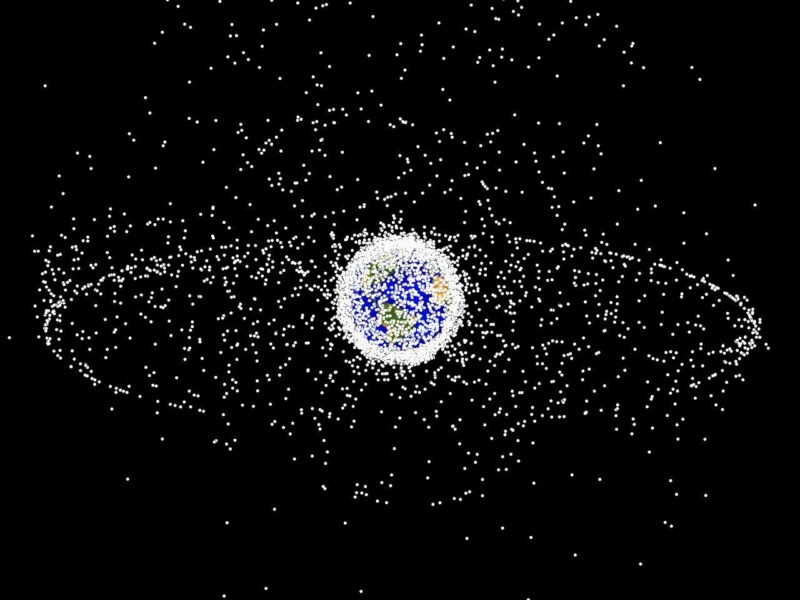 A computer-generated image shows objects in the Earth’s orbit being tracked. About 95% of the objects in the illustration are orbital debris. (NASA via Courthouse News)
For example, to avoid collisions that cause more debris, satellite operators would need to hire around-the-clock debris-tracking services and use satellites capable of being moved by controls from Earth in case they need to be shifted to avoid hitting floating debris.
“Space operators shall be required to take comprehensive, proportionate and all-hazard measures to manage all risks to space infrastructure,” the draft law reads. “These measures extend throughout the entire lifecycle of a space mission (from design and manufacturing to launch, operation and disposal) covering both digital and physical threats.”
On Earth, air traffic control systems ensure airplanes don’t bump into each other as they take off and land and don’t collide midair.
“In space, you don’t have rules of the road,” Poirier said. “You don’t have rules about who moves if there is a risk of collision.”
The EU law intends to fix that by setting up a traffic management system. Still, the difficulties remain huge, especially when dealing with the growing number of satellites being launched by countries seen as adversaries by the West, such as China, Russia, North Korea and Iran.
“A lot of countries or companies don’t want to disclose information about their satellites,” Poirier said.
Space junk isn’t just a hypothetical or exceptionally rare risk: Scientists say some trajectories in orbit are already becoming usable as the field of debris gets bigger.
“This is known as the Kessler syndrome,” Poirier said. “We’re already seeing it in some altitudes: A chain reaction where debris collides with other debris, and that then creates more debris. If we keep producing debris like we are, we might not be able to use space at some point.”
Limiting space debris is a global concern, but countries are not bound by any international treaty to remove dead satellites or other debris.
“If you create debris, nothing happens,” Poirier said. “You’re not really liable. There’s no fine, there’s no tax. You don’t have to do anything when your satellite reaches the end of life. You can just leave it up there like trash and you don’t have to move it elsewhere.”
An international body tries to tackle the problem of space debris — the Inter-Agency Space Debris Coordination Committee — but limits itself to issuing recommendations without teeth. Typically, countries simply take the IADC recommendations and include them in national legislation.
But the EU Space Act would make it mandatory for space operators to remove satellites from orbit once they have served their function.
For satellites in very low orbit around Earth, the EU wants to set a one-year deadline for “de-orbiting”; for those further out, it would allow 25 years, in line with global standards.
Spacecraft are removed by having them incinerate upon reentry into the atmosphere or by pushing them into so-called “graveyard orbits.”
The EU also wants to set limits on “light and radio pollution” caused by the growing number of satellites circling the Earth and interfering with ground- and space-based astronomical observatories.
Securing Europe’s satellites
The EU Space Act also would force satellite makers to protect satellites from getting hacked.
The need for better cybersecurity became dramatically apparent on Feb. 24, 2022, the day Russia launched its full-scale invasion of Ukraine.
On that day, a cyberattack struck Viasat’s KA-SAT satellite network, an American-owned communications system used by Ukraine’s military.
But the attack didn’t just knock out Ukraine’s military communications, it quickly had a cascading effect across Europe, disabling thousands of civilian internet connections in Germany, France, the United Kingdom, Czechia, Poland and Greece. It also destroyed scores of modems and affected German wind turbines after their remote monitoring systems were knocked offline.
“The Viasat hack had a Pearl Harbor effect in the space industry,” Poirier said.
Blechová said the law would force satellite companies to add robust cybersecurity measures into their satellite designs.
“The space industry is super expensive and some industry representatives said they didn’t also want to invest in cybersecurity, saying we don’t need it,” Blechová said. “But that perspective changed with the cyberattack at the beginning of the Ukraine war. It was a wake-up call.”
Stirring trouble with U.S.
For all its good intentions, the passage of the EU Space Act would heighten tensions with the U.S. Federal Communications Commission Chairman Brendan Carr has warned the U.S. might retaliate against the act. He said the legislation would impose “unacceptable regulatory burdens” on American space companies by creating a “non-tariff barrier” to the European market.
Musk too is lobbying against the EU’s space law. In April, SpaceX complained the rules are “discriminatory” because they target large “giga-constellations” like its Starlink network.
Under the draft law, the EU would impose tougher rules on satellite systems with more than 100 satellites and even tougher requirements on “giga-constellations,” systems with more than 1,000 satellites. Starlink is the only system with that many satellites, though Amazon Leo is racing to catch up.
“Essentially, it creates a little carve out where it says, ‘Well, we’re going to regulate you extra and we’re going to put a lot of extra compliance burdens on you because you operate one of these large systems,’” Stout said.
The EU rules would make these systems take into consideration “orbit congestion,” take extra steps to avoid collisions and set stricter deadlines for de-orbiting satellites.
U.S. officials are concerned the law would apply not just to satellites flying over Europe, but to anyone who wants to sell space goods or services in the European market, effectively forcing them to comply with EU standards globally.
Stout said the EU rules would fragment technical standards by introducing requirements on debris mitigation and operations that “diverge from a lot of the widely used global standards.”
He said companies would have to abide by EU rules “to get market access” in Europe and then use other standards for projects outside Europe.
He also said there was potential for a conflict of interest because the European Space Agency would be reviewing non-EU operators even though the agency designs spacecraft, making it a market player. The Paris-based ESA is not part of the EU, but it has long led Europe’s space activities, especially in the pursuit of science.
“That’s kind of a classic conflict of interest situation,” he said.
Another concern is how the law would empower EU regulators to inspect American facilities on U.S. soil, Stout said. Space companies working on secret projects for the U.S. government could not allow this, he said.
“Essentially, the way the EU Space Act is being written right now would force these firms to either violate U.S. export control laws and other sorts of secret laws, or not get access to the EU,” Stout said. “It’s just kind of a weird Catch-22 that they’re putting these firms in.”
The U.S. also doesn’t like the strong environmental standards being proposed by Brussels because American companies don’t want to be constrained “as strongly as the EU would like to constrain them,” McDowell said.
Blechová said the European approach differs from the U.S. one.
“U.S. regulation is definitely much more bottom-up driven,” she said. “There’s no overreaching regulation.”
She said the U.S. relies on guidelines and best practices, or “soft law,” when it comes to space activities. “I see why they were kind of scared of it, because it’s just definitely much stricter, much broader, than any U.S. regulation,” she said.
Poirier said the EU Space Act might benefit European companies.
“Of course, the U.S., they’re not really happy about it,” she said. “They will have to comply with it if they want to do business in Europe. So, it’s definitely not advantageous for the U.S.”
Stirring trouble in Europe too
Brussels’ attempt to claim jurisdiction over space is causing friction inside Europe too.
One point of contention starts with the EU’s very own treaty that spells out how the bloc functions, the Lisbon Treaty, signed in 2007.
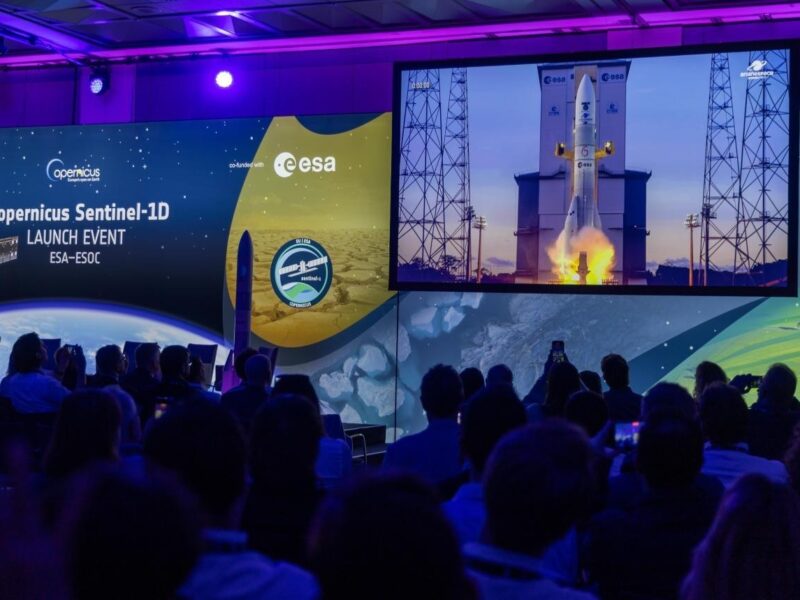 Spectators at the European Space Operations Center watch the launch of the Copernicus Sentinel-1D satellite on board an Ariane 6 rocket taking off from Europe’s spaceport in Kourou, French Guiana, on Nov. 4, 2025. (European Space Agency via Courthouse News)
In Article 189, the treaty called on the EU to develop a space policy but specifically said it could not promulgate a common set of space laws and regulations for EU states.
To steer around that legal limitation, the European Commission argues the proposed EU Space Act falls under its powers to lay down rules for the EU’s internal market, as laid out in Article 114 of the Lisbon Treaty.
“It’s not the first time in Europe they are doing something like that,” Blechová said. “They use Article 114 on the internal market as an ultimate argument for regulating almost anything.”
Other EU institutions — the European Parliament and European Council — support the commission’s approach and are unlikely to challenge the legality of an EU-wide space law, she said.
Besides this legal gray area, critics worry the EU is once again showing a penchant for over-regulation to the detriment of innovation and business growth.
The rules may be particularly burdensome for smaller startups. For example, makers of nanosatellites — tiny satellites that can fit in a person’s hand — may find it very difficult to equip their miniscule spacecraft with the hardware to make sure they can move out of the way of a collision.
“The stakes and the challenges are completely different if you are a big German company or a small Czech-based company,” Poirier said. “You’re not seeing this regulation in the same way.”
Also, some European firms worry the laws would spark a damaging tit-for-tat spat with the U.S.
Another source of friction comes from what experts say is a feud between the European Commission and the European Space Agency.
The ESA, founded in 1975, works with European national space programs, including those of non-EU nations such as Canada, Norway, Switzerland and the United Kingdom. It has overseen numerous space programs.
But over the past decade, the EU has expanded its interest in space and created the European Union Agency for the Space Programme, or EUSPA. The EU Space Act is seen as an extension of Brussels’ interest in taking the lead on space.
EUSPA was given oversight of Europe’s Galileo navigation satellite system and Copernicus, an earth-monitoring satellite program, both of which formerly were under ESA.
“It’s still unclear how the carve-up between the ESA and the EU Space Agency is going to play out,” McDowell said. “You’ve got these two agencies and they’re going to fight if there is no clear alignment between what their spheres of activity are.”
Courthouse News reporter Cain Burdeau is based in the European Union.

Follow @cainburdeauSubscribe to our free newsletters
Our weekly newsletter Closing Arguments offers the latest about ongoing
trials, major litigation and rulings in courthouses around the U.S. and the world,
while the monthly Under the Lights dishes the legal dirt from Hollywood,
sports, Big Tech and the arts.