
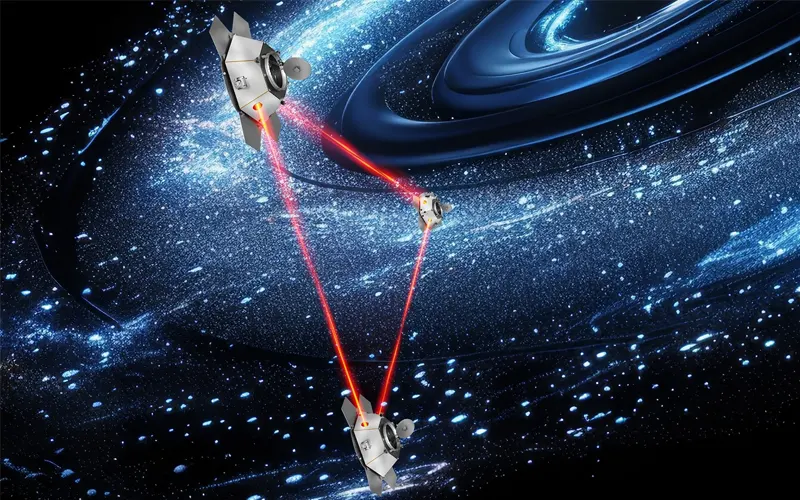
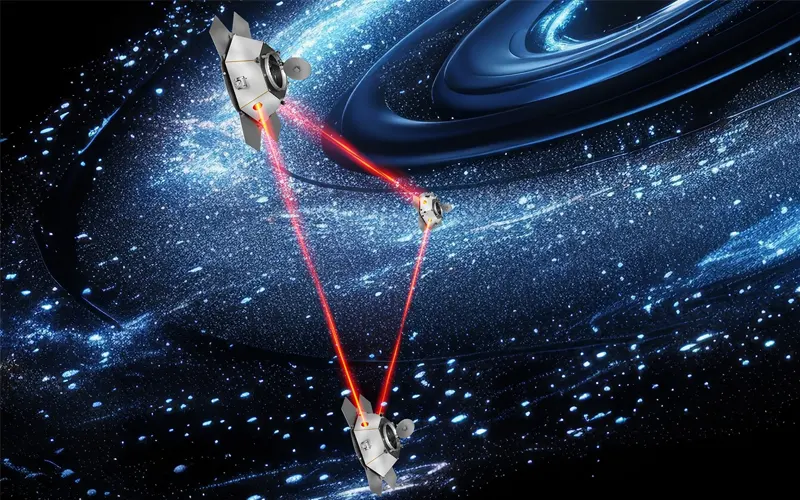
 Credit: OHB
The European Space Agency has awarded Thales Alenia Space a €26.1 million contract to develop six optical telescopes for the three spacecraft that will make up ESA’s LISA mission.
Selected as ESA’s third Large-Class mission in July 2017, the Laser Interferometer Space Antenna (LISA) will be dedicated to detecting gravitational waves that occur during some of the most significant events in the Universe, such as when two black holes collide. ESA’s Large-Class missions are described by the agency as “European-led flagship missions with a launch cadence of approximately one every decade.” These missions are funded through the agency’s Science Programme with a budget per mission of no more than €1.05 billion.
ESA selected OHB to develop the mission’s three spacecraft in June 2025, awarding the company a €839 million contract. Responsibility for the development of the mission’s payload is, according to ESA, a “collaborative effort between ESA, its member states, and NASA.” As part of that division of responsibilities, on 5 May, ESA awarded Thales Alenia Space the contract to develop the mission’s optical telescopes.
The contract will cover Phase 1 of the telescopes’ development, with work expected to extend over a total of three phases. Thales Alenia Space and its partner, Thales SESO, will be responsible for the development, design, assembly, and testing of the telescopes, which will be made from Zerodur®, a glass-ceramic material primarily used for precision optics.
Thales Alenia Space’s contributions to LISA go well beyond the mission’s telescopes. Shortly after being tapped to lead the development of LISA’s spacecraft, OHB awarded Thales Alenia Space a €263 million contract to develop avionics and control software, telecommunications systems, and drag-free and attitude control systems for the three spacecraft. This was followed in January 2026 by a second contract, valued at €16.5 million, for the mission’s propulsion subsystems. According to a Thales Alenia Space announcement at the time, the contract covered Phase B2 development, with the full contract value expected to rise to €89.5 million to complete and deliver the subsystems.
With industrial development underway across the spacecraft and payload elements, LISA is being prepared for launch in the next decade. Once complete, all three spacecraft are expected to be launched together aboard an Ariane 6 no earlier than 2035.
Keep European Spaceflight Independent
Your donation will help European Spaceflight to continue digging into the stories others miss. Every euro keeps our reporting alive.