
Cannes, 5 May 2026 – Thales Alenia Space, the joint venture between Thales (67%) and Leonardo (33%), announces the signing of a €26.1 million phase 1 contract with the European Space Agency (ESA) related to the development of LISA’s telescopes. Made up of three satellites, the LISA (Laser Interferometer Space Antenna) mission will be the first European space observatory capable of detecting and studying gravitational waves generated by extreme cosmic events.
This latest announcement follows the signing of two other contracts related to the same mission. In June 2025, Thales Alenia Space announced a contract with prime contractor OHB System AG to provide several critical elements, including the spacecraft avionics and control software, the telecommunication system, and the drag-free and attitude control system (DFACS). In January 2026, the company was also selected by OHB System AG to provide the propulsion subsystem.
Thales Alenia Space’s optical excellence at the service of space exploration
©OHB
In France, Thales Alenia Space and Thales SESO®, which are responsible for developing the optical payload telescopes, will make a major contribution to the mission.
Based on its globally renowned expertise in the design and manufacture of advanced optical technologies, Thales Alenia Space has been selected by the European Space Agency (ESA) to conduct Phase 1 for the development of the six telescopes, which is expected to proceed in three phases.
As prime contractor, Thales Alenia Space will be responsible for the development, design, assembly, and testing of the telescopes. The manufacture of the six telescopes, made entirely of Zerodur®, will present an unprecedented technological challenge.
It is only the combined expertise in design and manufacturing of Thales SESO® and Thales Alenia Space, along with Zerodur®’s extremely low thermal sensitivity, that will enable the picometer-level stability required by LISA mission.
For this initial development contract, Thales Alenia Space will be able to draw on the long-standing expertise of Thales SESO®, Europe’s leading supplier of ultra-lightweight Zerodur® mirrors.
Thales SESO® will be responsible for the procurement, machining, and polishing of the optics and structure. In addition, Thales Alenia Space and Thales SESO® will jointly be responsible for assembling the telescopes, aligning the optics, and conducting environmental and performance tests. With more than 200 Zerodur® Space mirrors manufactured and flying, Thales SESO® is among the world top leaders for optical surface precision achieved through polishing, with 0.2 nanometers reached over the 230-mm diameter surface of the mirrors made for Virgo (the European ground gravitational wave detector) —a level of precision that is priceless for the LISA mission.
“LISA represents a pioneering initiative in astrophysics and space exploration that has not previously been attempted. Thales Alenia Space is responsible for several mission-critical components of the LISA project. I am pleased to expand our collaboration with Thales Alenia Space to include the first phase of the development of the telescopes, significantly mitigating the risk of this technological challenge. Thales Alenia Space will partner with Thales SESO®, a leading European supplier of ultra-lightweight Zerodur® mirrors. I am looking forward to seeing the first results of this development by year-end.” said Filippo Marliani, LISA Project Manager at ESA.
“We are extremely proud to be part of this exceptional mission dedicated to the study of gravitational waves from space, and we would like to thank ESA for its renewed trust,” said Bertrand Denis, Vice President Observation, Science, and Exploration at Thales Alenia Space in France. “The development of these telescopes is fully aligned with the core expertise of Thales Alenia Space and Thales SESO® in high-performance optical instrumentation. Our capability to produce instruments in series will also be a real asset in the project’s success.”
LISA: the first space-based observatory for the study of gravitational waves
LISA (Laser Interferometer Space Antenna) is a unique space exploration mission by the European Space Agency (ESA) designed to detect gravitational waves directly from space. This space observatory will detect the tiniest distortions in spacetime caused by gravitational waves generated by the acceleration of massive objects, as predicted by Albert Einstein’s theory of general relativity in 1916, with a sensitivity and within a very low frequency range (between 0.1 mHz and 100 mHz), inaccessible to existing ground-based measurement facilities such as LIGO in the United States and VIRGO in Europe, due to their limited size and seismic interferences.
The LISA mission will provide a new opportunity to understand the early universe that existed before the formation of stars and galaxies, as well as celestial phenomena such as the interaction of compact stars or the merger of supermassive black holes at the centers of galaxies.
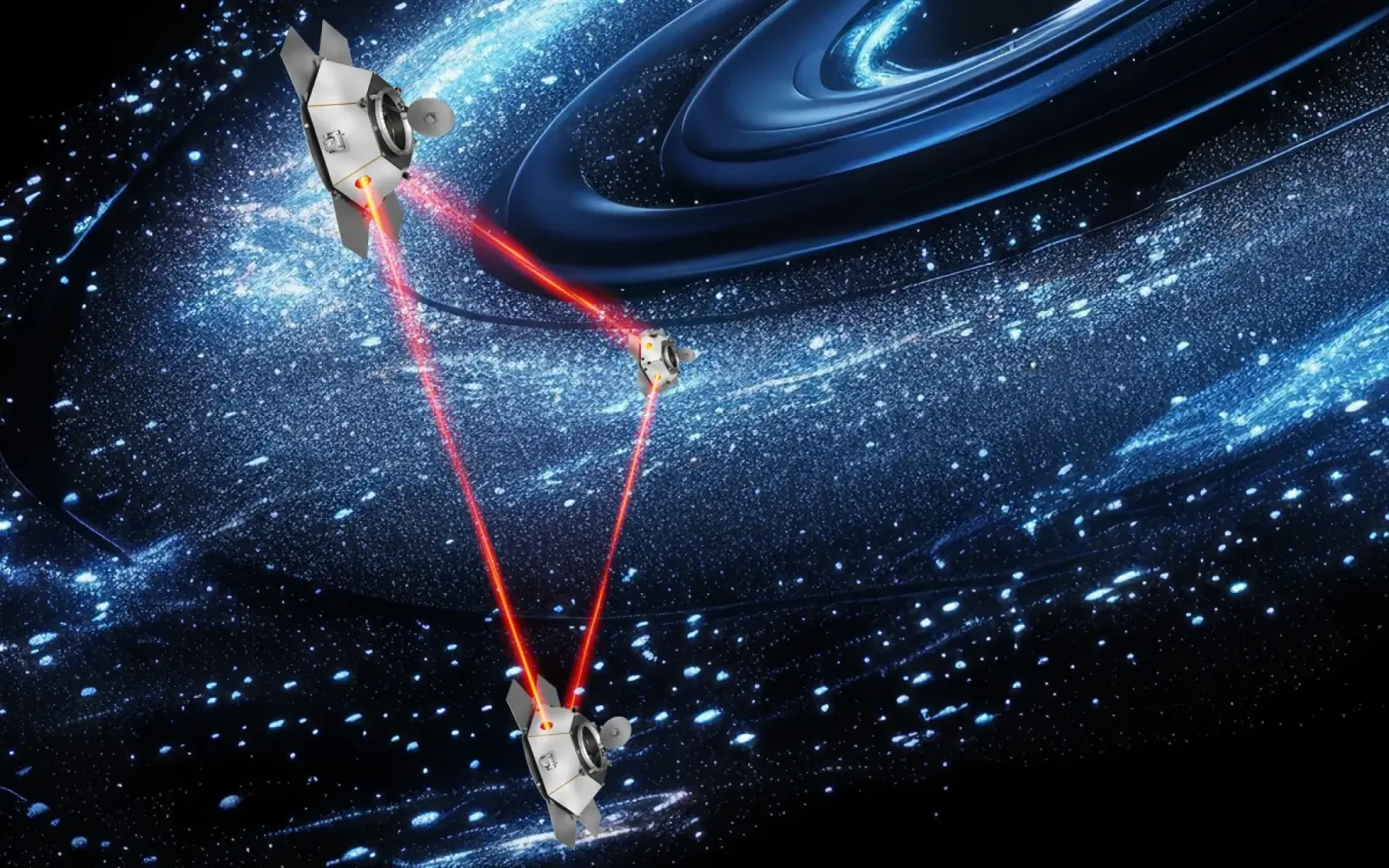
LISA consists of a constellation of three satellites, each spaced 2.5 million kilometers apart, forming an equilateral triangle and each carrying two test masses. These three satellites are linked by six laser beams, thus forming a massive optical interferometer. These inter-satellite laser beams will measure the displacement of these masses with an accuracy on the order of a picometer (smaller than an atom).
The LISA mission satellites benefit from the experience gained during the LISA Pathfinder program, launched in 2015, which successfully demonstrated the ability to maintain test masses in a state of “free fall” with exceptional precision. The same precision propulsion system, also used for ESA’s Gaia and Euclid missions, will ensure that each satellite keeps the laser interferometer beams pointed toward the other satellites with the utmost precision.
LISA will employ advanced laser interferometry measurement techniques to study astrophysical phenomena involving massive and distant systems, thereby offering unprecedented opportunities to explore and understand our universe. The three satellites are scheduled to launch in 2035 aboard an Ariane 6 rocket.
LISA mission: Thales Alenia Space’s contribution
Thales Alenia Space will provide prime contractor OHB System AG with several mission-critical elements, including the spacecraft avionics and control software, the telecommunication system, and the drag-free and attitude control system (DFACS). The joint venture will be responsible for the design, manufacture, assembly, integration, and testing of the propulsion subsystem for the LISA mission. Thales Alenia Space is also responsible for ensuring the exceptional electromagnetic, radiation, and self-gravity operational environment for the payload, essential to mission performance, for which Thales Alenia Space is also managing the budgets.
Thales Alenia Space in Turin, Italy, as member of the LISA Core Team makes use of the experience and design solutions inherited from the five-year study phase led by Thales Alenia Space as the prime contractor. Our facility, in Gorgonzola, Italy, will develop the On Board Computer and the Mass Memory in the same integrated unit. In the United Kingdom, the company is supplying the propulsion system, while France is responsible for developing the telescopes in collaboration with Thales SESO®. Our teams in Switzerland are involved in developing part of the instrument’s electronics and of the Constellation Acquisition System for LISA.
Leonardo is also contributing with its technologies to the LISA mission with some key equipment, such as the micro propulsion assemblies, a highly precise system of thrusters used to control the satellite’s attitude with extreme accuracy. Other company sites will also have the opportunity to contribute to the LISA mission, supplying spacecraft subsystems or equipment.
About Thales Alenia Space
Thales Alenia Space leverages a unique combination of skills, technological expertise, and industrial capabilities to deliver innovative solutions for telecommunications, navigation, Earth observation, defense, exploration, science, and orbital infrastructures— drawing on 50 years of proven experience. Institutions, governments, and private industry rely on Thales Alenia Space to design satellite-based systems that provide anytime, anywhere, connections and positioning, monitor our planet, enhance management of its resources, explore our Solar System, and unlock the mysteries of the Universe. Embodied by its Space for Life purpose, Thales Alenia Space sees space as a new horizon, helping build a better and more sustainable life on Earth, and beyond. A joint venture between Thales (67%) and Leonardo (33%), Thales Alenia Space also teams up with Telespazio to form the Space Alliance, which offers a complete range of solutions including services. Thales Alenia Space posted consolidated revenues of €2.36 billion in 2025 and has more than 8,000 employees in 7 countries with 14 sites in Europe. #spaceforlife www.thalesaleniaspace.com