
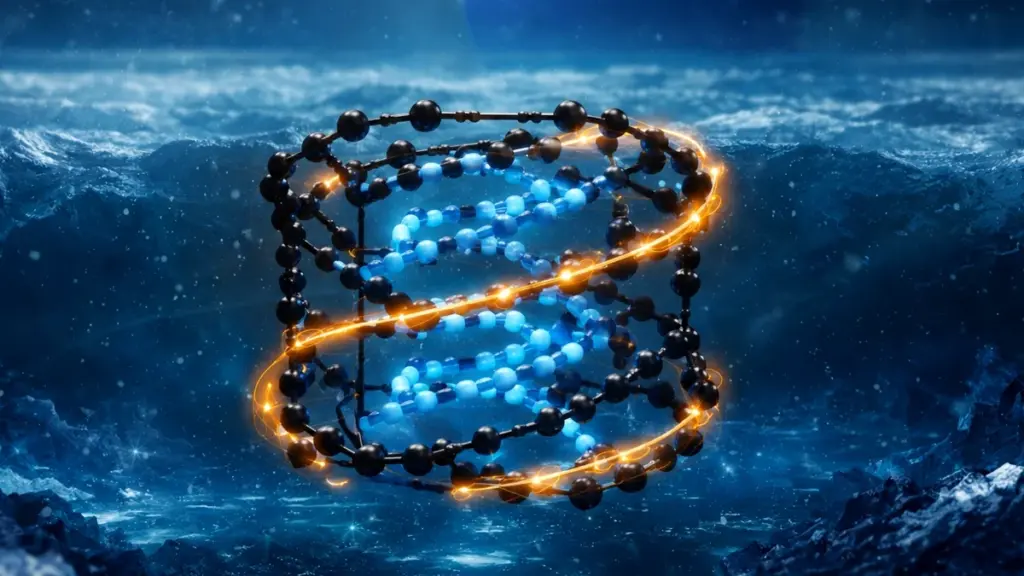
A state of matter that has never been observed before may exist inside Uranus and Neptune. Researchers at the Carnegie Institution have modeled how, under extreme pressure and at extremely high temperatures, carbon and hydrogen atoms form a structure with unique properties—and this may explain a long-standing mystery surrounding these planets.
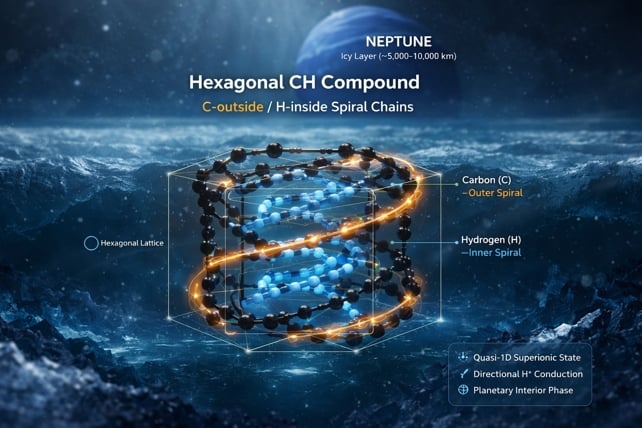 Illustration of the new CH compound, which research suggests exists inside Uranus and Neptune (Cong Liu/The Carnegie Institute). Source: The Carnegie Institute
A model instead of an experiment
Scientists have long known that these icy giants are nothing like what their name suggests. Instead of ordinary ice, a thick, hot mixture of water, ammonia, and methane swirls there under pressure millions of times greater than on Earth’s surface. It is practically impossible to replicate these conditions in a laboratory—most materials simply cannot withstand them.
Researchers at the Carnegie Institution for Science approached the problem from the perspective of quantum mechanics—they built a simulation from scratch, without relying on simplified models. According to their calculations, at pressures exceeding 1,100 gigapascals (more than 11 million times higher than Earth’s atmospheric pressure), carbon and hydrogen form a stable compound with an unusual structure: the carbon atoms are locked into a solid lattice twisted into a spiral—like a microscopic spiral staircase.
Liquid inside a solid body
At temperatures ranging from 1,000 to 3,000 Kelvin, this structure transitions into what is known as the superionic state. It sounds complicated, but the idea is simple: some atoms remain “frozen” in a solid lattice, while others flow through it like a liquid. In superionic ice—a special state of water formed under extremely high pressure—hydrogen protons behave in the following way: they move through a stationary lattice of oxygen atoms.
In the new compound, the situation is different: carbon forms the solid framework, while hydrogen atoms move along spiral “ladders.” They hardly move sideways—instead, they rotate. This asymmetry in motion led researchers to classify the phenomenon as a distinct type and name it the “quasi-one-dimensional superionic state”—the first of its kind in science.
Connection to magnetic anomalies
The findings, published in the journal Nature Communications, may help explain one of the major mysteries of planetary science: why the magnetic fields of Uranus and Neptune are so unusual. They are highly inclined and asymmetrical—nothing like Earth’s or Jupiter’s magnetic field.
Traditional models assumed that the superionic materials inside these planets conduct heat and electricity equally well in all directions. But the new compound behaves differently: along the spiral axis, it conducts heat and electricity well, while in perpendicular directions, it does so much less effectively. This asymmetry in properties—known as anisotropy—may better correspond to actual observational data.
The hydrocarbon environment studied by the scientists is only an approximate model of the actual chemistry deep within these icy giants. However, even this approach provides insight into how a substance behaves under extreme conditions that no laboratory on Earth can replicate.
According to sciencealert.com