
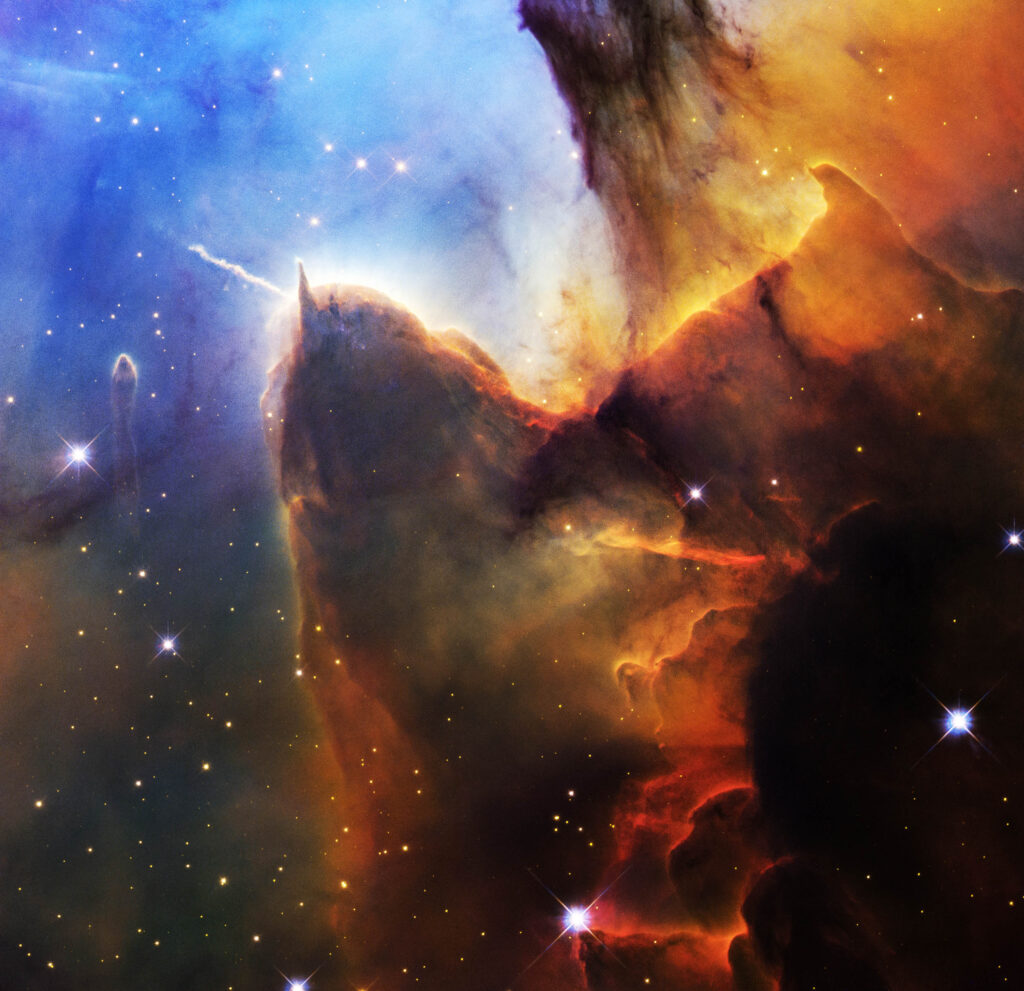
Hubble just captured a new close-up of the Trifid Nebula, a star-forming region about 5,000 light-years from Earth.
The view doesn’t feel still – it has a sense of motion, as if the gas and dust are shifting right before your eyes.

The image celebrates Hubble’s 36th year in space, a milestone that was reached on April 24. It reveals clouds of gas and dust that have been shaped by strong stellar winds for at least 300,000 years.
The winds push and carve through space, forming huge bubbles and packing material together.
That pressure sparks new stars into existence. It may look quiet at first, but there’s a lot going on.
Revisiting a nebula, decades later
Hubble first photographed this same region in 1997. Nearly three decades later, it has returned with sharper tools and a wider view.
This time, the telescope’s upgraded camera picks up subtle changes that were not visible before.
Scientists now track how gas flows and jets move across the nebula. That matters because it shows how young stars grow and interact with their surroundings.
Watching the same place over time turns a still image into something closer to a story.
Cloud that resembles a sea slug
The focus of this new image is a strange, curved cloud that resembles a sea slug. Scientists nicknamed it the “Cosmic Sea Lemon.”
The cloud has a rounded head and a long, wavy body made of thick dust and gas. Inside that structure, a young protostar shoots out jets of plasma.
One of these jets stretches from what looks like a horn on the left side of the cloud. It has been erupting in bursts for centuries.
On the opposite side, a matching counter jet leaves behind jagged streaks, tracing the star’s activity over time.
Another young star sits near the right side of the cloud. It is harder to see, but a faint red dot and a tiny jet give it away.
Around it, a green arc hints that intense radiation from nearby stars is slowly stripping away its surrounding disk. That activity suggests the star is close to finishing its formation.
Signs of hidden activity
Not all of the action is easy to spot. Near the center of the image, a sharp, angled streak shifts position between observations.
That movement likely comes from another jet, fired by a star still buried deep in dust.
Off to the left, a thin pillar of gas and dust stands its ground. Much of its material has already been blown away, but its densest core remains.
These pockets of resistance often mark places where new stars may still form.
The darkest area sits in the far-right corner. There, thick dust blocks most visible light.
Some stars appear in front of this patch, but they may not belong to the nebula at all. They could simply lie closer to Earth, lining up by chance.
A colorful but harsh environment
The colors in the image reveal how radiation from massive stars shapes the region.
Near the top left, blue tones dominate where strong ultraviolet light has stripped electrons from gas. That process creates a glowing effect and clears out surrounding dust.
Elsewhere, yellow streams rise where radiation slams into denser material. Over time, this constant exposure breaks down gas clouds.
It is a slow process that will eventually erase much of the nebula. What remains will be a cluster of fully formed stars.
Bright orange points scattered across the scene mark stars that have already cleared their surroundings. They stand out as finished products in a space still under construction.
A telescope that keeps delivering
Hubble’s long life has made this kind of comparison possible. Over 36 years, it has collected more than 1.7 million observations.
Nearly 29,000 astronomers have used data from Hubble, producing over 23,000 scientific papers.
In 2025 alone, close to 1,100 papers relied on Hubble’s findings.
The telescope’s reach goes beyond visible light. Hubble also studies ultraviolet and near-infrared wavelengths, giving scientists a broader view of space.
That range helps reveal details hidden from ground-based telescopes.
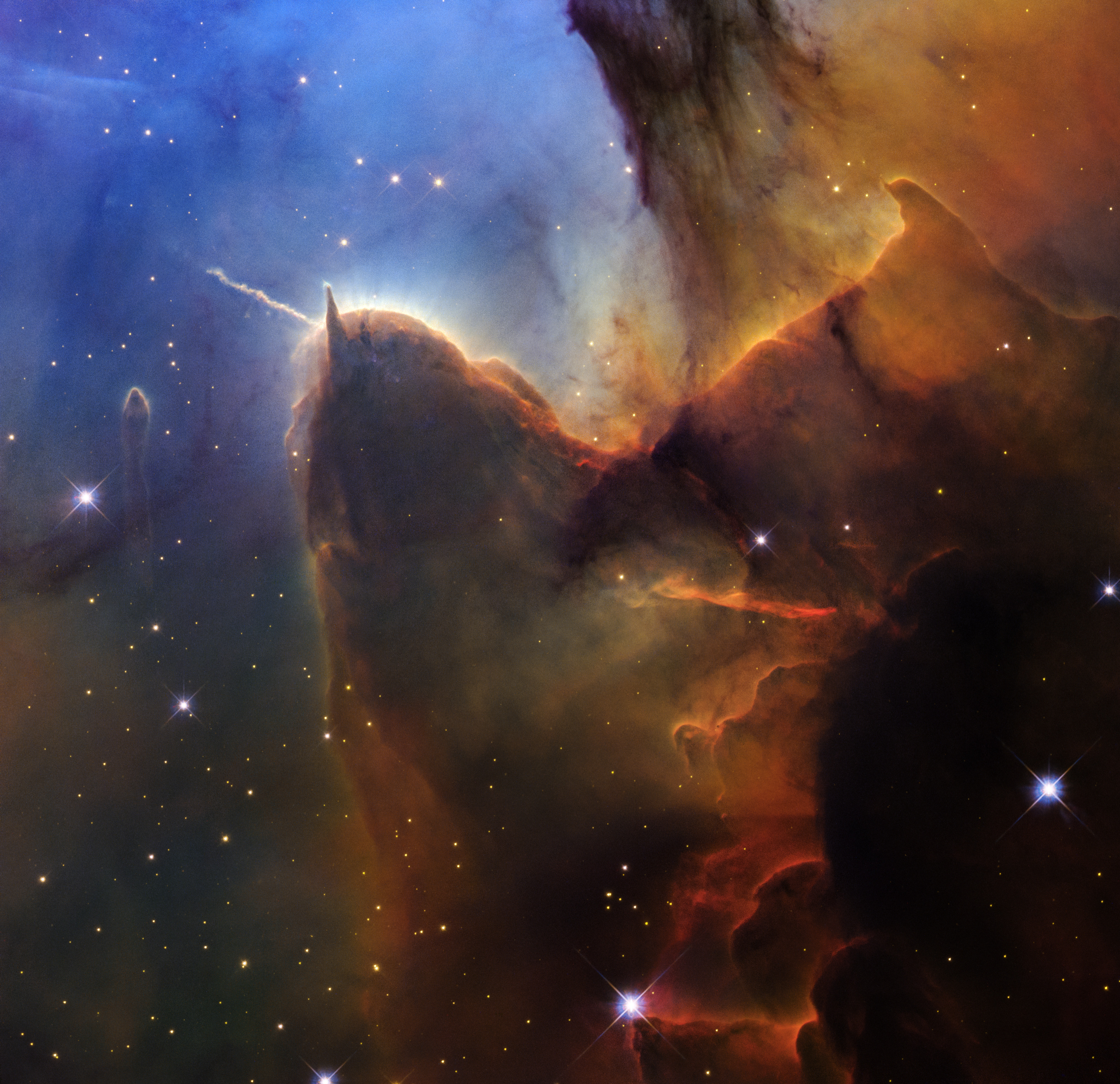 NASA celebrates Hubble’s 36th anniversary with a new image of the Trifid Nebula, a star-forming region it first captured in 1997. Credit: NASA, ESA, STScI; Image Processing: Joseph DePasquale (STScI). Click image to enlarge.Working with the next generation
Hubble isn’t working on its own anymore. Since 2022, astronomers have been combining its data with observations from the James Webb Space Telescope.
Webb observes the universe in infrared light, allowing it to reveal details that remain hidden to the Hubble Space Telescope.
The Nancy Grace Roman Space Telescope is set to start scanning huge sections of the sky. Its camera is wide enough to capture the entire Trifid Nebula in one go.
That kind of coverage could reveal new objects that haven’t stood out before.
The proposed Habitable Worlds Observatory would take things even further with a larger mirror and the ability to study different kinds of light.
The mission’s focus is simple but ambitious: find planets like Earth and check if they might support life.
A changing view of the universe
The latest image of the Trifid Nebula shows more than a pretty scene. It captures motion, energy, and time at work.
Gas flows shift, stars grow, and radiation reshapes everything in its path.
Hubble’s return to this region proves that space is not frozen. Even across vast distances, change is constant. And with each new observation, that change becomes a little easier to see.
—–
Like what you read? Subscribe to our newsletter for engaging articles, exclusive content, and the latest updates.
Check us out on EarthSnap, a free app brought to you by Eric Ralls and Earth.com.
—–