
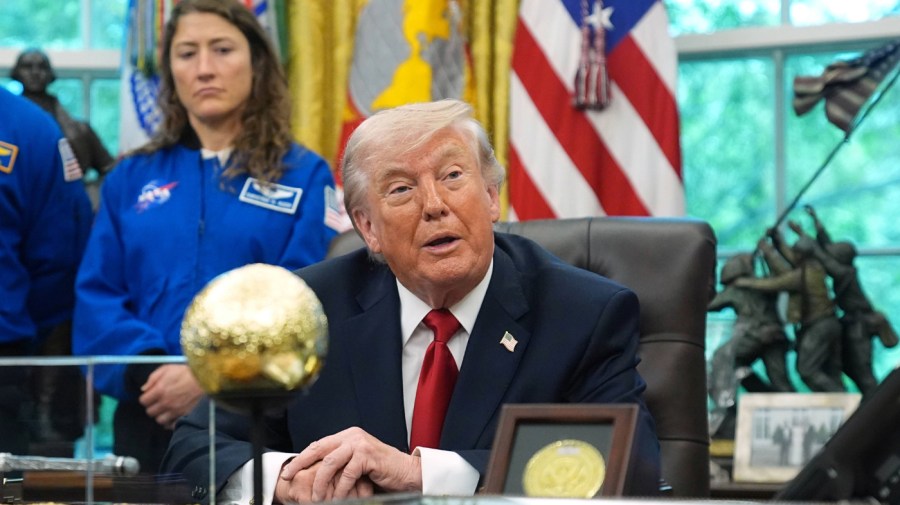
The Artemis II was still flying toward the moon when the Trump administration presented its proposed budget for NASA for the next fiscal year. As with the previous year’s proposal, the White House suggested cutting the space agency’s overall budget by 23 percent, and its science, aeronautic and education accounts by 47 percent.
As it did last year, Congress took a dim view of the White House’s budget. That much was apparent when NASA Administrator Jared Isaacman appeared before the House Science Committee to explain the proposal. Isaacman was confirmed as NASA administrator after the NASA budget proposal was put together. Nevertheless, he was obliged to defend it, which he did adroitly.
Isaacman asserted that some of the cuts dealt with duplicate programs, especially in the education accounts. He also suggested that commercializing some Earth science and space science missions would free up money for some of the larger, flagship missions that only NASA could fund.
Two examples of such missions that made it into the budget are the Nancy Grace Roman Space Telescope, due to be launched in early September of this year on a Falcon Heavy, and the Dragonfly drone to Saturn’s moon, Titan. Separately, NASA is planning a nuclear-propelled Mars probe to test the technology that can reduce interplanetary trip times.
The fact that Isaacman knows how to stretch a dollar, being able to finance two private space missions, supported his arguments. One got the impression that his words, while received respectfully by members of the committee, went in one ear and out the other. What the NASA administrator had to say was irrelevant. The Trump administration cuts would be restored.
Indeed, both House and Senate appropriators proceeded to do so.
The Trump administration has a huge problem. The national debt is approaching $40 trillion. The deficit for 2025 was $1.78 trillion. The deficit for the 2026 fiscal year is estimated to be $1.9 trillion. Something clearly has to be done before the U.S. encounters a fiscal train wreck. Economies have to be found. Unpleasant tradeoffs must be made.
Against the backdrop of uncontrolled deficits, an attempt to cut lower priority programs at NASA seems to be reasonable. Isaacman is just the person needed to make those cuts work and to lessen their pain.
However, the White House proposed cutting NASA funding at exactly the wrong time. The United States, and indeed the world, was celebrating the first crewed mission to the moon in over 50 years. The crew of Artemis II, Reid Wiseman, Victor Glover, Christina Koch and Jeremy Hansen, had become rock star celebrities.
The fact that the White House has fully funded the Artemis return to the moon program was irrelevant. The emotional response to Artemis II is to want to increase all NASA funding, not to slash it.
The reaction was inevitable. The Planetary Society launched another “Save NASA Science” campaign on Capitol Hill, led by Bill Nye the Science Guy. Members of Congress also expressed their displeasure. Sen. Ted Cruz (R-Texas), chair of the Science Commerce Committee, actually invoked the Chinese space threat against the proposed NASA cuts. Artemis is the answer to China, but one supposes that Earth observation satellites and planetary probes work as well.
It looks like the Trump administration is going to have to look elsewhere to deal with the budget deficit, not to mention fund the biggest military buildup since the 1980s. Good luck. Every account of government spending has its constituency, even waste, fraud and abuse.
Robert Zimmerman, who runs the blog “Behind the Black,” supports the NASA cuts at programs that he regards as pork. But he provides one ray of hope. Perhaps Congress, while restoring the money that the White House proposes to cut, will give Isaacman more discretion on how to spend it.
Congress tends to use the power of the purse to micromanage government departments and agencies. The infamous Space Launch System, behind schedule and over budget, is a prime example. It rarely doles out pots of money and gives the executive branch a lot of leeway about how to use it.
Could NASA prove to be an exception? Isaacman would be just the person to hand money to and, under broad guidelines, let him invest it as he wills. If the experiment works and Isaacman finds ways to invest the money that will return dividends, it could be the start of a new way of doing business for the federal government.
Then again, maybe pigs will fly to the moon.
Mark R. Whittington, who writes frequently about space policy, has published a political study of space exploration entitled “Why is It So Hard to Go Back to the Moon?” as well as “The Moon, Mars and Beyond” and, most recently, “Why is America Going Back to the Moon?” He blogs at Curmudgeons Corner.
Copyright 2026 Nexstar Media, Inc. All rights reserved. This material may not be published, broadcast, rewritten, or redistributed.
For the latest news, weather, sports, and streaming video, head to The Hill.