
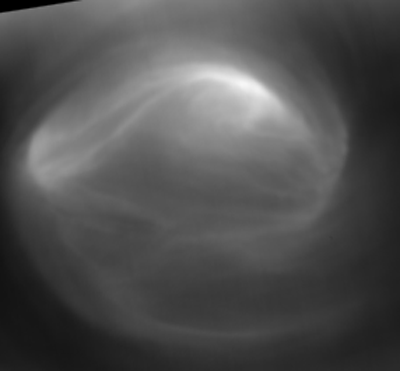
GIF of the ESA Venus Express spacecraft images of the polar vortex (or cyclone) at the south pole of Venus. This was made from 10 images taken over a period of five hours,
by Grahamthicke
GIF of the ESA Venus Express spacecraft images of the polar vortex (or cyclone) at the south pole of Venus. This was made from 10 images taken over a period of five hours,
by Grahamthicke
2 Comments
Entrancing! 🤩✨
Venus has a very choppy and fast-moving atmosphere – although wind speeds are sluggish at the surface, they reach dizzying speeds of around 400 km/h at the altitude of the cloud tops, some 70 km above the surface. At this altitude, Venus’ atmosphere spins round some 60 times faster than the planet itself. This is very rapid; even Earth’s fastest winds move at most about 30% of our planet’s rotation speed. Quick-moving Venusian winds can complete a full lap of the planet in just four Earth days.
Elements of a giant cyclone circling above the south pole of Venus constantly break apart and re-form, according to research. Scientists studying observations of the planet taken over the last six years have concluded that the long-lived storm is constantly evolving, raising even more questions about the unusual weather formation.
Using the observations taken by Venus Express, planetary scientist Garate-Lopez and her team at the University of the Basque Country in Spain concluded that the giant [storm is in constant flux](https://www.space.com/11325-venus-vortex-changes-shape.html). Elements of the vortex are constantly breaking apart and reforming as it circles every 2.2 days.
Polar vortices form because heated air from equatorial latitudes rises and spirals towards the poles, carried by the fast winds. As the air converges on the pole and then sinks, it creates a vortex much like that found above the plughole of a bath.