
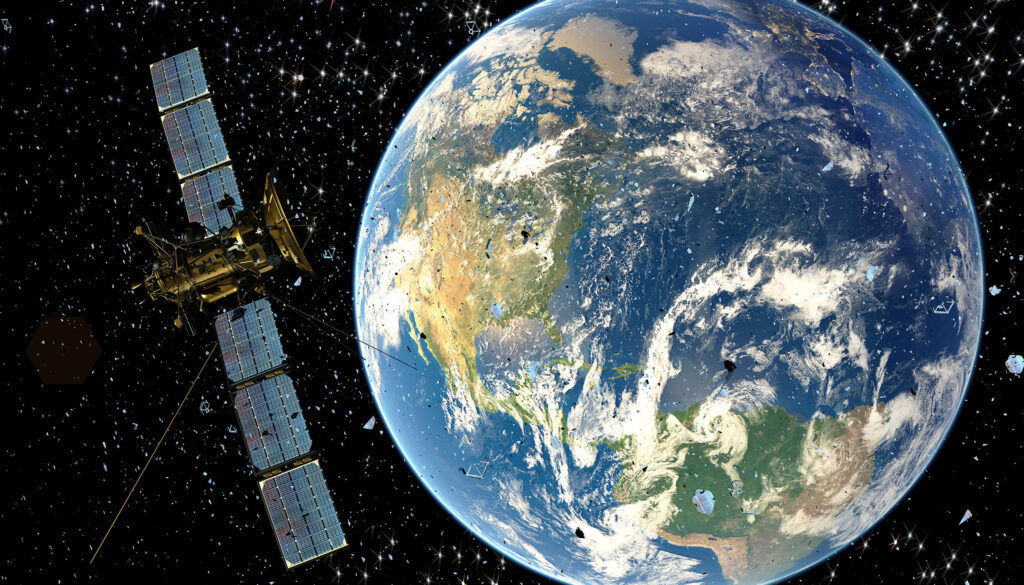
The phrase “house of cards” gets used a lot for politics and drama, but its original meaning is simpler and scarier: a system that looks stable right up until the moment it isn’t.
Sarah Thiele, the study’s lead author, was formerly a PhD student at the University of British Columbia and is now a researcher at Princeton.

Thiele and her colleagues argue that today’s giant satellite constellations fit that description uncomfortably well.
Their point isn’t that operators are careless or that collision avoidance doesn’t work. It’s that the system is getting so crowded, so maneuver-dependent, and so reliant on constant control that a rare disruption – especially a strong solar storm – could push it from “busy but manageable” to “we can’t keep up” surprisingly fast.
Crowded reality of low-Earth orbit
Low Earth orbit used to be big and mostly empty, at least in practical terms. Mega-constellations changed that.
When you pack thousands of satellites into similar altitude bands and orbital shells, you don’t need anything dramatic to create risk – you just need time.
The researchers emphasized just how often satellites come close to one another. Across low Earth orbit mega-constellations, a “close approach,” defined as two satellites passing within less than one kilometer, happens about once every 22 seconds.
Inside Starlink alone, close approaches happen roughly every 11 minutes. To keep everything separated, each Starlink satellite reportedly performs an average of 41 course corrections per year.
On paper, this sounds like a success story: the satellites see each other coming, nudge out of the way, and carry on. But it also reveals the real dependency: constant, fine-grained maneuvering isn’t a bonus feature anymore. It’s the price of admission.
Scenarios like solar storms
Engineers worry most about the situations that don’t happen often – because those are the ones that normal routines weren’t built around.
These rare scenarios are sometimes called “edge cases,” and they’re the reason a system can look reliable for years and then unravel in a weekend.
For mega-constellations, the paper argues that solar storms are a prime edge case. Not because operators ignore them, but because storms can hit multiple weak points at once, and they don’t give you much time to prepare.
How solar storms disrupt satellites
Solar storms can disrupt satellites in at least two big ways. First, they can heat and expand Earth’s upper atmosphere.
When the upper atmosphere “puffs up,” satellites encounter more drag. That drag makes them lose altitude faster and forces them to burn more fuel to maintain their orbits. It also increases uncertainty in where satellites actually are, which is a nightmare for collision avoidance.
If you’re less sure about positions and your satellites are being pushed around, you end up making more avoidance maneuvers – exactly when fuel and precision matter most.
The paper points to the “Gannon Storm” in May 2024 as an example, noting that more than half of all satellites in low Earth orbit had to expend fuel on adjustments during the event.
The second problem is even more direct: solar storms can interfere with, degrade, or knock out navigation and communications.
In other words, satellites may not just have messier orbits – they may lose the ability to receive commands or coordinate avoidance maneuvers at all.
That’s when the “crowded sky” stops being an operational challenge and starts looking like a pileup waiting for a trigger.
Earth satellites and disaster mode
When people talk about orbital catastrophe, they often jump straight to Kessler syndrome: collisions create debris, which causes more collisions, and eventually space becomes too hazardous to use.
The scary part is that Kessler syndrome is slow. It unfolds over decades. That can make it feel abstract, like a far-off dystopia.
Thiele and colleagues try to make the near-term risk easier to grasp by introducing a new metric: the Collision Realization and Significant Harm (CRASH) Clock.
The goal is to estimate how quickly you’d get a major, debris-producing collision if satellites suddenly lost the ability to carry out avoidance maneuvers.
Using that approach, they calculate that as of June 2025, a complete loss of command over avoidance maneuvers could lead to a catastrophic collision in about 2.8 days.
For comparison, they estimate that in 2018 – before mega-constellations reshaped low Earth orbit – similar conditions would have allowed about 121 days before such a collision.
They also emphasize that you don’t need a long outage for the risk to become uncomfortable. Losing control for just 24 hours, they estimate, carries a 30% chance of a major collision that could start the kind of debris cascade everyone fears.
Why warnings may not be enough
Solar storms don’t usually give weeks of notice. Often, the warning window is a day or two.
And even when you do get warning, there’s only so much you can do besides protecting systems, monitoring conditions, and hoping communications and navigation stay reliable.
The more troubling implication is timing: if a solar storm disrupts control and tracking, operators may have only a few days to restore real-time command before the probability of a serious collision becomes unacceptably high.
And while the May 2024 storm was the strongest in decades, it wasn’t the strongest in recorded history. The Carrington Event of 1859 remains the benchmark for extreme space weather.
A modern equivalent could plausibly cause disruptions that last longer than a couple of days – which matters a lot if your “time to first disaster” is measured in days, not months.
Rare disruptions in space
Mega-constellations bring real benefits: global connectivity, redundancy, new services, and a reshaped space economy.
The point of the “house of cards” framing isn’t to deny those benefits. It’s to underline that the system’s stability now depends on continuous, high-quality control in an environment where rare but severe disruptions are part of reality.
If the consequences of a worst-case failure include a debris chain reaction that limits space access for generations, then “how likely is it?” stops being a niche technical question.
It becomes a global infrastructure question – like asking whether the power grid can survive a once-in-a-century storm, except this grid is moving at 27,000 km/h over everyone’s head.
The research is published in arXiv.
—–
Like what you read? Subscribe to our newsletter for engaging articles, exclusive content, and the latest updates.
Check us out on EarthSnap, a free app brought to you by Eric Ralls and Earth.com.
—–